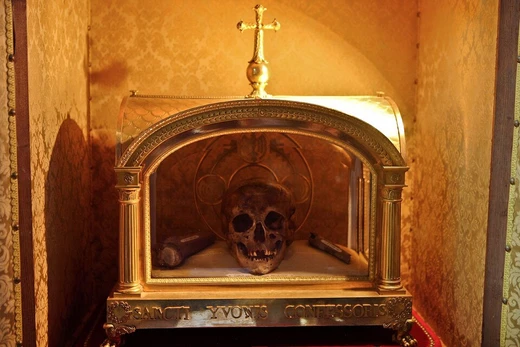
Relics of Saint Sava
Burned by Ottomans in 1594; left hand preserved at Mileševa.
The relics of Saint Sava, the founder of the Serbian Orthodox Church, were burned by Ottoman forces on the Vračar plateau in Belgrade in 1594. The destruction was ordered by Grand Vizier Sinan Pasha in retaliation for a Serb uprising that used the saint's portrait on war flags. It is believed that his left hand was saved and is currently held at Mileševa.
Quick Facts
- Date of burning
- 27 April 1594
- Location of burning
- Vračar plateau, Belgrade
- Ordered by
- Grand Vizier Sinan Pasha
- Relics brought from
- Mileševa
- Surviving relic
- Left hand, held at Mileševa
- Uprising year
- 1594
- Suppression year
- 1595
Facts from the source article.
Commemoration
The Serbian Orthodox Church observes a holiday on 27 April (10 May on the Gregorian calendar) to mark the burning of Saint Sava’s relics. Saint Sava established the Serbian Orthodox Church, its ecclesiastical law, and the nation’s early literature. After his death, he was canonized as a miracle-worker, and under Ottoman rule his cult merged with local folk traditions. Devotion to his remains caused friction between Serbs and the Ottoman authorities.
In 1774, Sava was officially named the patron saint of all Serbs. During the 19th century, as Serbs sought independence from the Ottomans, his cult was revived within a nationalist framework, evoking a golden age, national unity, and martyrdom for church and country. Following full independence, plans for a cathedral honoring the saint became part of Belgrade’s modernization. A construction board was set up in 1895, but building of the winning design—inspired by Gračanica and Hagia Sophia—did not start until 1935.
Work halted during World War II and the communist period, resuming only after permission was granted in 1984. By 2018, the church was completed, making it the second largest Orthodox church in the world. The Vračar plateau, where Saint Sava’s relics were burned, now holds both the National Library of Serbia and the Church of Saint Sava, built in the 20th century. Dominating Belgrade’s skyline, the church has become a national symbol.
More in Christian Relics
Spotted an error? Know more?
Reader corrections go straight into our review queue. Suggest an edit · How this site is sourced