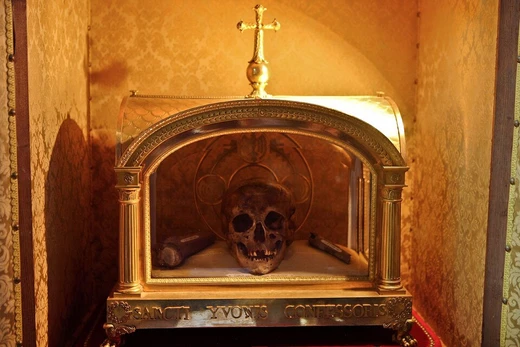
Furta sacra
Medieval Christian relic thefts framed as divine acts.
Furta sacra refers to the theft of relics in western medieval Europe by Christians. The term was popularized by a 1978 book that argued such thefts were integral to medieval identity and culture. These acts were often framed in hagiographic narratives as divinely sanctioned.
Quick Facts
- Term popularized by
- Patrick J. Geary
- Year of book publication
- 1978
- Book title
- Furta Sacra: Thefts of Relics in the Central Middle Ages
- Example of theft
- Body of Mark the Evangelist (827)
- Location of theft
- Alexandria to Venice
Facts from the source article.
History
The Middle Ages saw frequent relic thefts, a phenomenon termed furta sacra. Patrick J. Geary's 1978 book argued that these thefts were integral to medieval identity and culture, with hagiographic narratives legitimizing possession by religious and political authorities. Such thefts occurred across many kingdoms, cities, and duchies in the Mediterranean and western Europe. Florence Bourgne linked furta sacra to the translation of texts, suggesting Europe's claims to Mediterranean culture stemmed from linguistic and material appropriation.
Relics were believed to contain saints' spirits, and bringing a relic to a church boosted its prestige, prompting pilgrimages and donations. Thefts often happened during war. Tomasz Borowski and Christopher Gerrard connected relic theft to military orders like the Templars and Hospitallers, which combined religious devotion with political power. Relics were also acquired by persuading guardian priests or through petty theft.
Venice's acquisition of Mark the Evangelist's body in 827 exemplifies this, achieved through ecclesiastical and martial maneuvering.
Context and circumstances of furta sacra
The theft of Mark the Evangelist and his coffin illustrates the context of furta sacra. In 827, Venice was caught between the Carolingian Empire and the Byzantine Empire, striving for maximum independence. The city faced potential absorption by external forces, a credible threat after Charlemagne's son besieged Venice in 810. The Carolingians might also undermine Venice through ecclesiastical channels.
Mark the Evangelist had founded the church of Aquileia, to which other regional churches owed allegiance, and Venice sought to assert power and distance itself from Aquileia. Failure would mean allegiance to Aquileia and the Carolingians, a loss of power the Venetians could not accept. However, this risked angering the Byzantine Empire, which was sensitive about Venice's independence. Before Alexandria fell to Islamic forces, the body of Mark belonged to the Byzantines in their view.
Marco Papasidero revisited the Italian context, highlighting hagiographic biases that reimagined narratives to uphold Christian legitimacy and reinforce local identity.
Religious war as an avenue for furta sacra
Furta sacra allowed these regions to bolster identity and power, especially in northern Italy where fractured cities competed for prestige. The church consolidated power, leading to more centralized papal control. The rise of Islam saw Muslim forces control cities once Christian strongholds, creating resentment. Research by Damien Boquet and Piroska Nagy showed that relic thefts were considered divinely sanctioned, with Christians feeling called to 'rescue' relics from Islamic control.
The Golden Legend describes the theft of Mark from Alexandria, where Venetian priests convinced guardians to take the body away fearing Muslim rulers. The body was borne secretly to the Venetian ship, showing fear of the relic falling into Muslim hands. Byzantium, as Rome's continuation, saw itself as the religious hub, but differences between Western and Eastern doctrine grew, including the banning of iconography, which affected relics. The West valued relics more, leading to more furta sacra in western Europe.
Alfred J. Andrea and Paul I. Rachlin analyzed crusade-era texts showing how holy war and relic theft intertwined to create a medieval Christian identity for Western power in the Mediterranean, manifesting in the Fourth Crusade.
More in Christian Relics
Spotted an error? Know more?
Reader corrections go straight into our review queue. Suggest an edit · How this site is sourced