Animal styles in Chinese martial arts
Martial arts mimicking animal movements, notably in Southern Chinese styles.
Last updated
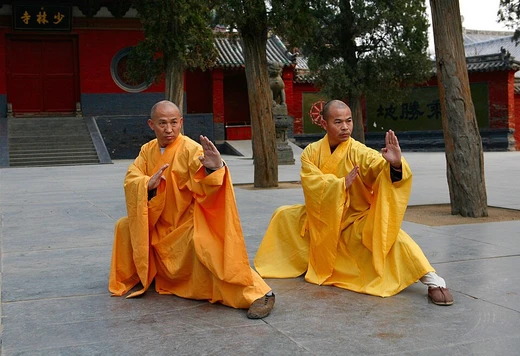
Animal styles in Chinese martial arts are fighting systems that imitate the movements and strategies of specific animals. These styles are notable for their legendary connection to the Shaolin Temple and their influence on both martial practice and popular culture.
Legendary origin
According to legend, the 13th-century Shaolin martial artist Jueyuan expanded the original 18 Luohan Hands into 72 techniques. In Lanzhou, Gansu Province, he met Li Sou, a master of 'Red Fist' Hongquan, who accompanied him to Luoyang to introduce Jueyuan to Bai Yufeng, a master of an internal method. The three returned to Shaolin, expanding the techniques to approximately 170 and organizing them into the Five Animals: Tiger, Crane, Leopard, Snake, and Dragon. Jueyuan is also credited with the Northern style 'Flood Fist' Hongquan, which does not feature the Five Animals but shares its written characters with the Southern style Hung Kuen, though the two styles have nothing in common beyond the name.
Five-animal exercise in present-day qigong
The 'Five Animal play' (Wuqinxi) is a set of qigong exercises developed during the Han dynasty (202 BC – 220 AD). Some claim the author was Hua Tuo, but Yang Jwing-Ming suggests it was the Taoist Master Jiun Chiam, with Huatuo perfecting its application and passing it to disciples including Wu Pu, Fan E, and Li Dangzhi. The five animals are the tiger, deer, bear, monkey, and crane.
The tiger exercise emphasizes grasping and stretching, reaching up and down to engage the sinews, which relate to the liver. Rolling through the spine stimulates the ren mai and du mai channels, activating the microcosmic orbit. The exercise concludes with a slow forward bend and a sudden shout, releasing anger, as the tiger catches its prey while standing on one leg, stretching the sinews and activating the jing-well points at the fingertips.
The 12 animals of Xinyiquan
The 12 animal forms of Xingyiquan differ significantly from the 5 animal forms of Southern Shaolin styles like Hung Ka and Choy Li Fut. The Xingyiquan forms came first, with about 600 years between them and the Southern Shaolin five animal forms.
These forms emulate the techniques and tactics of each animal rather than just physical movements. The 12 animals are: Dragon (contracting and expanding), Tiger (courage), Monkey (agility), Horse (speed), Alligator (gliding), Cockerel (combative), Hawk (soaring), Swallow (skimming), Snake (sliding), Ostrich (ramming), Eagle (gripping), and Bear or Eagle (stability). The animal techniques complement the 5 element forms and add more striking, kicking, and stepping techniques.
In popular culture
The film Wendy Wu: Homecoming Warrior features statues of the Five Animals containing the spirits of five monks, who possess the title character's teachers during training. In the Kung Fu Panda franchise, the Furious Five consist of a crane, snake, monkey, mantis, and tiger, while their predecessor Tai Lung is a leopard whose name means 'Great Dragon'.
More in Chinese Martial Arts
Sources
Compiled from Wikipedia and the sources listed below. Text from Wikipedia is available under CC BY-SA 4.0; this entry is adapted from it.
- Wikipedia: Animal styles in Chinese martial arts (CC BY-SA 4.0).
Spotted an error? Know more?
Reader corrections go straight into our review queue. Suggest an edit · How this site is sourced