
Shanhai Pass
Fortified gateway at the eastern end of the Great Wall, commanding the narrowest choke point of the Liaoxi Corridor.
Last updated

via Wikipedia: Shanhai Pass · see source
Where it is
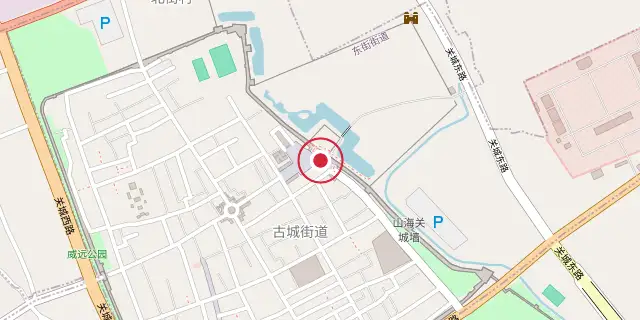
Coordinates: 40°00′32″N 119°45′14″E (40.0090, 119.7540) · Open in OpenStreetMap
Coordinates and connected clubs: the infobox of Wikipedia: Shanhai Pass (CC BY-SA 4.0). Map: drawn by Codexery from OpenStreetMap tiles.
The Shanhai Pass sits at the easternmost point of the Great Wall of China, in what is now the Shanhaiguan District of Qinhuangdao, Hebei, on the Shi River’s eastern bank. Its walls run from the Yan Mountains down to the Liaodong Bay coast. The pass controls the tightest bottleneck in the Liaoxi Corridor—a narrow coastal strip between the Yan foothills and the Bohai Sea—which is the only easy land route linking North and Northeast China.
For centuries, garrisons here formed the front line against raids from northeastern groups such as the Dongyi, Donghu (including Xianbei and Wuhuan), Khitan, and Jurchen (later known as Manchus). The current structure dates to the early Ming dynasty, built as the easternmost stronghold of the Ming Great Wall. After the Yongle Emperor moved the capital from Nanjing to Beijing, the pass was heavily upgraded and became China’s most vital defensive point, protecting the imperial heartland. Its location meant that any invading army either had to launch a costly direct siege or try to bypass it via treacherous mountain passes in the Yan range, which made supply lines nearly impossible for large forces.
This earned it the nickname “Greatest Pass Under Heaven.” Today, it is a popular tourist spot, especially where the wall meets the sea at a place called “Old Dragon’s Head.” In 1961, China’s State Council designated it a Major Historical and Cultural Site, and UNESCO listed it as part of the Great Wall World Heritage Site in 1987. The gatehouse lies about 300 kilometers east of Beijing, linked by the Jingshen Expressway to Shenyang. The Shanhaiguan railway station, a key stop on the Beijing–Harbin line, sits just south of the old barbican wall of the main gate.
Quick Facts
- Location
- Shanhaiguan District, Qinhuangdao, Hebei, China
Facts from the source article.
Background
In 1381, Ming general Xu Da and his soldiers were ordered to repair the old Yongping and Jieling passes. From this, they constructed the present pass, which was named Shanhaiguan (literally 'mountain-sea-pass') because of its location between the mountains and the sea. In the late 16th century, Ming general Qi Jiguang began fortification and construction of a military city around the pass, building cities and forts to the east, south and north, making it one of the most heavily fortified passes in China. The pass' strategic location dictated that without mounting a costly direct siege, the only way an invading army can get past the pass' defense was to circumvent it around the north through a few treacherously narrow mountain passes deep within the Yan Mountains, which would make it very difficult to maintain supply lines and thus any sizeable invasions.
Later history
This defensive significance therefore earned the pass the famous nickname 'Greatest Pass Under Heaven' (天下第一关). During the Qing era, the Shanhai Pass, situated between Shenyang and Beijing, was referred to as the 'Key to the Capitals'. In July 1900, 15,000 Imperial Japanese Army troops landed at Shanhai Pass as part of the Eight-Nation Alliance, prior to marching on Beijing to relieve the Siege of the International Legations by the Boxers. A pre-landing bombardment of the area was unnecessary as few Chinese troops were present.
Inter-allied relations were dealt a blow when a drunken fracas occurred at the Shanhai Pass between Japanese and French troops; in the fighting three French and seven Japanese soldiers were killed, and five French and 12 Japanese were wounded. In November 1945, the North Eastern People's Liberation Army attempted to hold Shanhaiguan against Kuomintang forces attacking from the south, but their forces of 10,000 were under equipped and too few to defend the position and retreated to Siping. In 1644, Li Zicheng led a rebel army into Beijing, marking the end of the Ming dynasty.
Battle of Shanhai Pass
Ming general Wu Sangui contacted the Manchu Qing dynasty, suggesting they combine forces to drive the rebels from the capital. Dorgon, regent of the Qing, marched his army to Shanhai Pass to receive Wu's surrender. Together, Wu and the Manchus defeated Li Zicheng's army near the pass, and Li was forced to abandon the capital. The Qing victory enabled their army to enter Beijing unopposed, and established them as the dominant power in China.
More in Chinese History
Sources
Compiled from Wikipedia and the sources listed below. Text from Wikipedia is available under CC BY-SA 4.0; this entry is adapted from it.
- Wikipedia: Shanhai Pass (CC BY-SA 4.0).
Spotted an error? Know more?
Reader corrections go straight into our review queue. Suggest an edit · How this site is sourced