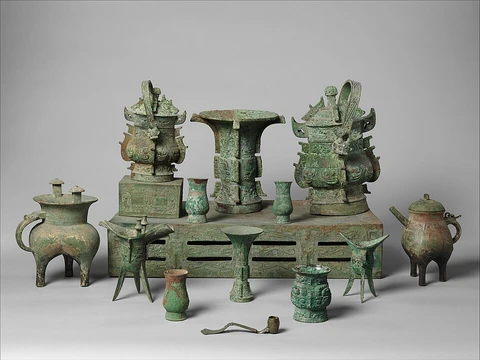
Nine Tripod Cauldrons
Ancient Chinese symbols of dynastic authority and national unity.
The Nine Tripod Cauldrons were ancient Chinese bronze vessels that represented a ruler's right to govern, granted by the Mandate of Heaven. Legend says Yu the Great of the Xia dynasty cast them. During the Shang dynasty, around the second millennium BCE, these cauldrons became symbols of dynastic power, with strict rules governing their use. Common scholars could use one or three; state ministers, five; feudal lords, seven; and only the emperor, the Son of Heaven, could use all nine. Offering ritual sacrifices to ancestors and heaven using these cauldrons was a major ceremony. Over time, the ding naturally came to stand for national political authority and were eventually seen as a National Treasure.
Quick Facts
- Material
- bronze
- Created
- Xia dynasty
- Location
- lost
Facts from the source article.
Origin
The Records of the Grand Historian recount that once Yu the Great had finished taming the floods that once engulfed the land, he divided the territory into the Nine Provinces and collected bronze in tribute from each one. Thereafter he cast the metal into nine large tripod cauldrons. It has been said that each ding weighed around 30,000 catties equivalent to 7.5 tons. However, the Zuo Zhuan states that the nine tripod cauldrons were cast by Yu the Great's son, Qi of Xia, the second Xia king, and it was he who received the tributes of bronze from the Nine Provinces. The Xia Shu section of the Book of Documents contains the Yu Gong or 'Tribute of Yu' that describes the rivers and mountains of the Nine Provinces.
Vicissitudes of the cauldrons
After Tang of Shang overthrew Jie of Xia, the nine tripod cauldrons were moved to the Shang capital at Yan. Later, when the Shang king Pan Geng moved his capital to Yin, the cauldrons again went with him. Following the overthrow of the Shang dynasty by the Zhou dynasty, after being inspected for damage by Nangong Kuo, the new King Wu of Zhou put the nine tripod cauldrons on public display for the first time. The Bamboo Annals state that in his 15th year of ruling the Zhou, three years after the conquest of Shang, King Wu moved the tripod cauldrons to Luo.
When King Cheng of Zhou ascended the throne, the Duke of Zhou built the eastern capital of Luoyi, he moved the cauldrons there, at the same time asking King Cheng to carry out their ritual installation in the settlement's Ancestral Hall. The power of the Zhou royal family began to decline at the start of the Eastern Zhou Period in 771 BCE, with each vassal state clamoring for kingship. At the time of King Ding of Zhou (r. 605–586 BCE), King Zhuang of Chu inquired for the first time regarding the 'weight of the cauldrons' only to be rebuffed by the Zhou minister Prince Man.
King Ling of Chu (r. 540–529 BCE) later again inquired of the cauldrons but was unsuccessful due to unrest sweeping the country. During the reign of King Huiwen of Qin (r. 338–311 BCE), the strategist Zhang Yi formulated a plan by which he hoped to seize the Nine Tripod Cauldrons. King Qingxiang of Chu, along with the king of the State of Qi also sought possession of the treasures as did the states of Wei and Han. The last Eastern Zhou monarch King Nan of Zhou (r. 314–256 BCE) dealt with all these rival claimants by playing them off against one another and thus kept possession of the cauldrons.
Loss and recasting
After the overthrow of Zhou and the foundation of the new Qin dynasty, the Nine Tripod Cauldrons disappeared. Theories as to their fate abound with no clear agreement amongst scholars. Amongst these theories are claims that the cauldrons were: lost in the Si River near Pengcheng by King Zhaoxiang of Qin (r. 306-250 BCE) en route to the Qin Capital; stolen by Quanrong nomads following the fall of Haojing in 771 BCE; melted down and recast into coins or weapons in the final years of the Zhou dynasty.
According to historical records, both Qin Shi Huang and Emperor Wen of Han (r. 180–157 BCE) searched for the nine tripod cauldrons in the Si River but with no success. Later emperors time and again recast the cauldrons, the most well known examples being Wu Zetian in the fourth month of 697 CE and the two recastings by Song dynasty Huizong Emperor in 1105 CE. Cauldrons were also cast by other dynasties in the Sinosphere, such as the Nguyễn dynasty.
The Nine Cauldrons of the Nguyễn dynasty are placed in front of the Ancestral Temple in Hue Imperial Palace. In 2006, the National Museum of China in Beijing cast Nine Tripod Cauldrons which are now on permanent display as a tourist attraction.
More in Chinese Bronzeware
Spotted an error? Know more?
Reader corrections go straight into our review queue. Suggest an edit · How this site is sourced