Statues (game)
A children's game of freezing and advancing, known worldwide.
Last updated

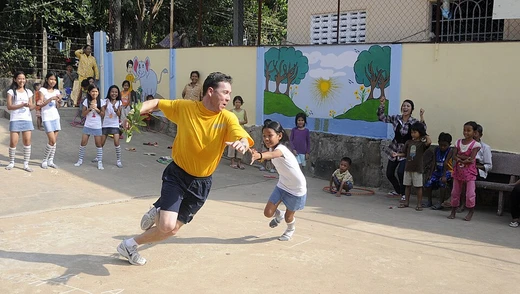
Joe Haupt from USA · CC BY-SA 2.0
Statues is a children's game known by various names worldwide, including Red Light, Green Light in North America and Sly Fox, Grandma's/Grandmother's Footsteps or Fairy Footsteps in the United Kingdom. The game involves one player acting as the 'curator' who turns their back while others attempt to advance and tag them, freezing when the curator turns around.
Quick Facts
- Variations
- Red Light, Green Light
Facts from the source article.
Background
The game Statues has a simple premise: one player, the curator, stands at one end of a field while the other players line up at the far end. The curator turns their back, and the statues attempt to race across and tag the curator. Whenever the curator turns around, the statues must freeze in position and hold that pose as long as the curator looks at them. If a statue is caught moving, they are sent back to the starting line or eliminated.
Frequently Asked Questions
What is Statues (game)?
Statues is a classic outdoor group game in which children race toward a target while a designated watcher faces away, and everyone must freeze the instant the watcher turns around. It is one of the most universally recognized children's games played across cultures.
What are the different names for Statues?
The game is most commonly called Red Light, Green Light in North America and Sly Fox or Grandma's/Grandmother's Footsteps in the United Kingdom. Many other local names exist worldwide, but the core freeze-and-advance mechanic remains the same everywhere.
How do you play Statues (game)?
One child is chosen as the curator, turns their back, and calls a signal while the others creep forward. If the curator pivots around and catches anyone still moving, that player is sent back to the starting line. The first player to reach and tag the curator wins and takes over the curator role for the next round.
More in Children'S Games
Sources
Compiled from Wikipedia and the sources listed below. Text from Wikipedia is available under CC BY-SA 4.0; this entry is adapted from it.
- Wikipedia: Statues (game) (CC BY-SA 4.0).
Spotted an error? Know more?
Reader corrections go straight into our review queue. Suggest an edit · How this site is sourced