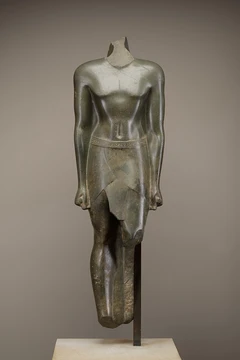
Artaxerxes II
Last updated

via Wikipedia: Artaxerxes II · see source
Artaxerxes II, born Arses or Arsaces (c. 445–359/8 BC), was King of Kings of the Achaemenid Empire from 405/4 BC to 359/8 BC. He was the son and successor of Darius II and his mother was Parysatis. Soon after his accession, he faced opposition from his younger brother Cyrus the Younger, who assembled an army from his Lydian and Ionian satrapies and Greek mercenaries.
The brothers clashed at Cunaxa in 401 BC, resulting in Cyrus's defeat and death. Artaxerxes II later contended with revolts by Evagoras I in Cyprus (391–380 BC), the Phoenicians (c. 380 BC), and the Great Satraps' Revolt in the 360s and 350s BC. The rulers of the Parthian Empire considered Artaxerxes II their progenitor.
Background and early life
Arsaces, the eldest child of Darius II and his half-sister Parysatis, was born before his father took the throne in 424 BC. He had a younger sister, Amestris, and three younger brothers: Cyrus, Ostanes, and Oxathres. Most of the thirteen children born to the royal couple died young. Before becoming king, Arsaces married Stateira, whose father Hydarnes was a descendant of one of the seven conspirators who overthrew the false Smerdis.
This marriage was arranged by Darius II to secure a political alliance during the early, unstable years of his reign. When Darius II lay dying, Arsaces stayed at his bedside.
Xenophon wrote that the dying king summoned Cyrus, who arrived with Tissaphernes and three hundred Greek hoplites. Plutarch, however, claimed it was Parysatis who called for Cyrus, because she preferred him over Arsaces and tried to persuade Darius to name Cyrus his heir. Modern historians doubt this version, believing Arsaces had already been designated heir years earlier.
Reign
Tissaphernes noted flaws in Cyrus the Younger's claims of a military expedition against the Pisidians, leading him to believe Cyrus was planning to revolt. Cyrus sought political support, finding it from Sparta and the Persian kingdom of Cilicia. Artaxerxes II built up a force to contend with his brother's revolt. Upon hearing of his father's death, Cyrus declared his claim to the throne, arguing he was born after Darius II's accession while Artaxerxes was born before.
Artaxerxes II initially sought a peaceful resolution, but negotiations failed. At the Battle of Cunaxa in Babylon in 401 BC, Cyrus's mixed army fought to a tactical victory, but Cyrus himself was killed by Mithridates. The Greek historian Xenophon, a leader of the Greek troops, later recounted this battle in the Anabasis.
Legacy
The Persian Empire under Artaxerxes II faced many complications, including wars with Greece. His conflict with Cyrus the Younger created a power vacuum that allowed the Satrap Revolt and the rebellion of Egypt.
Artaxerxes II restored monuments of his predecessors, most notably the Palace of Darius in Susa. His tomb is located at Persepolis, built on the model of his predecessors at Naqsh-e Rustam. Greek sources portray Artaxerxes II as sad in his reign and focus on his problems with his harem and eunuchs.
Identification
The Jewish high priest Johanan appears in both the Elephantine papyri from 407 BC and in the books of Ezra, which helps confirm the timeline. Some scholars identify Artaxerxes II as the Ahasuerus from the Book of Esther. Plutarch recorded that Deinon and Ctesias called him Oarses and Arsicas, names derived from the Persian Khshayarsha, the same root as Ahasuerus and the short form Arshu found on an inscription. The 13th-century historian Bar-Hebraeus, citing John of Ephesus, also equated Ahasuerus with Artaxerxes II.
Did You Know?
- Artaxerxes II's given name Arses derives from the Old Persian Ṛšā- meaning 'man' or 'hero'.
- He was also widely known by the hypocorism Aršak, from which the Arsacid dynasty of the Parthian Empire takes its name.
- Greek authors gave him the epithet 'Mnemon' (Μνήμων), meaning 'remembering' or 'having a good memory'.
- Plutarch's Life of Artaxerxes II is the only ancient biography of an Achaemenid king.
More in Children of Pharaohs
Sources
Compiled from Wikipedia and the sources listed below. Text from Wikipedia is available under CC BY-SA 4.0; this entry is adapted from it.
- Wikipedia: Artaxerxes II (CC BY-SA 4.0).
Spotted an error? Know more?
Reader corrections go straight into our review queue. Suggest an edit · How this site is sourced