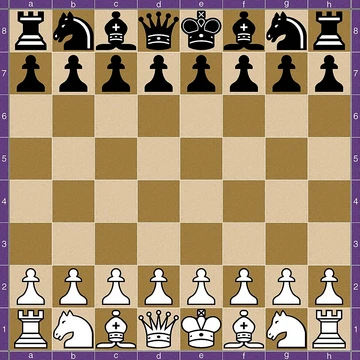
King and pawn versus king endgame
Master this endgame to exchange confidently from complex positions.
The king and pawn versus king endgame is essential to master, as piece exchanges in more complex positions often lead to it. A player must know instantly if the position is a win or draw and how to play it. Success hinges on whether the pawn can promote, enabling checkmate.
Quick Facts
- Key squares for a-pawn
- b7 and b8
- Key squares for h-pawn
- g7 and g8
Facts from the source article.
Did You Know?
- The opposition is a means to an end; the end is penetration to a key square.
- A king and doubled pawns (except rook pawns) win in all normal circumstances; the extra pawn is used to make a tempo move to gain the opposition.
Rule of the square
The rule of the square determines if a pawn can queen unassisted by its king. A square is imagined with the queening square in one corner and the pawn in an adjacent corner; the side length equals the number of squares from the pawn to the queening square (including the queening square). If the defending king can move into this square, it can catch the pawn; otherwise, the pawn wins the race. For example, if the pawn is on the fifth rank from promotion, a 5×5 square is drawn.
If it is Black's move and the king can enter the square, the pawn is caught; if White moves first, the pawn advances and the square shrinks, preventing the king from entering. Even if the defending king enters the square, the attacking king may block it, as shown in a diagram from Alexander Fishbein. In some cases, the king can catch a pawn from outside the square by creating threats that gain a tempo, as in the Réti endgame study (1921), where the white king draws by 'going after two birds at once'.
Key squares
In a king and pawn versus king endgame, the defending king can stop the pawn alone if it stands inside the square around the pawn. Otherwise, the attacking king must help. A key square is any square in front of the pawn that, once occupied by the attacking king, guarantees promotion no matter where the defending king is or whose turn it is, as long as the pawn is safe. These key squares sit ahead of the pawn.
A rook pawn on the a- or h-file is much harder to promote because if the defending king reaches any square directly in front of it, the pawn cannot be forced through. For an advanced a-pawn, the key squares are b7 and b8; for an h-pawn, they are g7 and g8. If the attacking king reaches one of these, it can block the defending king and the pawn will queen. If the defending king reaches any square marked with a dot or cross in the standard diagram, it stops the pawn. In most practical situations, the defending king can get in front of a rook pawn and hold the draw.
Rules
For non-rook pawns, several rules apply. Rule 1: With one exception, if the black king can get to the square in front of the pawn or the square in front of that (key squares), he draws. The exception occurs when White is to move and the pawn advances, putting Black in zugzwang. Rule 2: White wins if at least two of these conditions are met: the white king is in front of the pawn, White has the opposition, and the black king is on its sixth rank. If at least two conditions are not met, the result depends on whether the attacker can reach a position meeting two conditions. If the white king is on its sixth rank, the pawn must advance to the seventh rank without giving check; otherwise, the black king can move in front of the pawn, resulting in a draw. Accurate play from a winning position is still needed.
More in Chess Theory
Spotted an error? Know more?
Reader corrections go straight into our review queue. Suggest an edit · How this site is sourced