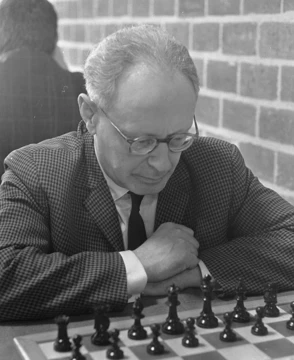
Soviet chess school
A national style emphasizing training and sport over art.
The Soviet school of chess was a national style of play promoted by Soviet players and journalists, supported by state leaders as a pastime after the Russian Revolution. Its existence became widely acknowledged after World War II, when a generation of Soviet players, led by Mikhail Botvinnik, achieved a series of victories over international competitors. The school's main contribution was its emphasis on rigorous training and treating chess as a sport rather than an art or science.
Quick Facts
- Notable player
- Mikhail Botvinnik
- Contrasting player
- David Bronstein
- Comparison for botvinnik
- Wilhelm Steinitz
Facts from the source article.
Sample game
The following game was played in 1938 between Mikhail Botvinnik (White) and José Raúl Capablanca (Black), using the Nimzo-Indian Defence: Normal Line (ECO code E40). In this opening, Black pins White's knight to prevent 4.e4 and seeks to inflict doubled pawns, while White aims to create a pawn centre and develop pieces for an assault. The game is often set as an example for the foundation of chess strategy in the middlegame. After 41.Kh5, a brilliant mating attack would have followed: 41...h6 42.Qg6+ Kh8 43.e8=R+ Qxe8 44.Qxe8+ Kg7 45.Qe7+ Kh8 46.Kxh6 b5 47.Qg7#. Capablanca's resignation, in Garry Kasparov's opinion, symbolized the end of an era of chess titans dominating through natural genius, after which professional preparation became integral to success.
More in Chess in the Soviet Union
Spotted an error? Know more?
Reader corrections go straight into our review queue. Suggest an edit · How this site is sourced