Chernobyl Sarcophagus (Shelter Object)
The steel and concrete shelter built over reactor 4 in 1986.
Last updated
Where it is
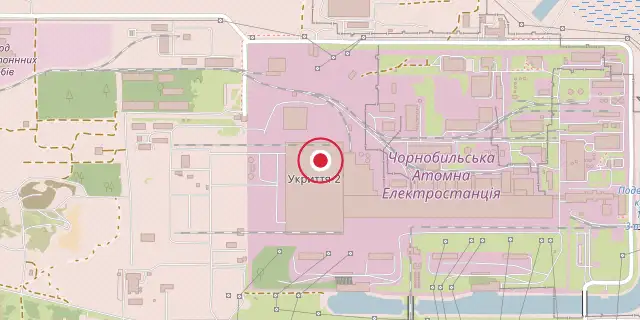
Coordinates: 51°23′24″N 30°05′56″E (51.3900, 30.0990) · Open in OpenStreetMap
Coordinates and connected clubs: the infobox of Wikipedia: Chernobyl Nuclear Power Plant sarcophagus (CC BY-SA 4.0). Map: drawn by Codexery from OpenStreetMap tiles.
The Chernobyl sarcophagus, also called the Shelter Object, is the massive steel and concrete structure that covers the building of reactor number 4 at the Chernobyl Nuclear Power Plant. It was put up in the months after the 1986 disaster to limit the spread of radioactive contamination by encasing the most dangerous area and shielding it from the weather. By 2017 it had itself been enclosed by the New Safe Confinement.
Last updated 2026-09-29 from the source article.
Lore & Background
Design work started on 20 May 1986, 24 days after the disaster, and construction took 206 days, from June to late November of that year. Radiation was so high that bolts could not be tightened or seams welded directly, so the work was done remotely wherever possible, and the seams could never be fully sealed. The work went through eight stages, beginning with clearing and concreting the ground around the unit and ending with the installation of a ventilation system.
More than 400000 m3 of concrete and 7,300 tonnes of metal framework went into the structure, which enclosed 740000 m3 of heavily contaminated debris. A helicopter crashed during the clean-up on 2 October 1986. The structure has over 60 bore holes that allow the interior of the core to be observed, with filtration to stop radioactive material escaping.
Reader's Guide
The sarcophagus rests largely on the damaged reactor building, and that has always been its weakness. A beam supporting the roof sits partly on the west wall, which was cracked by the accident. By 1996 the structure had deteriorated enough to need numerous stabilisation measures. A steel support structure 63 m tall was added beside it, and in December 2006 it was extended until 50% of the roof load had been moved onto it.
A further danger is the upper biological shield of the reactor, a disk 17.7 metres across weighing 1000 tons, which the explosion threw upwards and which now rests nearly upright on debris. It is nicknamed Elena.
Its replacement, the New Safe Confinement, is designed to protect the environment while the sarcophagus is demolished and the clean-up continues.
More in Reactor & Technology
Elsewhere in Chernobyl Disaster
Sources
Compiled from Wikipedia and the sources listed below. Text from Wikipedia is available under CC BY-SA 4.0; this entry is adapted from it.
- Wikipedia: Chernobyl Nuclear Power Plant sarcophagus (CC BY-SA 4.0).
Spotted an error? Know more?
Reader corrections go straight into our review queue. Suggest an edit · How this site is sourced