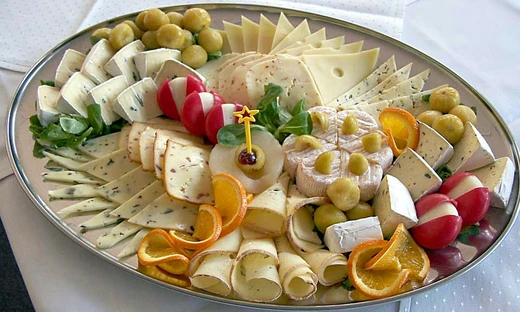
Mascarpone
Soft Italian dairy cream made without rennet.

Wikipedia / Wikimedia Commons
Mascarpone is a soft Italian dairy product made by heating cream and adding acid to cause coagulation. Technically, it is a dairy cream rather than a cheese because it contains no rennet and does not form a true curd. It holds the official Italian designation of *prodotto agroalimentare tradizionale* (PAT).
To produce mascarpone, cream is denatured, and then the whey is removed without pressing or aging. It can also be made using cream and the residual tartaric acid found on the sides or bottom of wine barrels. In the traditional method, 2.4 grams of tartaric acid powder are dissolved in 10 grams of hot water, and this solution is added to 1000 grams of heavy cream heated to between 350 K and 360 K. The mixture is then cooked at that temperature for five minutes, allowed to cool to room temperature, poured into a cheesecloth-lined colander set over a shallow pan, strained, and chilled for at least six hours.
The name "mascarpone" is popularly thought to come from *mascarpa*, an unrelated milk product made from the whey of stracchino cheese, or from *mascarpia*, a local dialect word for ricotta. Unlike ricotta, which is made from whey, mascarpone is made from cream. Lombard journalist Gianni Brera argued that the original form should be "mascherpone," derived from Cascina Mascherpa, an unidentified location in the lower Po Valley near the borders of Lodi, Milan, and Pavia. *Mascherpa* is a dialect term of uncertain origin meaning “ricotta” and is also a common surname in that area. This interpretation aligns with one of the earliest official mentions of the product outside Lombardy: in 1933–1934, the dairy of Cison di Valmarino (Treviso), owned by Count Gerolamo Brandolini d’Adda and directed by Remo Dolce, registered the trademark "Mascherpone Valmarino" (trademark no. 48371) with the Ministry of Corporations and the Intellectual Property Office of Treviso. This registration, documented in local archives and journalistic sources, confirms that production and commercial distribution in the Treviso area began in the early twentieth century. Recent food-historical reconstructions describe it as a cream-based, acid-set dairy product even then. Earlier historical uses of the term “mascarpone” may not have referred to the modern product made by acid-heat coagulation of cream.
Mascarpone is milky-white in color and easy to spread. It is used in various Lombardy dishes and is considered a regional specialty. It is a key ingredient in tiramisu. Sometimes it replaces or accompanies butter or Parmesan cheese to thicken and enrich risotto. It is also used in cheesecake recipes. In the UK, mascarpone is commonly used on pizzas topped with prosciutto and mushrooms.
- field
- Dairy product
- nationality
- Italian
- known_for
- Key ingredient in tiramisu; used in Lombardy dishes, risotto, cheesecake, and UK pizzas
- type
- Soft dairy cream (acid-heat coagulated cream)
- color
- Milky-white
- texture
- Easy to spread
Lore & Background
The name mascarpone is popularly held to derive from mascarpa, an unrelated milk product made from the whey of stracchino, or from mascarpia, a local dialect word for ricotta. Unlike ricotta, which is made from whey, mascarpone is made from cream. According to Lombard journalist and writer Gianni Brera, the original form of the name should rather be 'mascherpone', deriving from Cascina Mascherpa, an unidentified locality in the lower Po Valley. Mascherpa, a dialect term meaning 'ricotta', is also a widespread surname in the same area.
One of the earliest official attestations of the product name outside Lombardy dates to 1933–1934, when the dairy of Cison di Valmarino (Treviso), owned by Count Gerolamo Brandolini d’Adda and directed by Remo Dolce, registered the trademark 'Mascherpone Valmarino'. The registration testifies to production and commercial distribution in the Treviso area already in the early twentieth century. Previous historical uses of the term 'mascarpone' may not have corresponded to the modern dairy cream produced by acid-heat coagulation of cream.
Reader's Guide
Mascarpone is significant as a traditional Italian dairy product recognized as a PAT (prodotto agroalimentare tradizionale). Its production method—acid-heat coagulation of cream without rennet—distinguishes it from true cheeses. The traditional process involves adding tartaric acid solution to heavy cream heated to 350K–360K, cooking for 5 minutes, cooling, straining through cheesecloth, and chilling for at least 6 hours. Mascarpone is milky-white and easy to spread. Its legacy is tied to Lombardy cuisine, where it is considered a specialty. It is one of the main ingredients in tiramisu and is sometimes used instead of or along with butter or Parmesan cheese to thicken and enrich risotto. It also appears in cheesecake recipes and, in the UK, on pizzas with prosciutto and mushrooms. The product's name has disputed origins, with connections to the terms mascarpa, mascarpia, and mascherpone, and an early trademark registration in Treviso in the 1930s. This history underscores mascarpone's regional roots and its evolution into a globally recognized ingredient.
Did You Know?
- Mascarpone is made without rennet and does not undergo true curd formation.
- The traditional production method uses tartaric acid powder dissolved in hot water, added to heavy cream at 350K to 360K.
- One of the earliest official attestations of the product name outside Lombardy is a trademark registered in 1933–1934 for 'Mascherpone Valmarino'.
- Mascarpone is milky-white in colour and easy to spread.
More in Cheese 1-18
Spotted an error? Know more?
This is a living reference — every entry is fact-audited, and reader corrections feed straight into our audit queue. Suggest an edit · See this site's audit record