Anemoi
Greek wind gods of the cardinal directions.
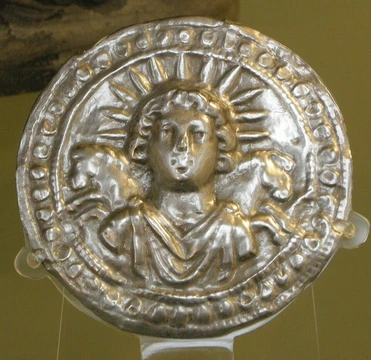
The Anemoi are wind gods from ancient Greek religion, each associated with a cardinal direction and specific weather conditions.[1] They were the children of Eos and Astraeus, and are considered minor gods subject to Aeolus.[1][2] They were sometimes depicted as gusts of wind, winged men, or horses kept by Aeolus.[2]
Quick Facts
- Parents
- Eos and Astraeus
- Chief anemoi
- Boreas
- Zephyrus
- Notus
- Eurus
- Roman equivalents
- Venti
Facts from the source article.
Making and release
The earliest known Greek word for the winds appears in Mycenaean Linear B tablets as "a-ne-mo-i-je-re-ja," meaning "priestess of the winds"[3] The four chief Anemoi are Boreas (north wind), Zephyrus (west wind), Notus (south wind), and Eurus (southeast or east wind).[4] Boreas brings cold winter air, Zephyrus brings light spring breezes, and Notus brings storms of late summer and autumn.[4] Eurus is not mentioned in Hesiod's Theogony or the Orphic Hymns.[4]
Zephyrus is sometimes shortened in English to Zephyr.[5] Notus was feared as a destroyer of crops and associated with the hot wind after midsummer.[6] The Mycenaean Greek terms a-ne-mo-i-je-re-ja and a-ne-mo,i-je-re-ja, meaning "priestess of the winds," are inscribed on the KN Fp 1 and KN Fp 13 tablets in Linear B script.[3] The name "Australia" comes from Auster, the Latin equivalent of the Greek south wind god Notus.[4][6][7]
What the cited sources add
Eurus is described as a turbulent wind that tosses ships and is called the "savior of Sparta" in a Homeric paean.[8] Apeliotes, the Greek deity of the southeast wind, is depicted wearing high boots and carrying fruit, with curly hair and a friendly expression.[9][10] Apeliotes was often syncretized with Eurus, and his Roman counterpart is Subsolanus.[10] In Nonnus's work Dionysiaca, Eurus is described as the "hot wind."[8]
References
- Wikipedia, "Anemoi" (CC BY-SA 4.0), which cites: Roman, L., & Roman, M. (2010). (original not read by us) en.wikipedia.org
- Wikipedia, "Anemoi" (CC BY-SA 4.0), which cites: Pausanias 2.34.2 compared by Festus to the Roman sacrifice of the October Horse, 190 in the edition of Lindsay. (original not read by us) en.wikipedia.org
- Wikipedia, "Anemoi" (CC BY-SA 4.0), which cites: Raymoure, "KN 13 Fp(1) (138)", Linear B Transliterations; "DĀMOS: Database of Mycenaean at Oslo - Department of Philosophy, Classics, History of Art and Ideas" (original not read by us) en.wikipedia.org
- Wikipedia, "Anemoi" (CC BY-SA 4.0), which cites: Aulus Gellius 2.22.12.; Liddell, Scott, & Jones Greek Lexicon.; Lewis and Short, Latin Dictionary. (original not read by us) en.wikipedia.org
- Wikipedia, "Anemoi" (CC BY-SA 4.0), which cites: Aulus Gellius 2.22.12. (original not read by us) en.wikipedia.org
- Wikipedia, "Anemoi" (CC BY-SA 4.0), which cites: "Google Image Result for", Google.ca (original not read by us) en.wikipedia.org
- Wikipedia, "Anemoi" (CC BY-SA 4.0), which cites: Online etymological dictionary. (original not read by us) en.wikipedia.org
- Wikipedia, "Anemoi" (CC BY-SA 4.0), which cites: Valerius Flaccus. The Argonautica. Translation by Mozley, J. H. Loeb Classical Library. Cambridge, Massachusetts: Harvard University Press. Book 1, ff 346, 574,; Greek Lyric V New School of Poetry and Anonymous Songs. Translation by Campbell, D. A. Loeb Classical Library Vol 144. Frag. 858 (from Strasbourg papyrus). Mass (original not read by us) en.wikipedia.org
- Wikipedia, "Anemoi" (CC BY-SA 4.0), which cites: Liddell, Scott & Jones, Greek Lexicon. (original not read by us) en.wikipedia.org
- Wikipedia, "Anemoi" (CC BY-SA 4.0), which cites: Aulus Gellius 2.22.1; Pliny the Elder 2.46. (original not read by us) en.wikipedia.org
Each numbered sentence above was checked against the source it cites before publication. Sentences citing Wikipedia adapt text from the English Wikipedia article Anemoi (contributors), used under CC BY-SA 4.0; this entry is available under the same licence. Other sources were used for facts only; no text or images are copied from them.
More in Characters in Roman Mythology
Spotted an error? Know more?
Reader corrections go straight into our review queue. Suggest an edit · How this site is sourced