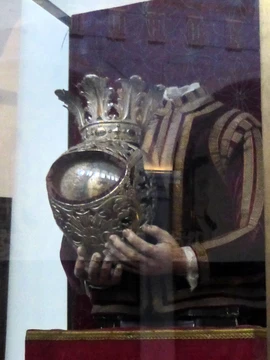
Ginés de la Jara
Semi-legendary Spanish saint and co-patron of Cartagena.
Ginés de la Jara, also known as Ginés de la Xara, Ginés el Franco, or Genesius Sciarensis, is a semi-legendary saint of Spain associated with the region around Cartagena, of which he is co-patron. A hermitage was founded near the Mar Menor, and ruins of a monastery bearing his name date from the Visigothic era, before the Moorish conquest of 711 AD.
Quick Facts
- Honorific prefix
- Saint
- Feast day
- 25 August
- Venerated in
- Roman Catholic Church, Eastern Orthodox Church
- Place of death
- near Mar Menor, Murcia, Spain?
- Canonized
- 1541
- Canonized by
- Pope Paul III
- Patronage
- Cartagena, Spain
- sailors
- vintners
- agricultural laborers
- invoked against hernias and storms
- Major shrine
- monastery of San Ginés de la Jara
Facts from the source article.
Historicity and legends
Pre-Christian or Muslim origins for the cult have been suggested, including identification with a Roman genius, an Islamic jinn, or an ancient Carthaginian site dedicated to Ba'al. The site's later association with Christian hermits and anchorites is undisputed, but no actual tomb or sepulchre for Ginés exists, and the location of his relics prompted multiple legends. Some scholars believe he may be identical with Genesius of Arles, known in Spanish as San Ginés de Arlés, who was martyred in the 4th century; their identical feast days are taken by some as proof of this identity.
According to Serafino Prete, the spread of Genesius's cult in Gaul and beyond led to the multiplication and localization of his cult, so that Genesius of Alvernia, Genesius of Béziers, Genesius of Rome, Genesius of Cordoba, and Ginés de la Jara are variations on the same saint. A manuscript from 1243, the Liber Sancti Iacobi, states that the martyr of Arles was buried at Arles but his head was miraculously transported by angels to Cartagena, possibly explaining the cult's presence in two locations.
Another legend says that after decapitation in southern France, Ginés picked up his head and threw it into the Rhône, and the head was carried by sea to the Murcian coast. No definite birth or death dates exist. He is believed to have sailed from France around 800 AD and been shipwrecked on the Murcian coast, where he established a monastery. Another legend makes him a kinsman of Roland who refused the throne of France.
After his death, his coffin was brought to France but arrived empty, the relics remaining near the Mar Menor. Additional stories describe a pilgrimage to Compostela and his remaining on the hill Cabezo del Miral until his death, where his sepulchre became a pilgrimage site with many miracles.
Veneration
The site of Ginés's hermitage at the Mar Menor survived Muslim rule and was mentioned by Moorish authors. After the Castilian conquest, Alfonso X restored the bishopric and founded the monastery of San Ginés de la Jara in 1250, declaring it a holy place and pilgrimage site. The monastery, re-founded in 1491 and rebuilt in the 16th century, is the centre of his cult and considered the resting place of his relics. His cult is essentially local but spread to Lorca, Murcia, Orihuela, and North Africa. Ginés was patron of vintners, protector of agricultural labourers and fields, and invoked by sailors against storms and against illnesses such as hernias in children. Pope Paul III officially canonized him in 1541. Around 1692, La Roldana made a polychromed sculpture of Ginés de la Jara, now at the Getty Center.
More in Cephalophores
Spotted an error? Know more?
Reader corrections go straight into our review queue. Suggest an edit · How this site is sourced