Nucleic acid
Last updated
The two main types are DNA, which encodes protein-making instructions, and RNA, which performs multiple cellular roles including protein synthesis.[1] Nucleotides, each made up of a nitrogenous base, a phosphate group, and a sugar, are the monomeric building blocks that constitute the large biomolecules known as nucleic acids.[2][1] Genomic information is stored and expressed by nucleic acids within all cells and viruses.[1]
Quick Facts
- Types
- DNA and RNA
- Monomer
- Nucleotide
Facts from the source article.
Key facts and history
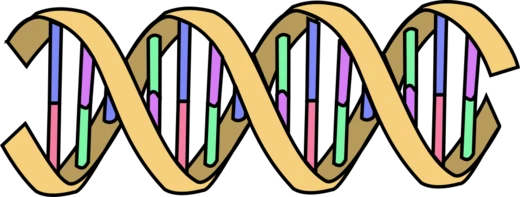
Friedrich Miescher first discovered nucleic acid in 1869 at the University of Tübingen, calling it nuclein.[3] The Avery–MacLeod–McCarty experiment in 1944 demonstrated that DNA carries genetic information.[4] Watson and Crick proposed the double-helix structure of DNA in 1953.[4] Albrecht Kossel later refined the substance, establishing its strong acidic character and also identifying the nucleobases.[3][5]
The term "nucleic acid" was introduced by Richard Altmann in 1889, at a time when no distinction was made between DNA and RNA.[5] Both DNA and RNA are present in every living cell, whereas viruses typically possess either DNA or RNA, but not both.[6] DNA molecules are likely the biggest individual molecules known; for instance, human chromosome 1 is a single molecule with 247 million base pairs.[7]
What the research sources say
The Genome.gov account states that nucleic acids are made of nitrogen-containing bases, phosphate groups, and sugar molecules.[1] The OpenStax biology textbook explains that DNA is a polymer of nucleotides with deoxyribose sugar, a phosphate group, and one of four bases: A, T, C, or G.[8] Base pairing occurs between a purine and a pyrimidine, with A pairing with T and G pairing with C.[8] The OpenStax textbook also describes that adenine and thymine form two hydrogen bonds, while cytosine and guanine form three hydrogen bonds.[8]
The Genome.gov account mentions that the discovery of nuclein set in motion the eventual discovery of DNA.[1]
References
- "Nucleic Acid", Genome.gov. facts only, no text reused. genome.gov
- Wikipedia, "Nucleic acid" (CC BY-SA 4.0), which cites: "Nucleic Acid", Genome.gov (we also read that source) en.wikipedia.org
- Wikipedia, "Nucleic acid" (CC BY-SA 4.0), which cites: Bannwarth, "Lexikon der Biologie", Spektrum.de; "Discovering DNA: Friedrich Miescher and the early years of nucleic acid research", Human Genetics, January 2008, p. 565–581; Edlbacher, "Kurzgefasstes Lehrbuch der physiologischen Chemie", De Gruyter, 2020, p. 85 (we also read that source) en.wikipedia.org
- Wikipedia, "Nucleic acid" (CC BY-SA 4.0), which cites: "DNA Structure", What is DNA (original not read by us) en.wikipedia.org
- Wikipedia, "Nucleic acid" (CC BY-SA 4.0), which cites: "BIOdotEDU", www.brooklyn.cuny.edu; Cox, "Principles of Biochemistry", Susan Winslow, 2008, p. 288 (original not read by us) en.wikipedia.org
- Wikipedia, "Nucleic acid" (CC BY-SA 4.0), which cites: "Brock biology of microorganisms", Pearson / Benjamin Cummings, 2009; Hardinger, Steven, "Knowing Nucleic Acids", ucla.edu, 2011; Mullis, Kary B. The Polymerase Chain Reaction (Nobel Lecture). 1993. (retrieved December 1, 2010) http://nobelprize.org/nobel_prizes/chemistry/laureates/1993/mu (we also read that source) en.wikipedia.org
- Wikipedia, "Nucleic acid" (CC BY-SA 4.0), which cites: "The DNA sequence and biological annotation of human chromosome 1", Nature, May 2006, p. 315–21 (original not read by us) en.wikipedia.org
- Zedalis, "14.2 DNA Structure and Sequencing - Biology for AP® Courses OpenStax", openstax.org, 2018-03-08. facts only, no text reused. openstax.org
Each numbered sentence above was checked against the source it cites before publication. Sentences citing Wikipedia adapt text from the English Wikipedia article Nucleic acid (contributors), used under CC BY-SA 4.0; this entry is available under the same licence. Other sources were used for facts only; no text or images are copied from them.
More in Cell And Molecular Biology
Sources
Compiled from Wikipedia and the sources listed below. Text from Wikipedia is available under CC BY-SA 4.0; this entry is adapted from it.
- Wikipedia: Nucleic acid (CC BY-SA 4.0).
- Word definitions: the Codexery glossary, each quoted from its Wikipedia article.
Spotted an error? Know more?
Reader corrections go straight into our review queue. Suggest an edit · How this site is sourced