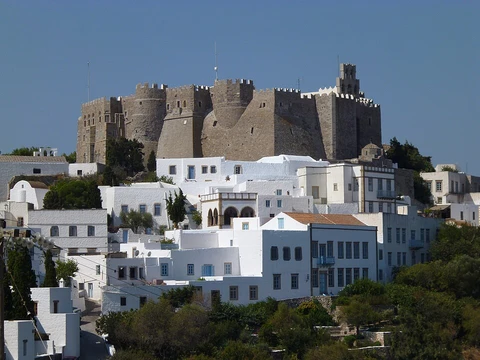
Cornštejn Castle
Ruined medieval fortress in the Dyje River Valley.
Cornštejn Castle, also known as Cornštýn or Zornstein, is a ruined castle near Bítov, 31 km west of Znojmo in south-west Moravia, Czech Republic.
Quick Facts
- Location
- Bítov; Moravia
- Built
- Early 14th century; Last fortifications 1542
- Builder
- Raimund of Lichtenburg
- Controlled by
- March of Moravia
- Materials
- stone
- Condition
- Ruins (partially reconstructed)
- Owner
- South Moravian Museum in Znojmo
- Open to public
- June to September daily
Facts from the source article.
History
The castle was built on royal demesne land subordinated to Bítov Castle, pawned and later granted as a fief to the Lichtenburg family in 1308. In the 1320s, Raimund of Lichtenburg, a favorite of King Wenceslaus II, decided to strengthen security of Bítov Castle and the road to Vranov Castle by building a fort named Zornstein, also to provide for his sons. The first written record of Cornštejn appears in an instrument issued by Moravian Margrave Charles on 31 May 1343, allowing Raimund's sons Smil and Czenek to divide their father's demesne including 'Vethow' and 'Czornstein' castles.
Originally a small Gothic noble residence with a courtyard, high enclosing wall, and palace guarded by a shield-wall, it gradually developed into a large medieval fortress. In the latter half of the 14th century, Henry of Lichtenburg built a pre-wall around the whole castle, creating the Upper Bailey. In the first third of the 15th century, Albrecht and John of Lichtenburg and Zornstein erected another palace on the other side of the courtyard and established the Lower Ward with barracks and other buildings, surrounded by a new ring of curtain walls with two gates and two bastions.
After a Hussite siege in 1422, the lords fortified the strategic hill south of Cornštejn with a detached outwork. The Lichtenburg family became very powerful; John of Lichtenburg waged war with Austrian lords and opposed Holy Roman King Frederick III. His son Hynek of Lichtenburg, supported by Pope Pius II, denied allegiance to King George of Bohemia in 1463. Declared a traitor by the Moravian Diet, Hynek's fortress was assaulted, but the siege lasted eleven months.
King George punished Hynek and confiscated the castle, granting it to Wolfgang Kraiger of Kraigk, who reconstructed and modernized both palaces. His sons Lipolt and Henry built an advanced fort on the rocky platform south of the castle, reflecting latest artillery trends. After 1526, the castle returned to the Lichtenburgs of Bítov.
Post-medieval status
By the late 16th century, medieval castles were no longer needed, and after the Lichtenburgs died out in 1576, the new owners, the Streuns of Schwarzenau, abandoned the castle and may have removed the roofs to avoid tax. The castle fell into ruin, and subsequent owners—Jankovský of Vlašim (1617), Counts von Daun (1788), and the Haases von Hasenfels (1912)—made no changes. In 1945, Czechoslovak president Edvard Beneš decreed confiscation from the Haases, and the castle was nationalized. The Monument Preservation Institute in Brno reconstructed two thirds of the castle in the early 1970s. Since 1987, it has been administered by the South Moravian Museum in Znojmo, and the stabilized ruins have been open to the public since 1998.
More in Castles in the Czech Republic
Spotted an error? Know more?
Reader corrections go straight into our review queue. Suggest an edit · How this site is sourced