Făgăraș Citadel
A medieval fortress turned political prison in Transylvania.
Last updated
Where it is
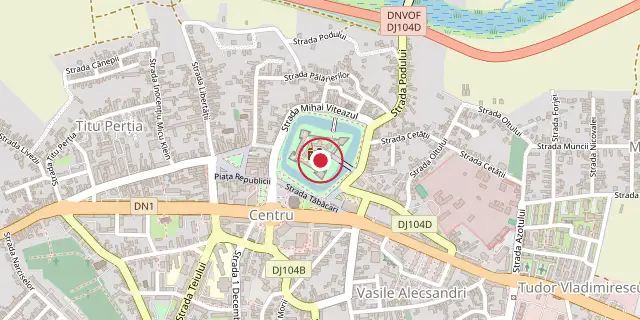
Coordinates: 45°50′42″N 24°58′26″E (45.8450, 24.9740) · Open in OpenStreetMap
Coordinates and connected clubs: the infobox of Wikipedia: Făgăraș Citadel (CC BY-SA 4.0). Map: drawn by Codexery from OpenStreetMap tiles.
Făgăraș Citadel, a historic monument in the town of Făgăraș, Brașov County, Romania, was first built in 1310. It replaced a 12th-century wooden fortification with earth ramparts that had been violently destroyed around the mid-13th century, likely during the Mongol invasion of 1241. Its position, midway between Brașov and Sibiu and near Wallachia, made it a key defensive stronghold against attacks into southeastern Transylvania.
In 1526, the citadel’s walls were doubled in thickness. The Ottomans captured it in 1541, taking prisoner Mailat, who died in captivity at Istanbul’s Yedikule Fortress. Between 1567 and 1573, owner Gáspár Bekes dug a moat around the fortress, using the excavated earth to reinforce the inner walls. Under Stephen VIII Báthory and Balthasar Báthory, the first bastion was added to the southeastern corner of the outer defensive ring.
In 1599, Michael the Brave occupied the citadel, sheltering his family and royal treasure there. In the 17th century, Prince Gabriel Bethlen prioritized its modernization over Alba Iulia, and Michael I Apafi turned it into a princely residence. It became a garrison in 1689 and retained its military role after Transylvania’s union with Romania.
In 1950, the citadel was converted into a political prison. Its moat, thick walls (two to three meters), barred windows, and geometric layout made escape nearly impossible. The Securitate used the exterior fortifications as a base against anti-communist resistance in the Făgăraș Mountains. The prison held former Siguranța and police cadres, and by early 1950 housed 101 common criminals.
That autumn, over 800 political prisoners arrived from Târgșor, including generals who all died in detention in the 1950s. Generals and Gheorghe Linteș also died there in 1954–55. Over a hundred more prisoners arrived in early 1951, and about 400 were sent to the Danube–Black Sea Canal in 1951–52, returning in 1954. Prisoners were held without trial or sentence.
Peasants opposing collectivization spent weeks or months there, while those aiding Ion Gavrilă Ogoranu’s partisans were locked up longer. Around 100 condemned war criminals came from Aiud in 1955.
In 1957, 80 sympathizers of the Hungarian Revolution, mostly workers and peasants including Onisifor Ghibu, were brought from Sibiu. By then, the prison was overcrowded, with some held past their warrants’ expiration. In total, about 5,000 people were detained there, many tortured.
During its decade as a prison, 161 detainees died from poor conditions, though former inmates say the toll was higher. Food was limited to relatively fresh bread and barely edible corn gruel. No doctors treated the sick; bathrooms were nonfunctional, creating a terrible stench, especially in summer.
Cells had few brooms for cleaning, and cold was a constant problem. In late 1959, the Stalin Region council requested the citadel for historical preservation. Four groups of over 100 detainees were sent to Gherla in February 1960, followed by a smaller number of common criminals, ending the prison’s operation.
Restoration work took place from 1965 to 1977. Today, the citadel functions as a museum, displaying various artifacts.
Frequently Asked Questions
What is Făgăraș Citadel?
Făgăraș Citadel is a medieval stone fortress in the town of Făgăraș, Brașov County, Romania. Over the centuries it served as a military garrison, a princely seat, and a political prison before eventually becoming a public museum.
When was Făgăraș Citadel built and what came before it?
Stone construction began in 1310 on the site of an older 12th-century wooden fortification with earthen ramparts. That earlier structure was likely razed around the mid-13th century, most probably during the Mongol invasion of 1241.
What was Făgăraș Citadel's main purpose in medieval times?
It functioned as a defensive bulwark protecting south-eastern Transylvania from external incursions, while also housing a garrison and serving as a residence for regional princes. In later periods it was repurposed as a prison for political detainees.
More in Castles in Romania
Sources
Compiled from Wikipedia and the sources listed below. Text from Wikipedia is available under CC BY-SA 4.0; this entry is adapted from it.
- Wikipedia: Făgăraș Citadel (CC BY-SA 4.0).
Spotted an error? Know more?
Reader corrections go straight into our review queue. Suggest an edit · How this site is sourced