Katsuren Castle
A Ryūkyūan gusuku with a golden age of trade.
Last updated

via Wikipedia: Katsuren Castle · see source
Where it is
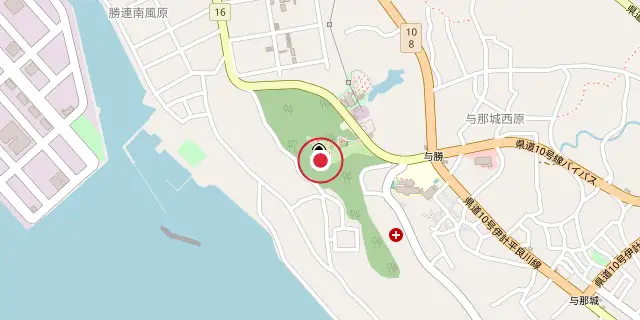
Coordinates: 26°19′48″N 127°52′44″E (26.3300, 127.8790) · Open in OpenStreetMap
Coordinates and connected clubs: the infobox of Wikipedia: Katsuren Castle (CC BY-SA 4.0). Map: drawn by Codexery from OpenStreetMap tiles.
Katsuren Castle, a Ryūkyūan gusuku in Uruma, Okinawa, became a National Historic Site in 1972 and a UNESCO World Heritage Site in 2000 as part of the Gusuku Sites and Related Properties of the Kingdom of Ryukyu.
History
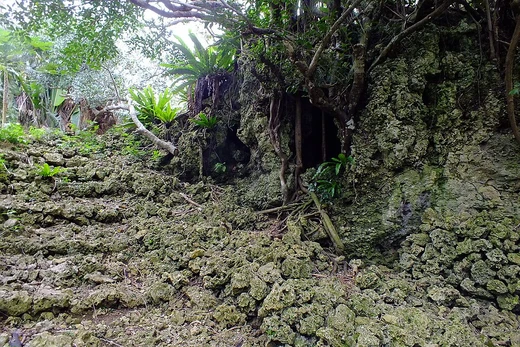
Katsuren Castle sits on a large limestone hill, rising between 60 and 100 meters above sea level at the southern edge of the Katsuren Peninsula. Because the Pacific Ocean borders it on two sides, it is often called the "Ocean Gusuku." The fortification is divided into three sections: the southern castle, known as Hegusuku; the middle castle, called Uchi; and the northern castle, Nishigusuku. The northern part contains three baileys, or kuruwa, separated by stone walls.
These baileys are arranged in a stepped pattern, with the first bailey at the highest point. In the second bailey, archaeologists found the remains of a large building about 17 meters wide and 14.5 meters deep, likely a shrine with evenly spaced pillars and foundation stones. Roofs were mostly made of shingles when the castle was built, though Japanese-style roof tiles have also been uncovered nearby. To the south, the Haebaru settlement, also called the Haebaru Furushima ruins, stretched out and served as a port for trade.
The castle was constructed in the early 1300s by Katsuren Aji, the fifth son of King Taisei of the Eiso dynasty. Its peak came in the mid-1400s under Amawari, the tenth Katsuren Aji. Amawari seized power by overthrowing the ninth Aji, Mochitsuke, who was known for being oppressive and an alcoholic.
After taking control, Amawari boosted international trade and grew very powerful. He defeated Gosamaru in the Gosamaru-Amawari Rebellion and then tried to unite the Ryukyu Islands, even attempting to overthrow King Shō Taikyū. The royal court defeated him in 1458, and the castle fell into ruin afterward.
Excavations have uncovered Chinese Yuan Dynasty ceramics, including blue and white porcelain, showing the castle’s prosperity. The "Omoro Sōshi" also records this wealth. Folklorist Yanagita Kunio wrote in his book "Omoro Saushi" that Katsuren was the cultural center of its time, with a distinct "Katsuren culture" that contrasted with the "Urasoe culture" based in Urasoe, Shuri, and Naha. Within the first bailey, an active shrine of the Ryukyuan religion is dedicated to Kobazukasa.
In the 2010 Okinawa earthquake, an outer wall on the northeast side of the third bailey was damaged. In 2016, both ancient Roman coins and medieval Ottoman coins were excavated here, marking the first time Roman coins were found in Japan. The Japanese Castle Foundation listed Katsuren Castle as one of the Continued 100 Fine Castles of Japan in 2017.
More in Castles in Okinawa Prefecture
Sources
Compiled from Wikipedia and the sources listed below. Text from Wikipedia is available under CC BY-SA 4.0; this entry is adapted from it.
- Wikipedia: Katsuren Castle (CC BY-SA 4.0).
Spotted an error? Know more?
Reader corrections go straight into our review queue. Suggest an edit · How this site is sourced