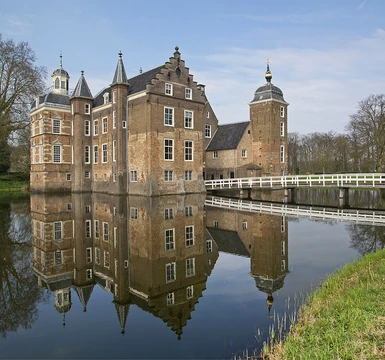
Castle Buren
A princely residence and one of the largest castles in Gelderland.
Last updated

via Wikipedia: Castle Buren · see source
Castle Buren, also called Kasteel Buren or Huis Buren, was a princely home in Buren, Gelderland, and ranked among the Netherlands' largest castles. It served as the seat for the Egmond family's Buren line and the House of Orange. Demolished in the 1800s, little remains today: a monument on the former bailey and a model in the local museum.
Quick Facts
- Location
- Buren, Gelderland, Netherlands
- First mentioned
- 1298
- Demolished
- 1809
- City rights granted
- 1395
Facts from the source article.
History
The earliest castle at Buren likely went up in the 1100s, perched on the sand of a ridge running east to west. A man named Otto van Buren shows up in records around 1190, but the castle itself isn’t mentioned until 1298. No foundations from that era have turned up, though the oldest pottery fragments found on the site date back to the 1000s or 1100s.
There was probably a tower made of tuff stone, standing about thirteen meters high. When the castle was torn down in 1809, 400 tons of that tuff stone were sold. Tuff stone, which came from the German Eifel region, was a common building material for castles from the 1000s onward, but its use faded as brick became popular in the 1200s.
Because of its strategic location, the Lordship of Buren was ruled by strong leaders for centuries. The Lords of Buren, the castle’s first residents, managed the local water systems, made the laws, and organized the earliest buildings along the Korne River. They also founded a chapel in 1367, which later grew into the current parish church of Saint Lambertus. Lord Alard gave Buren its city rights in 1395.
Rectangular Castle with Outer Bailey (13th to 15th century)
In the 1200s and early 1300s, the tuff stone tower was turned into a rectangular castle built around a courtyard. This new structure had two residential wings, one on the north side and one on the west, big towers at each of the four corners, a defensive wall with a battlement, and a large rectangular gate tower.
An outer bailey was added too, with towers at the northeast and southeast corners. In 1335, enemy troops captured the castle and damaged it. Nearly a hundred years later, in 1430, it was besieged again and heavily damaged.
The Egmonds in Buren (16th century)
Arnold, Duke of Guelders, who lived from 1410 to 1473, kicked out the Lords of Buren. He gave the castle, town, and lordship of Buren to his cousin, Frederik of Egmond, who lived from 1440 to 1521. The Egmond family came from the Dutch village of Egmond near Alkmaar.
By the 1400s, they were among the most important nobles in the Netherlands, holding high military and political jobs. They served as commanders and advisors to emperors, guardians of hereditary princes, and stewards over large parts of the country. Their influence at the Burgundian-Habsburg Court was so great that they were made counts in 1498.
In 1493, the castle took heavy damage again when Charles II, Duke of Guelders, who was Arnold’s grandson and lived from 1467 to 1538, besieged it. Frederik van Egmond had the castle repaired and turned it into a comfortable residential palace in the early 1500s. Renaissance ornaments gave it a palatial feel. New residential wings, along with a gate tower and a projecting extension called the Princes’ Quarter, were built between the corner towers.
Because cannons had made the castle indefensible, an earthen rampart with bastions and gunpowder magazines was built around the castle’s corners. A gatehouse was placed in the eastern rampart. At this point, the castle complex reached its largest size, measuring 225 by 300 meters. It became a “Palazzo in Fortezza,” a structure where a palace or noble residence sits inside a fortress or fortified complex.
Other examples of this type include Breda Castle, Villa Farnese in Caprarola, Italy, and Krzyżtopór Castle and Łańcut Castle in Poland.
The work was overseen by several master builders, including Rombout II Keldermans, who was active before 1530. Andrien Seron was the architect for the castle in Breda, where the natural stone ornaments for Buren Castle were made in the construction workshop.
So Seron might have also been the architect for Buren Castle. Alessandro Pasqualini, a fortification engineer, supervised the construction of the castle’s defenses but probably didn’t design them. Tomasso Vincidor has also been mentioned as an architect.
With each new generation, the Egmonds grew more powerful and wealthy. Count Floris van Egmont, who lived from 1570 to 1539, brought Alessandro Pasqualini from Bologna in the Papal States to Buren in 1537. This versatile architect worked for the counts of Buren, with a few breaks, until 1548.
He is best known for his extensive renovation of Buren’s 1100s defensive fortress. Over six years, the castle was turned into a luxurious Florentine Renaissance-style palace, with four corner towers and one hundred seventy rooms. The total area measured “in its circumference 1360 steps,” according to a description from 1741. More and larger windows were added, totaling 365, letting sunlight flood in.
Niches were carved into the thick walls so people could look out at the water in the moat. It was a comfortable residence. An elegant gallery with ornamented pilasters rose in the large courtyard.
Did You Know?
- The marriage of Prince William of Orange and Countess Anna of Egmond-Buren was blessed in the castle's chapel on July 8, 1551.
- For the Great Court garden, 30 linden trees, 6,000 hornbeam trees, and 35,000 firethorns were imported.
More in Castles in Gelderland
Sources
Compiled from Wikipedia and the sources listed below. Text from Wikipedia is available under CC BY-SA 4.0; this entry is adapted from it.
- Wikipedia: Castle Buren (CC BY-SA 4.0).
Spotted an error? Know more?
Reader corrections go straight into our review queue. Suggest an edit · How this site is sourced