Bjelaj Fortress
Medieval fortress with Ottoman additions near Bjelaj, Bosnia.
Last updated
Where it is
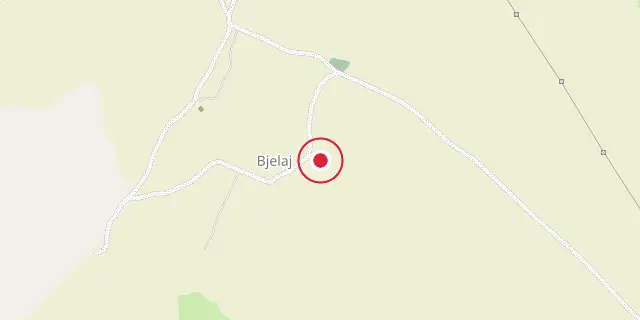
Coordinates: 44°34′59″N 16°11′56″E (44.5830, 16.1990) · Open in OpenStreetMap
Coordinates and connected clubs: the infobox of Wikipedia: Bjelaj Fortress (CC BY-SA 4.0). Map: drawn by Codexery from OpenStreetMap tiles.
Bjelaj Fortress, known locally as Stari Grad Bjelaj, is a medieval complex near the village of Bjelaj in Bosanski Petrovac, Bosnia and Herzegovina. It has a southern medieval section and a northern Ottoman section, built atop a prehistoric Bronze and Iron Age site. First recorded in 1495, its name comes from the whiteness that made it stand out above the Bjelajsko field.
History
The site includes a great fort on the south end of the northern half, a prehistoric settlement from the Bronze and Iron Age, and a small fort on the north end. The medieval town has an irregular rectangular ground plan over 40 meters long and about 35 meters wide. A large pen was added along with the medieval city during the Ottoman period, beginning from the tower on the west side. The fortress was first recorded in 1495, when Vladislaus II’s Treasurer paid Gašpar Perušić 30 forints to preserve his city of Belaj.
By 1505, most of the city, along with Sokolac fortress and Ripač, was held by Princess Beatrice Frankopan, limb of Duke Johannes Corvinus, and managed by kaštelan Dujam Orlovčić. Between 1530 and 1537, Bjelaj came under Ottoman rule, becoming part of the Sanjak of Bosnia. It was first mentioned as a nahija in 1540, later as Nahija Bjelaj-Blagaj, and then fell under the cadiluk Kamengrad. From 1562, Nađija Bjelaj was connected to the cadillac Novosel.
In 1577, a crew of 370 Ottoman mercenaries was stationed there under a dizdar. From 1592, the city was part of the Bihac captaincy, and from the 18th century, of the Petrovac captaincy. In 1747, the crew numbered 30 members under Dizdar Hasanag. An 1833 list recorded one top of 12 pedals and three small canopies of 6 pedals.
Description
The old town has two parts: the southern medieval section and the northern Ottoman section. The medieval city has an irregular rectangular layout over 40 meters long north-south and about 35 meters wide east-west, with the entrance facing north. It is half-closed, with partially preserved arches and doorways. In the northwest corner stands a massive round tower about 16 meters high, with its entrance about 4 meters above the current ground level.
The tower is assumed to have had three interior levels: a ground floor or basement, a level at the entrance, and a space above the entrance, as a ceiling is visible on the wall. East of the entrance are remains of a narrow, hollow, heavily walled area as high as the ramparts (15–16 meters), built beside the rampart; only the upper part survives, likely used for soldiers to reach the top of the wall, which has coarse and small loopholes. On the ground are remains of an eastern longitudinal wall that forms a whole with the vertical rest of the described wall, dividing the easternmost interior from the west.
These wall remains are lost after a few meters to the south, and no traces appear on the west side toward the tower, suggesting part of an enclosure protecting penetration into the city. The western side was harder to defend, so its ramparts are monolithic and end with clods, of which only a small part remains. Beneath the chestnut tree level, stone consoles on top of the ramparts supported a wooden backbone, with a series of shorter brackets embedded below. The eastern rampart, facing Bjelajsko polje, has four large semi-rounded loopholes.
Current state
A February 2007 inspection showed the medieval core of Bjelaj Fortress in good condition, but only a fragment of the Ottoman-era western wall remained. Stone-extraction holes scar the medieval walls. The site suffers from decay caused by neglect, no upkeep, and a missing management plan.
Did You Know?
- The fortress is located on a plateau about 850 meters long on the northern slope of the Osječenica mountain.
- The area around the city is uninhabited and lean.
More in Castles in Bosnia and Herzegovina
Sources
Compiled from Wikipedia and the sources listed below. Text from Wikipedia is available under CC BY-SA 4.0; this entry is adapted from it.
- Wikipedia: Bjelaj Fortress (CC BY-SA 4.0).
Spotted an error? Know more?
Reader corrections go straight into our review queue. Suggest an edit · How this site is sourced