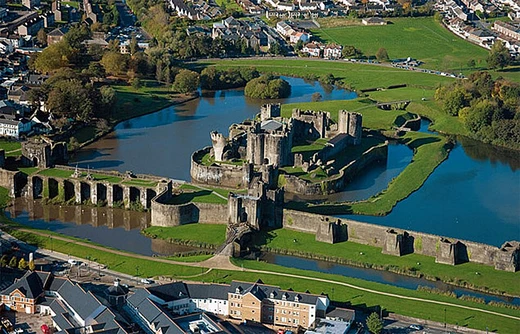
Dryslwyn Castle
Native Welsh castle overlooking the Towy Valley.
Perched on a rocky hill between Llandeilo and Carmarthen, Dryslwyn Castle overlooks the Towy Valley. Built around the 1220s by a prince of Deheubarth, this native Welsh fortress changed hands multiple times during Welsh-English conflicts. It is a Grade I listed building and one of the most significant surviving structures built by a Welsh chieftain.
Quick Facts
- Location
- Carmarthenshire, Wales
- Built
- 1220s
Facts from the source article.
Castle of Deheubarth
Perched on an isolated rocky hill above the Towy Valley, Dryslwyn Castle commands a strong defensive position. It may sit on a site used in prehistoric times, though no evidence supports this. In the 1100s, Rhys ap Gruffydd, known as Lord Rhys, ruled the kingdom of Deheubarth, bringing peace and stability. After his death in 1197, his three sons fought over the inheritance, allowing neighboring Welsh kingdoms and the English to encroach on Deheubarth.
Around this time, Dryslwyn Castle was built. It is unclear exactly who built it, but it was likely constructed in the 1220s by a prince of Deheubarth, possibly Rhys Gryg. Along with nearby Dinefwr Castle, Dryslwyn was long central to the kingdom’s security. It was apparently attacked in 1246, as the Annales Cambrie chronicle mentions a siege by the Seneschal of Carmarthen, acting for its “rightful owner,” though neither that owner nor the siege’s outcome is known.
Rhys Gryg may have built both Dryslwyn and Dinefwr to provide legacies for his two sons before his death in 1234. The castles share a similar design: a round tower with a flared base inside a ward enclosed by a curtain wall following the hillside. The ward held a great hall and an adjoining building, likely a kitchen. Between the hall and curtain wall was a small enclosed structure, possibly a prison.
The castle underwent major expansion in the late 1200s. After Dafydd ap Gruffudd, the last native prince of Wales, died in 1283, Dryslwyn became one of the few substantial stone castles in Wales still held by a Welshman. The leading Welsh lord, Rhys ap Maredudd, continued strengthening its defenses. The English allowed him to keep the castle because he had been more conciliatory than other Welsh lords.
However, in 1287 he rebelled against English rule, and King Edward I’s forces besieged and captured the castle after three weeks. The English army numbered 11,000, using a trebuchet and undermining the curtain walls. Several English knights died when a mine tunnel collapsed while they inspected it. Rhys’s revolt faded the next year, and he was captured and executed in 1292.
Owain Glyndŵr seized Dryslwyn in the summer of 1403. When English forces recaptured it, they decommissioned the castle by blocking access routes, walling up the gatehouse, removing stone stair treads, and even taking the hinges off the main gate. Later, all major buildings were burned down, and much stone was removed from the site. The castle’s limestone walls were built in the 1220s and systematically demolished in the early 1400s, likely to prevent Welsh rebels from using it again.
The polygonal inner ward holds the main remains to the southwest, with traces of middle and outer wards to the northeast. The early-1200s curtain wall of the inner ward now stands only one meter high. A garderobe lies on the east side, and a remodeled 1200s gatehouse to the northeast survives only at foundation level. On the gatehouse’s south side is the Round Tower, the original keep. Foundations of the original great hall and Rhys ap Maredudd’s hall also survive.
Little of the original structure remains, and much that is visible was uncovered by excavation. A small part of the middle and outer walls survives, mostly around their gates. The best-preserved remains are in the inner ward, showing the polygonal plan that fit the hilltop. Dryslwyn is considered one of the most important surviving structures built by a Welsh prince and is a Grade I listed building, notable as the only native Welsh castle with three wards. Since 2024, Cadw has used the Welsh name Castell Dryslwyn in English as part of an effort to standardize names in both languages.
Structure
The castle of limestone walls was built in the 1220s, and was systematically demolished in the early fifteenth century, presumably in an attempt to stop Welsh rebels using it again. The polygonal inner ward contains principal remains to the south-west, with traces of the middle and outer ward to the north-east. The early-thirteenth-century curtain wall to the inner ward only stands 1 m high. There is a garderobe to the east side, and a remodelled thirteenth-century gatehouse to the north-east, surviving at foundation level only. On the south side of the gatehouse is the Round Tower, the original keep. The foundations of the original great hall and Rhys ap Maredudd's hall survive.
Dryslwyn today
Little is left of the original structure and much of what is now visible has been revealed by excavation. A small portion of the middle and outer walls survive, mostly associated with the middle and outer gates. The best-preserved remains are within the inner ward, and here can be seen the polygonal plan that was adopted to fit in with the shape of the hilltop. It is considered one of the most important remaining structures built by a Welsh prince and is a Grade I listed building, being noteworthy as the only native Welsh castle to have three wards. Since 2024, Cadw have used the Welsh name Castell Dryslwyn in English, as part of an effort to standardise the names in both languages.
More in Castle Ruins in Wales
Spotted an error? Know more?
Reader corrections go straight into our review queue. Suggest an edit · How this site is sourced