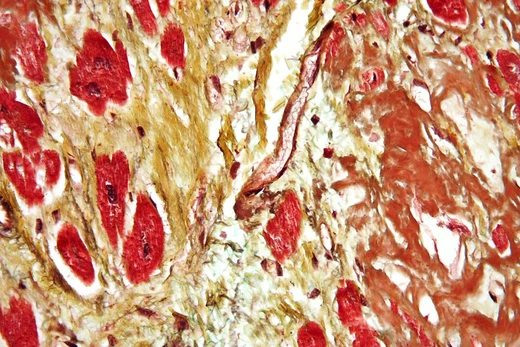
Atherosclerosis
Chronic arterial disease driven by cholesterol and inflammation.

Atherosclerosis is a form of arteriosclerosis where fatty plaques build up inside artery walls. This chronic condition involves inflammation driven by many cell types, and it is fueled by high levels of LDL cholesterol in the blood. The plaques narrow the arteries, and this disease is the leading cause of death and disability in wealthy nations.
The process often starts silently in childhood. Fibrous and gelatinous lesions can appear in children’s coronary arteries, and fatty streaks show up in juveniles. For decades, the arteries enlarge at plaque sites, so blood flow isn’t affected and there are no symptoms. Most plaque ruptures also don’t cause trouble until a clot severely narrows or blocks an artery. Symptoms usually begin around middle age and depend on which artery is affected. In the coronary arteries, narrowing can bring chest pain (angina), shortness of breath, sweating, nausea, dizziness, or palpitations. It can also cause arrhythmias—the heart beating too fast or too slow. Carotid artery narrowing, which supplies the brain, may cause weakness, confusion, trouble speaking, dizziness, blurred vision, numbness in the face or limbs, severe headache, or loss of consciousness—all signs of stroke. Peripheral arteries in the legs, arms, and pelvis can cause pain and numbness when narrowed. Renal artery narrowing reduces kidney blood flow, leading to chronic kidney disease, which is usually symptom-free until late stages. In 2004, U.S. data showed that for about 66% of men and 47% of women, the first sign of atherosclerotic disease was a heart attack or sudden cardiac death (death within an hour of symptoms). Autopsies of U.S. soldiers killed in the Korean War—average age 22.1 years—found that 77.3% had clear evidence of coronary arteriosclerosis.
The exact cause is unknown and likely involves multiple factors. Risk factors include abnormal cholesterol, high inflammatory markers, high blood pressure, diabetes, smoking (active and passive), obesity, genetics, family history, lifestyle, and poor diet. Plaques are made of fat, cholesterol, immune cells, calcium, and other blood components. The narrowing limits oxygen-rich blood flow. Diagnosis relies on a physical exam, electrocardiogram, and exercise stress test, among other methods. Prevention includes a healthy diet, exercise, not smoking, and maintaining a normal weight. Treatment for established disease may involve cholesterol-lowering drugs like statins, blood pressure medication, and anticoagulants to prevent clots. As the disease worsens, more invasive options include percutaneous coronary intervention, coronary artery bypass graft, or carotid endarterectomy. Some people have a strong genetic predisposition.
Atherosclerosis generally starts young and worsens with age. Almost everyone is affected to some degree by age 65. Though first described in 1575, evidence suggests the disease is genetically ingrained in humans, with origins possibly linked to CMAH gene mutations that occurred over two million years ago in hominin ancestors. The inflammatory process involves LDL particles being retained in the vessel wall’s endothelial cells—this retention may be a cause, an effect, or both of the inflammation. The plaque’s presence makes blood vessel muscle cells stretch to compensate for the extra bulk.
- field
- Cardiovascular pathology
- known_for
- Chronic inflammatory disease causing arterial plaque buildup, leading to heart attack, stroke, and peripheral artery disease
- affected_population
- Almost all people affected to some degree by age 65
- primary_risk_factors
- Abnormal cholesterol levels, high blood pressure, diabetes, smoking, obesity, genetic factors
Quick Facts
- Field
- Cardiology, vascular surgery, cardiothoracic surgery, interventional radiology
- Symptoms
- None
- Complications
- Coronary artery disease, stroke, peripheral artery disease, chronic kidney disease, heart disease
- Onset
- Youth (worsens with age)
- Causes
- Elevated LDL cholesterol, smoking, high blood pressure, and diabetes
- Risks
- High blood pressure, diabetes, smoking, obesity, family history, unhealthy diet (notably saturated fat, trans fat, ultra-processed foods, and hydrogenated oils)
- Prevention
- Healthy diet, exercise, not smoking, maintaining a normal weight
- Medication
- Statins, blood pressure medication, aspirin
- Frequency
- ≈100% (>65 years old)
Facts from the source article.
Lore & Background
Atherosclerosis generally starts when a person is young and worsens with age. Early atherosclerotic processes likely begin in childhood, with fibrous and gelatinous lesions observed in the coronary arteries of children and fatty streaks in juveniles. The disease is typically asymptomatic for decades because arteries enlarge at all plaque locations, compensating for the buildup. Most plaque ruptures do not produce symptoms until severe narrowing or closure of an artery due to clots occurs. Signs and symptoms only happen after severe narrowing impedes blood flow to different organs, and most patients realize they have the disease only when they experience cardiovascular disorders such as stroke or heart attack.
Reader's Guide
Atherosclerosis is significant as the leading cause of death and disability in developed countries. The disease process involves complex interactions between elevated LDL cholesterol, inflammatory processes, and genetic factors. Risk factors include modifiable elements such as diet, smoking, and sedentary lifestyle, as well as nonmodifiable factors like advanced age and genetic abnormalities. Treatment ranges from lifestyle changes and medications like statins to invasive procedures such as percutaneous coronary intervention or coronary artery bypass graft. The disease has ancient origins, with evidence suggesting genetic mutations linked to CMAH may have occurred over two million years ago in hominin ancestors.
Did You Know?
- The disease is typically asymptomatic for decades because arteries enlarge at all plaque locations, compensating for the buildup.
More in Cardiovascular & Blood 1-24
Spotted an error? Know more?
This is a living reference — every entry is fact-audited, and reader corrections feed straight into our audit queue. Suggest an edit · See this site's audit record