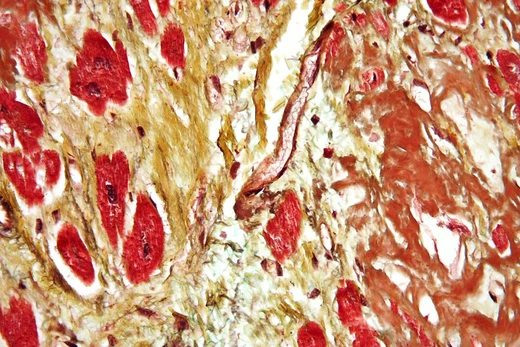
Arteriosclerosis
Hardening of the arteries, a set of vascular disorders.

Arteriosclerosis is a general term for a group of blood vessel disorders where artery walls thicken, harden, and lose their natural flexibility—hence its literal meaning, "hardening of the arteries." Over time, this process narrows the arteries, reducing blood flow to organs and tissues. The most dangerous form is atherosclerosis, which involves the buildup of fatty plaques, cholesterol, and other substances inside the arteries. Key risk factors include a family history of the condition, smoking, and obesity.
Atherosclerosis is the leading cause of coronary artery disease (CAD) and stroke, and it arises from a mix of genetic and environmental influences. Studies of families and populations have found many genetic and non-genetic contributors to CAD, but family history stands out as the single most important independent risk factor.
Signs and symptoms vary depending on which arteries are affected. When the disease strikes vessels in the brain or eyes—leading to a stroke or transient ischemic attack—symptoms can include sudden weakness, numbness in the face or legs, confusion, trouble understanding speech, and vision problems. If it affects the coronary arteries, as in CAD or acute coronary syndrome, chest pain is common.
The disease begins when the innermost layer of an artery, the intima, starts accumulating cellular waste. As these deposits grow, different forms of arteriosclerosis can emerge, but all share the features of stiffening, thickening, and degeneration of the arterial walls. Arteriolosclerosis is a type that affects only small arteries and arterioles, which supply blood to cells. Atherosclerosis, by contrast, narrows large and medium-sized arteries through plaque made of cholesterol, fatty substances, cellular debris, calcium, and fibrin; its location varies from person to person. Monckeberg's arteriosclerosis, or medial calcific sclerosis, is mostly seen in older adults and commonly affects arteries in the limbs. Hyperplastic arteriosclerosis also targets large and medium-sized arteries. Hyaline arteriosclerosis, also called arterial or arteriolar hyalinosis, involves the buildup of a glassy, homogeneous substance called hyaline in small arteries and arterioles.
Diagnosis of suspected arteriosclerosis may rely on a physical exam, blood tests, an EKG, and the results of these and other tests.
Treatment often focuses on prevention. Medications are commonly prescribed to manage underlying conditions, such as statins or cholesterol absorption inhibitors for high cholesterol, ACE inhibitors or angiotensin II receptor blockers for high blood pressure, and antiplatelet drugs. Lifestyle changes—like increasing exercise, quitting smoking, and limiting alcohol—are also recommended. Several surgical options exist: angioplasty with stent placement, where a balloon is inflated inside a narrowed artery to push back deposits and a mesh tube is left to keep it open; coronary artery bypass surgery, which grafts a healthy vein around a blockage to restore blood flow to the heart; endarterectomy, the surgical removal of plaque from a blocked artery; and thrombolytic therapy, which uses clot-dissolving medicine given intravenously to break up plaque masses.
In 2008, an estimated 16 million Americans had atherosclerotic heart disease, and 5.8 million had strokes. Cardiovascular diseases caused by arteriosclerosis led to nearly 812,000 deaths that year—more than any other cause, including cancer. About 1.2 million Americans are expected to have a heart attack each year.
The clinical significance of arteriosclerosis was not understood until the 20th century. After many cases were observed and recorded, the term was coined by Jean Lobstein while he studied the composition of calcified arterial lesions. The name comes from the Greek words *artēría* (artery) and *sklērōtikós* (hardened).
- field
- Vascular medicine, pathology
- known_for
- Umbrella term for arterial hardening disorders, including atherosclerosis
- risk_factors
- Family history, smoking, obesity
- types
- Atherosclerosis, arteriolosclerosis, Monckeberg's arteriosclerosis, hyperplastic, hyaline
Quick Facts
- Field
- Pathology
- Symptoms
- Sudden weakness
- Causes
- Smoking, High blood pressure
- Diagnosis
- Blood test, EKG
- Treatment
- Treatment of underlying condition
Facts from the source article.
Lore & Background
The lesions of arteriosclerosis begin when the intima, the innermost layer of an artery wall, accumulates cellular waste deposits. As these deposits develop, the disease can take several distinct forms, all sharing common features: stiffening of arterial vessels, thickening of arterial walls, and a degenerative progression. Atherosclerosis, the most common form, involves the narrowing of large and medium-sized arteries due to plaque buildup composed of cholesterol, fatty substances, cellular waste, calcium, and fibrin. In contrast, arteriolosclerosis affects only small arteries and arterioles that carry nutrients and blood to cells. Monckeberg's arteriosclerosis, or medial calcific sclerosis, appears mostly in the elderly, typically in arteries of the extremities. Hyperplastic arteriosclerosis also affects large and medium-sized arteries, while hyaline arteriosclerosis involves the deposition of homogenous hyaline in small arteries and arterioles. The term "arteriosclerosis" was coined by Jean Lobstein while analyzing calcified arterial lesions, though the diagnostics and clinical implications were not recognized until the 20th century. The name derives from Greek words meaning "artery" and "hardened." Risk factors include family history, smoking, and obesity, with family history identified as the most significant independent risk factor for coronary artery disease.
Reader's Guide
Arteriosclerosis is significant as an umbrella term encompassing several vascular disorders that lead to abnormal thickening, hardening, and loss of elasticity in arterial walls. The disease process gradually restricts blood flow, and signs and symptoms depend on the vessel affected, ranging from chest pain in coronary artery disease to sudden weakness or confusion in cerebrovascular accidents. Diagnosis can be based on physical exam, blood test, and EKG. Treatment includes preventive measures, medications for high cholesterol and high blood pressure, lifestyle changes, and surgical options such as angioplasty, coronary artery bypass surgery, endarterectomy, and thrombolytic therapy. The term was coined by Jean Lobstein while analyzing calcified arterial lesions, and the diagnostics and clinical implications were not recognized until the 20th century.
Did You Know?
- The term 'arteriosclerosis' is derived from Greek words meaning 'artery' and 'hardened'.
- Atherosclerosis is the specific form of arteriosclerosis caused by buildup of fatty plaques, cholesterol, and other substances.
- Family history is the most significant independent risk factor for coronary artery disease.
More in Cardiovascular & Blood 1-24
Spotted an error? Know more?
This is a living reference — every entry is fact-audited, and reader corrections feed straight into our audit queue. Suggest an edit · See this site's audit record