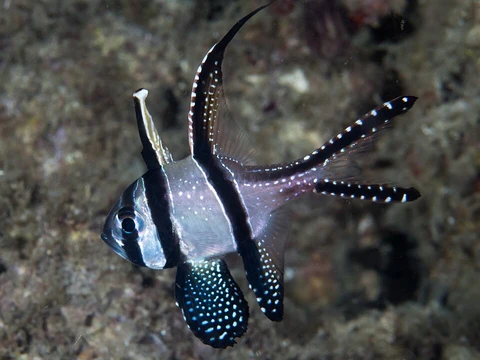
Ostorhinchus compressus
A cardinalfish with blue eye rings and brown stripes from the Indo-West Pacific.
Last updated

Ditch Townsend · via Wikipedia: Ostorhinchus compressus · CC BY-SA 4.0
Its specific name compressus refers to the fish's "strongly compressed" body.[1] Hugh McCormick Smith and Lewis Radcliffe originally described this marine cardinalfish species based on specimens gathered during the 1907–1910 Albatross Philippines expedition conducted by the United States Bureau of Fisheries.[2]
Scientific classification
- KingdomAnimalia
- PhylumChordata
- ClassActinopterygii
- DivisionTeleostei
- OrderGobiiformes
- FamilyApogonidae
- GenusOstorhinchus
- SpeciesOstorhinchus compressus
Named by (H. M. Smith & Radcliffe, 1911)
Close relatives
Other species of Ostorhinchus with a Codexery entry.
- Ostorhinchus capricornis Ostorhinchus capricornis
- Ostorhinchus cyanosoma Ostorhinchus cyanosoma
- Ostorhinchus doederleini Ostorhinchus doederleini
- Ostorhinchus fasciatus Ostorhinchus fasciatus
- Ostorhinchus fleurieu Ostorhinchus fleurieu
- Ostorhinchus maculiferus Ostorhinchus maculiferus
- Ring-tailed cardinalfish Ostorhinchus aureus
Sources: Wikipedia taxobox: Ostorhinchus compressus (CC BY-SA 4.0) · differs from this box at order: WoRMS AphiaID 712653 (CC BY 4.0)
Conservation status
Least Concern (LC)
- LC▲ this species
- NT
- VU
- EN
- CR
- EW
- EX
Source: IUCN Red List assessment · GBIF copy of the Red List category
How big is it?
Largest length in the source, 0.09 m, next to a 1.8 m person.
Diagram: drawn by Codexery, schematic shapes to scale (not a likeness). Length: Wikipedia: Ostorhinchus compressus
Where the ostorhinchus compressus has been recorded
Each dot is a place where the species has been observed and reported (945 records, half-degree grid) — not a modelled range. 27 inland records left out (institution coordinates). 1 isolated far-off record not drawn.
Map: drawn by Codexery. Data: GBIF occurrence search (records CC0 / CC BY) · Natural Earth basemap (public domain) · place coordinates: Wikipedia (CC BY-SA 4.0)
Biology and range
Juveniles begin with a black spot on a yellow caudal peduncle, which mimics juveniles of certain piscivorous Cheilodipterus species.[3] The species occurs in Australian waters from Scott Reef, Ashmore and Cartier Islands, and Rowley Shoals in Western Australia, and from the Great Barrier Reef to Middleton & Elizabeth Reefs Reserve and Lord Howe Island.[4] The species tolerates very low dissolved oxygen levels, even at 30 °C, possibly due to retreating into shallow branching corals with low water circulation.[5] Daytime resting occurs in mixed-species aggregations with other cardinalfishes, typically at depths between 2 and 20 metres.[5]
Studies of larval development indicate that ultraviolet light sensitivity grows stronger as the fish matures.[6] Because larvae are pelagic, older individuals can move downward through the water column to feed, potentially enhancing both predator avoidance and nutrient intake.[6] Gyrodactylid flatworm infections have been documented on the gills of O. compressus.[7]
What the specialist sources record
The Fishes of Australia account states the species occurs on offshore reefs of north Western Australia, Ashmore Reef and Cartier Island in the Timor Sea, the Great Barrier Reef, Queensland, and the Lord Howe Province in the Tasman Sea.[1] The World Register of Marine Species records Ostorhinchus compressus as an accepted species in the family Apogonidae, order Apogoniformes, class Teleostei.[8] GBIF holds 1,217 occurrence records for this taxon as of 7 October 2026.[9]
References
- Dianne J. Bray, "Ostorhinchus compressus", Fishes of Australia. facts only, no text reused. fishesofaustralia.net.au
- Wikipedia, "Ostorhinchus compressus" (CC BY-SA 4.0), which cites: Radcliffe, L. (1911): Notes on some fishes of the genus Amia, family of Cheilodipteridae, with descriptions of four new species from the Philippine Islands. (Sc; USNM records search (original not read by us) en.wikipedia.org
- Wikipedia, "Ostorhinchus compressus" (CC BY-SA 4.0) en.wikipedia.org
- Wikipedia, "Ostorhinchus compressus" (CC BY-SA 4.0), which cites: Dianne J. Bray, "Ostorhinchus compressus", Fishes of Australia (we also read that source) en.wikipedia.org
- Wikipedia, "Ostorhinchus compressus" (CC BY-SA 4.0), which cites: "Habitat specialisation and overlap in a guild of coral reef cardinalfishes (Apogonidae)", Marine Ecology Progress Series, 2005, p. 163–175; "The Physiology of Tropical Fishes", Elsevier, 2006, p. 583–596 (we also read that source) en.wikipedia.org
- Wikipedia, "Ostorhinchus compressus" (CC BY-SA 4.0), which cites: "Spectral sensitivity of larval and juvenile coral reef fishes: implications for feeding in a variable light environment", Marine Ecology Progress Series, 2001, p. 267–277 (original not read by us) en.wikipedia.org
- Wikipedia, "Ostorhinchus compressus" (CC BY-SA 4.0), which cites: "Diversity of gyrodactylids from some marine fishes in tropical and subtropical Queensland, Australia", Folia Parasitologica, 2001, p. 165–168 (original not read by us) en.wikipedia.org
- World Register of Marine Species, Ostorhinchus compressus (AphiaID 712653). CC BY 4.0. marinespecies.org
- GBIF Backbone Taxonomy and occurrence index, Ostorhinchus compressus (taxon key 5788261). CC BY 4.0 (backbone); counts are facts. gbif.org
Each numbered sentence above was checked against the source it cites before publication. Sentences citing Wikipedia adapt text from the English Wikipedia article Ostorhinchus compressus (contributors), used under CC BY-SA 4.0; this entry is available under the same licence. Other sources were used for facts only; no text or images are copied from them.
More in Cardinalfish
Sources
Compiled from Wikipedia and the sources listed below. Text from Wikipedia is available under CC BY-SA 4.0; this entry is adapted from it.
- Wikipedia: Ostorhinchus compressus (CC BY-SA 4.0).
- Classification: the source article's taxobox; compare WoRMS, the World Register of Marine Species (CC BY 4.0).
- Conservation status: IUCN Red List assessment.
- Occurrence records: GBIF (CC0 / CC BY). Basemap: Natural Earth (public domain).
- Word definitions: the , each quoted from its Wikipedia article.
Spotted an error? Know more?
Reader corrections go straight into our review queue. Suggest an edit · How this site is sourced