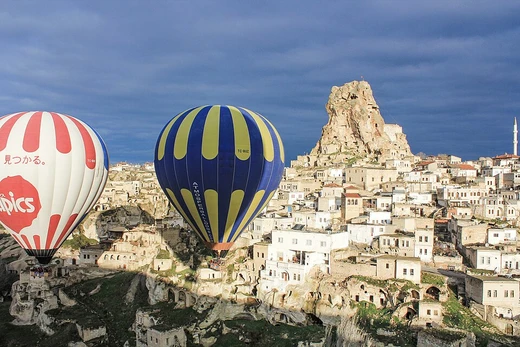
Avanos
Avanos is a Cappadocian town known for pottery and riverside charm.
Avanos is a town in Nevşehir Province in the Cappadocia region of Central Anatolia, Turkey, located 18 km north of Nevşehir. It is the seat of Avanos District and stands on the banks of the Kızılırmak, the longest river of Turkey. The town is notable for its pottery production, which likely dates back to Hittite times, and for its attractive old town and riverside location.
Quick Facts
- Province
- Nevşehir
- Leader party
- MHP
- Leader
- Mustafa Kenan Sarıtaş
- Elevation (m)
- 920
- Population
- 14968
Facts from the source article.
History
Old Avanos contains a network of small underground structures that may have once been residential but are now mainly used by pottery enterprises. Although no documented evidence confirms when these were carved, work on some likely began in the Hittite period. As Venessa, ancient Avanos was the third most important town in the Kingdom of Cappadocia according to the geographer Strabo, and it was the site of a temple of Zeus, of which nothing remains.
From 1867 until 1922, Avanos was part of Angora vilayet of the Ottoman Empire. Most visible historical remains date from the 19th and early 20th centuries, including stone houses built by the now-displaced Greek and Armenian populations, located in the older part on the northern bank of the river. The town expanded rapidly in the early 2000s, with modern housing on the southern side, which was landscaped and developed for recreation after 2010.
Attractions around Avanos
In 2019, a flood in the small settlement of Çalış, located north of Avanos, uncovered a three-story underground town roughly 5,000 years old. Locals named it “Gir-Gör,” meaning “Enter and See.” The site, stretching about five kilometers, included homes, tunnels, and worship spaces, and a small human figurine was found there. People in the area once believed its waters had healing properties and called it “Caesar’s bath.”
It remains closed to visitors. About five kilometers from Avanos and one kilometer from Paşabağ lies Zelve, a settlement carved into the steep northern slopes of Aktepe across three valleys. The exact date when people first occupied these rock-cut dwellings is unknown, but a significant Christian community lived here, and Zelve served as the region’s religious hub from the 9th to the 13th centuries. The first seminars for training priests in the area were held nearby.
Paşabağ features many fairy chimneys with unusually sharp tops and thick bases; one of them even houses a police station. Devrent is known for rock formations that resemble carvings, like a camel. On the Avanos-Göreme road at the edge of Çavuşin stands the Church of St. John the Baptist, also called the Nicephorus Phocas Church or the Great Pigeon House, built in 964-965 AD and decorated with frescoes. A second church with the same name is tucked away in Çavuşin’s old quarter.
In the Güllüdere valley, about two kilometers from Çavuşin, is the Church of St. Agathangelus, dating to the 6th or 7th century. Its square nave ends in a single wide apse added in the 9th or 10th century. The apse contains two or three layers of frescoes, showing it was repainted often, with symbols of the Gospel writers flanking an enthroned Jesus. On the flat ceiling, a relief cross sits inside a circle ringed by palm leaves and garlands, likely from the Iconoclastic period.
More in Cappadocia
Spotted an error? Know more?
Reader corrections go straight into our review queue. Suggest an edit · How this site is sourced