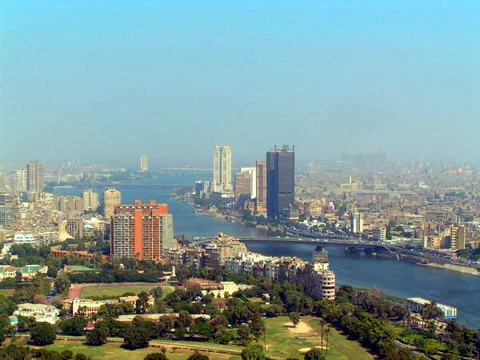
Antananarivo
Last updated
Where it is
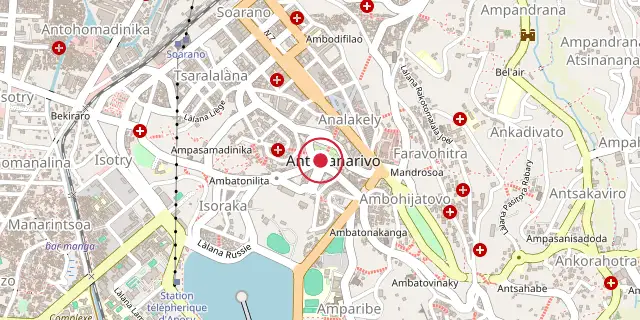
Coordinates: 18°54′36″S 47°31′30″E (-18.9100, 47.5250) · Open in OpenStreetMap
Coordinates and connected clubs: the infobox of Wikipedia: Antananarivo (CC BY-SA 4.0). Map: drawn by Codexery from OpenStreetMap tiles.
Antananarivo is the capital of Madagascar, situated approximately 1280 m above sea level in the Central Highlands region.[1] According to the 2018 census, the Merina people, whose historical capital was Antananarivo, still constitute the majority of the city's 1,274,225 residents.[2]
Geography and history
Andriamasinavalona designated specific territories for commoners and each noble subcaste, and these divisions were strictly enforced with numerous taboos.[3][4] The Vazimba community, considered the first inhabitants of the island, originally established a settlement called Analamanga, which translates to "Blue Forest" in Central Highlands Malagasy, on the site that later became Antananarivo.[5] Merina King Andrianjaka took control of the Analamanga location to establish his capital, and oral history records that he used a force of 1,000 soldiers to capture and hold the site.[6] Depending on the account, the city was founded around 1610 or 1625; later, King Andriamasinavalona changed its name to Antananarivo, meaning "City of the Thousand," as a tribute to Andrianjaka's troops.[7][6]
To supply rice for the expanding population, early Merina rulers employed fanampoana (statute labor) to build a network of irrigated paddy fields and dikes around the city; the largest of these fields, Betsimitatatra, is still used for rice cultivation.[3] By 1810, Antananarivo had become the island's biggest and most economically significant settlement, with a population exceeding 80,000.[8]
What the cited sources add
In 2005, the CUA partnered with city planners of Île-de-France to develop the Plan Vert – Plan Bleu strategy for creating protected heritage zones.[9] The plan prevents destruction of historic buildings and establishes construction codes to ensure new structures follow historic aesthetics.[9] The same article notes that many aristocrats copied the British model of two-story brick houses with wrapped verandas, a style known as trano gasy that spread throughout the Central Highlands.[10] An article by Andriamihaja in L'Express de Madagascar reports that brick-making was brought to the island by British missionaries during the 1820s, and that French industrialist Jean Laborde used stone and brick for his factories in the following decades.[10]
References
- Wikipedia, "Antananarivo" (CC BY-SA 4.0), which cites: "Fruits of Toil in the London Missionary Society", John Snow & Co., 1869, p. 44; UN-Habitat 2012, p. 7 (original not read by us) en.wikipedia.org
- Wikipedia, "Antananarivo" (CC BY-SA 4.0), which cites: "Madagascar: Regions, Cities & Urban Communes - Population Statistics, Maps, Charts, Weather and Web Information", www.citypopulation.de; Institut National de la Statistique, Madagascar. (original not read by us) en.wikipedia.org
- Wikipedia, "Antananarivo" (CC BY-SA 4.0), which cites: Callet 1908, p. 654–656 (original not read by us) en.wikipedia.org
- Wikipedia, "Antananarivo" (CC BY-SA 4.0), which cites: Callet 1908, p. 654–656; Acquier 1997, p. 63–64; Oliver 1886, p. 221 (original not read by us) en.wikipedia.org
- Wikipedia, "Antananarivo" (CC BY-SA 4.0), which cites: Shillington 2004, p. 158 (original not read by us) en.wikipedia.org
- Wikipedia, "Antananarivo" (CC BY-SA 4.0), which cites: Shillington 2004, p. 158; Callet 1908, p. 654–656 (original not read by us) en.wikipedia.org
- Wikipedia, "Antananarivo" (CC BY-SA 4.0), which cites: Government of France 1898, p. 918–919; Desmonts 2004, p. 114–115; Roman Adrian Cybriwsky, Capital Cities around the World: An Encyclopedia of Geography, History, and Culture, ABC-CLIO, USA, 2013, p. 15 (original not read by us) en.wikipedia.org
- Wikipedia, "Antananarivo" (CC BY-SA 4.0), which cites: Campbell, "The state and pre-colonial demographic history: the case of nineteenth-century Madagascar", Journal of African History, October 1991, p. 415–445; Ade Ajayi 1998, p. 165; Nativel 2005, p. 30 (original not read by us) en.wikipedia.org
- Wikipedia, "Antananarivo" (CC BY-SA 4.0), which cites: "Actes du séminaire international sur le développement urbain", Commune Urbaine d'Antananarivo, March 2012 (we also read that source) en.wikipedia.org
- Wikipedia, "Antananarivo" (CC BY-SA 4.0), which cites: Andriamihaja, "Habitat traditionnel ancien par JP Testa (1970), Revue de Madagascar: Evolution syncrétique depuis Besakana jusqu'au trano gasy", L'Express de Madagascar, 5 July 2006 (we also read that source) en.wikipedia.org
Each numbered sentence above was checked against the source it cites before publication. Sentences citing Wikipedia adapt text from the English Wikipedia article Antananarivo (contributors), used under CC BY-SA 4.0; this entry is available under the same licence. Other sources were used for facts only; no text or images are copied from them.
More in Capital Cities Of Africa
Sources
Compiled from Wikipedia and the sources listed below. Text from Wikipedia is available under CC BY-SA 4.0; this entry is adapted from it.
- Wikipedia: Antananarivo (CC BY-SA 4.0).
Spotted an error? Know more?
Reader corrections go straight into our review queue. Suggest an edit · How this site is sourced