Ethiopian wolf
Africa's most endangered carnivore, specialized for highland rodent hunting.

The Ethiopian wolf (Canis simensis)—also called the red jackal, Simien jackal, or Simien fox—lives only in the Ethiopian Highlands, including the Simien Mountains. In southeastern Ethiopia, it is sometimes referred to as the horse jackal. About the size and build of a coyote, it has a notably long, narrow skull and a coat of red and white fur. While most large canids are generalists found across wide areas, this wolf is a highly specialized predator of Afroalpine rodents and depends on very specific habitats. It ranks among the rarest canids worldwide and is Africa’s most endangered carnivore.
Its current range is confined to seven isolated mountain ranges at elevations between 3,000 and 4,500 meters. As of 2011, the total adult population was estimated at 360 to 440 individuals, with more than half living in the Bale Mountains. The IUCN lists the species as endangered due to its small numbers and fragmented distribution. Threats include habitat degradation from overgrazing caused by growing human populations, as well as disease transmission and interbreeding with free-ranging dogs. Conservation efforts are led by Oxford University’s Ethiopian Wolf Conservation Programme, which focuses on vaccination and community outreach.
The wolf was first scientifically described in 1835 by Eduard Rüppell, who provided a skull to the British Museum. Mid-19th-century European travelers in Ethiopia (then called Abyssinia by Europeans and Ze Etiyopia by its people) noted that locals never wore the animal’s skin, believing that any wolf hairs entering an open wound would cause death. Charles Darwin speculated that the species gave rise to greyhounds. After that, little was heard of the wolf in Europe until the early 20th century, when Major Percy Powell-Cotton shipped several skins to England. The species was recognized as needing protection in 1938 and received it in 1974. The first detailed studies began in the 1980s with the American-sponsored Bale Mountains Research Project. Populations in Bale Mountains National Park suffered during the Ethiopian Civil War, and a severe rabies epidemic combined with shooting in the early 1990s decimated most packs studied in the Web Valley and Sanetti Plateau. In response, the IUCN reclassified the wolf from endangered to critically endangered in 1994. The IUCN/SSC Canid Specialist Group recommended a three-pronged strategy: education, population monitoring, and rabies control in domestic dogs. The Ethiopian Wolf Conservation Programme was established in Bale in 1995 by Oxford University, working with the Ethiopian Wildlife Conservation Authority. Soon after, another wolf population was found in the Central Highlands. Elsewhere, information remained scarce; though first described in the Simien Mountains in 1835, the lack of recent data suggested a decline there, and reports from the Gojjam plateau were a century old. Wolves were recorded in the Arsi Mountains since the early 20th century and in the Bale Mountains since the late 1950s. Surveys in the late 1990s, made possible by improved travel in northern Ethiopia, revealed local extinctions in Mount Choqa, Gojjam, and every northern Afroalpine region with intensive agriculture and human pressure. This underscored the importance of the Bale populations for the species’ long-term survival and the need to protect other remaining groups. A decade after the rabies outbreak, Bale populations had fully recovered to pre-epizootic levels, leading the IUCN to downlist the species to endangered in 2004. It remains the world’s rarest canid and Africa’s most endangered carnivore.
The earliest known fossil of the Ethiopian wolf—the right half of a mandible—comes from the Melka Wakena site in the southeastern Ethiopian Highlands and dates to between 1.6 and 1.4 million years ago. Researchers suggest that the wolf’s ancestors arrived in Africa from Eurasia around the same time as the ancestors of the African wild dog, roughly 1.8 million years ago. The species survived many climatic shifts in its highland habitat, with its range expanding and contracting repeatedly during glacial cycles. A 1994 mitochondrial DNA analysis showed a closer relationship to the gray wolf and coyote than to other African canids, and C. simensis may be an evolutionary relic of a gray wolf-like ancestor that invaded northern Africa from Eurasia. Because of the high density of rodents in their new Afroalpine environment, the wolf’s ancestors gradually became specialized rodent hunters—a specialization reflected in their elongated skull, long jaw, and widely spaced teeth. During this period, the species likely reached its highest numbers and had a relatively continuous distribution. That changed about 15,000 years ago with the onset of the current interglacial, which fragmented the Afroalpine habitat and isolated wolf populations from one another.
- Conservation status
- Vulnerable (IUCN)
Lore & Background
A further wolf population was discovered in the Central Highlands. Surveys in the late 1990s revealed local extinctions in Mount Choqa, Gojjam, and every northern Afroalpine region where agriculture is well developed. A decade after the rabies outbreak, the Bale populations did not fully recover to pre-epizootic levels, but overall population estimates and improved conservation status prompted the species' downlisting to vulnerable in 2004. The earliest known fossil, a right mandible half tentatively dated to between 1.6 and 1.4 million years ago from the Melka Wakena site, has been proposed but is not definitively established. Mitochondrial DNA analysis shows a closer relationship to the gray wolf and coyote than to other African canids.
Reader's Guide
Its highly specialized diet of Afroalpine rodents and specific habitat requirements make it particularly vulnerable to habitat fragmentation and degradation. The species' conservation is led by Oxford University's Ethiopian Wolf Conservation Programme, which uses vaccination and community outreach to address threats from expanding human populations, overgrazing, and disease transference from free-ranging dogs. The wolf's evolutionary history, including its divergence from wolf-like ancestors and evidence of gene flow with African golden wolves, provides insight into canid adaptation to high-altitude environments. Its recovery from a severe rabies epidemic in the 1990s demonstrates the potential for conservation success, but its fragmented range and reliance on the Bale Mountains population underscore ongoing risks.
Did You Know?
- The Ethiopian wolf is one of several Canis species present in Africa, including the African golden wolf and the side-striped jackal, and is readily distinguishable from jackals by its larger size, longer legs, distinct r
- The earliest known fossil of the Ethiopian wolf is a right mandible half tentatively dated to between 1.6 and 1.4 million years ago, though this identification remains provisional.
Deep Roots in Miocene Jungles
Hyenas trace their origins to the dense jungles of Miocene Eurasia, roughly 22 million years ago, at a time when most other feliform species still spent much of their lives in trees. The earliest members of this lineage were slender, civet-like creatures rather than the robust scavengers we recognize today. One of the oldest identifiable hyena species, Plioviverrops, roamed Eurasia between 20 and 22 million years ago and can be distinguished as a true hyaenid by the architecture of its middle ear and the arrangement of its teeth. Over successive generations, this successful lineage produced descendants with progressively longer limbs and more tapered jaws, a body plan that mirrors the evolutionary trajectory independently followed by canids in North America. This gradual shift away from an arboreal, civet-like form set the stage for the family's most dramatic divergence: the split into two fundamentally different ecological strategies, the lightly built dog-like hyenas and the heavily built bone-crushing hyenas, a split that would ultimately determine which lineages survived and which vanished entirely.
The Wolfish Dynasty and Its Collapse
At their zenith around 15 million years ago, the dog-like hyenas represented one of the most prolific carnivore radiations in Earth's history, with more than thirty distinct species identified from the fossil record. These were agile, wolfish animals far removed from the heavy-jawed bone-crushers of today; one well-known member, Ictitherium viverrinum, closely resembled a modern jackal in build. In certain Miocene fossil deposits, the skeletal remains of Ictitherium and its relatives actually outnumber those of every other carnivore at the same site, underscoring how dominant this group once was. Yet their reign proved fragile. Beginning five to seven million years ago, shifting climates combined with the arrival of true canids across the Bering land bridge into Eurasia triggered a catastrophic decline. One remarkable exception, Chasmaporthetes ossifragus, crossed into North America and survived briefly by abandoning both endurance running and bone-crushing in favor of a cheetah-like sprinting strategy. By 1.5 million years ago, nearly the entire dog-like lineage had been extinguished, leaving only the insectivorous aardwolf as a solitary remnant.
Masters of the Carcass
The bone-crushing branch of the hyena family tells a story of ecological specialization and long-term dominance. By 10 to 14 million years ago, this lineage had clearly separated from its dog-like cousins, and its rise coincided with the disappearance of the similarly built Percrocutidae family. Where the nimble dog-like hyenas perished under the twin pressures of climate upheaval and canid competition, the robust bone-crushers proved remarkably resilient. They never attempted to cross into North America, a continent where the dog subfamily Borophaginae had already claimed the scavenging niche. Instead, they consolidated their position in Eurasia and Africa. By five million years ago, they had become the undisputed top scavengers on both continents, primarily feeding on the carcasses of large herbivores brought down by sabre-toothed cats. At the apex of this strategy stood Pachycrocuta, a 110-kilogram mega-scavenger powerful enough to splinter the bones of elephants. In the early Middle Pleistocene, however, Pachycrocuta gave way to the smaller genera Crocuta and Hyena, a turnover likely tied to the broader faunal shifts of the Mid-Pleistocene transition.
Four Survivors, Four Paths
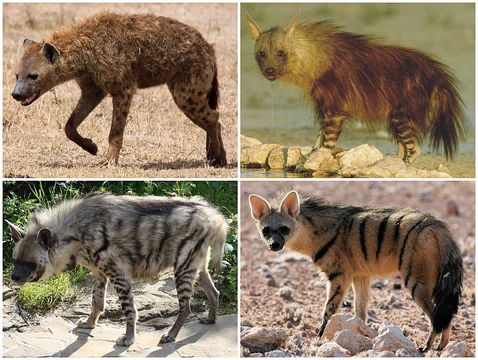
Today, the hyena family is represented by just four living species, each in its own genus: the striped hyena, the brown hyena, the spotted hyena, and the aardwolf. Their evolutionary stories are remarkably different. The aardwolf is the sole survivor of the dog-like lineage, tracing an unbroken line back to Plioviverrops 15 million years ago; its niche as an insectivore, particularly its ability to digest the terpene excretions of soldier termites, likely evolved from the powerful digestive system its ancestors used to process foul carrion, and it faced no competition when canids arrived. The striped hyena may descend from the Pliocene African form Hyaenictitherium namaquensis, and its fossils are abundant across Africa stretching back to the Villafranchian. Its spread into Europe appears to have occurred only after spotted hyenas disappeared from Asia at the end of the Ice Age, and Pleistocene populations in France, Germany, Austria, Portugal, and Gibraltar were notably larger than modern ones. The spotted hyena diverged from its striped and brown relatives 10 million years ago, descending from the Villafranchian Indian Crocuta sivalensis, and likely developed its complex social structure as a response to intensified competition over carcasses.
Frequently Asked Questions
What is the Ethiopian wolf?
The Ethiopian wolf (Canis simensis) is a small, highly specialized canid found only in the highland regions of Ethiopia. It goes by several nicknames—red jackal, Simien jackal, Simien fox—but is actually more closely related to wolves and coyotes than to true jackals.
What does the Ethiopian wolf eat?
Rather than being a generalist predator, it is almost exclusively a rodent specialist, feeding on Afroalpine rodents such as giant mole-rats. This narrow dietary focus makes it extremely vulnerable to any shift in rodent populations or loss of its alpine grassland habitat.
Where does the Ethiopian wolf live?
Its range is confined to the Afroalpine zones of the Ethiopian Highlands, with the Simien Mountains serving as its best-known stronghold. Because it depends on a very narrow band of elevation and climate, it simply cannot survive in lowland or forested areas.
How rare is the Ethiopian wolf?
It is one of the rarest canids on the planet and is widely regarded as Africa's most endangered carnivore. The IUCN classifies it as Vulnerable, with small, isolated populations facing threats from habitat fragmentation, disease spillover, and inbreeding.
What does the Ethiopian wolf look like?
It is roughly coyote-sized, with a strikingly long and narrow skull and a vivid coat of red and white fur. Its slender build and pointed muzzle help distinguish it from the broader-headed jackals and foxes it is often mistaken for.
More in Canids And Hyaenids 1-24
Spotted an error? Know more?
This is a living reference — every entry is fact-audited, and reader corrections feed straight into our audit queue. Suggest an edit · See this site's audit record