
Mazda GTP
A rotary-powered IMSA GTP car with limited success.
Last updated

Mr.choppers · CC BY-SA 3.0
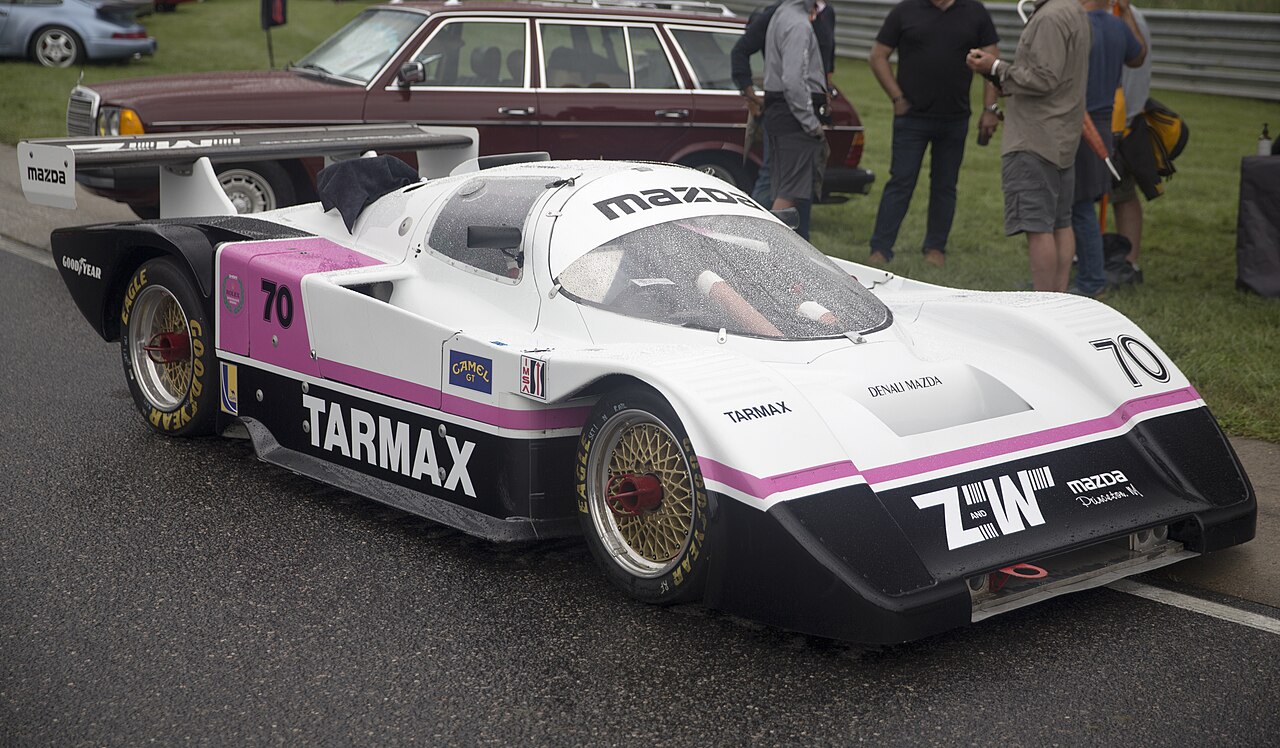
The Mazda GTP was a race car built for the IMSA GTP series by Pierre Honegger in 1981. It started life as a modified Mazda RX-7, competing in the GTX class under the name Mazda RX-7 GTP, before being reworked for the GTP category in 1983. The car used a Mazda 13B Wankel rotary engine, the same type found in road-going RX-7s. While rotary-powered prototypes were generally known for being dependable, the Mazda GTP struggled to finish races and never achieved a result better than eighth place, which it scored at the 1983 24 Hours of Daytona.
In 1981, Honegger built two cars from production RX-7s, fitting them with wide-body panels and a more powerful version of the 13B engine. Both were entered in the 24 Hours of Daytona that year, but neither qualified.
Honegger then entered one car in the 12 Hours of Sebring with Ernesto Soto, but withdrew before the race. Instead, he drove a standard RX-7 to a 61st-place finish. The RX-7 GTP was not used again until 1983.
1983
For 1983, Honegger rebuilt the car for the IMSA GTP class and renamed it the Mazda GTP. Its debut at the 24 Hours of Daytona saw Honegger, Walt Bohren, and David Palmer finish eighth overall and fifth in class. The car then retired after four laps at the Grand Prix of Miami, and its engine failed after 61 laps at the 12 Hours of Sebring.
After a five-race gap, Bohren retired again at Lime Rock after 75 laps. Another eight races passed before the car reappeared at Pocono, where Honegger and Bohren retired but were classified 15th after 143 laps. At the Daytona Finale, Honegger and David Loring retired after 64 laps.
1984
In 1984, Honegger, Loring, and David Weitzenhof crashed out of the 24 Hours of Daytona after 187 laps. The car sat idle until Lime Rock, where Honegger finished ninth, five laps down. At Watkins Glen, Loring and Frank Jellinek took tenth overall. The Road America 500 saw Jellinek, Loring, and Honegger finish 13th, and at Pocono, Honegger and Loring placed 15th.
1985
The 1985 season saw the car entered only sporadically. Loring retired after 27 laps at Watkins Glen, then Honegger and Loring took tenth at Pocono. Loring retired at the New York 500 after 45 laps and again at the Columbus 500 after 84 laps. The Mazda GTP never raced again after 1985, though two entries in 1986 led to nothing.
Later career
One chassis was later bought by Erie Scientific Racing and rebuilt as the Badger BB.
Lore & Background
In 1981, Pierre Honegger rebuilt a production Mazda RX-7 for the GTX category of the IMSA GT Championship, naming it the Mazda RX-7 GTP. Two cars were built, both entered in that year's 24 Hours of Daytona, but neither trio qualified for the race. The car was not used again until 1983, when Honegger rebuilt it for the IMSA GTP category and rechristened it as the Mazda GTP. Its debut at the 1983 24 Hours of Daytona saw the trio of Honegger, Walt Bohren and David Palmer finish eighth overall and fifth in class, which would remain the car's best result.
Throughout 1983 and 1984, the car suffered frequent retirements, though it occasionally finished mid-pack, such as a ninth at Lime Rock and a tenth at Watkins Glen in 1984. In 1985, the car's final race came at the Columbus 500, where David Loring retired after 84 laps. Two entries in 1986 led to nothing.
Reader's Guide
The Mazda GTP is notable as a privateer rotary-engined effort that competed in the IMSA GTP category during the early 1980s. Built by Pierre Honegger from a production Mazda RX-7, it represented an attempt to adapt a road-car rotary engine to top-level sports prototype racing. Despite the general reputation of rotary engines for reliability, the Mazda GTP frequently failed to finish races, and its best result was an eighth-place finish at the 1983 24 Hours of Daytona.
The car's legacy extends beyond its own racing career: one chassis was purchased by Erie Scientific Racing and rebuilt into the Badger BB, which achieved a best finish of 14th overall at the 1987 24 Hours of Daytona. The other chassis was rebuilt by Honegger into the Denali Speedcar, which won the GTP Lights category at the 1986 Lime Rock Grand Prix and achieved a fifth overall at the 1987 Watkins Glen Grand Prix. The Mazda GTP thus served as the basis for two subsequent cars that saw moderate success in the GTP Lights class.
More in Can-Am and Sports Racing Cars
Sources
Compiled from Wikipedia and the sources listed below. Text from Wikipedia is available under CC BY-SA 4.0; this entry is adapted from it.
- Wikipedia: Mazda GTP (CC BY-SA 4.0).
Spotted an error? Know more?
Reader corrections go straight into our review queue. Suggest an edit · How this site is sourced