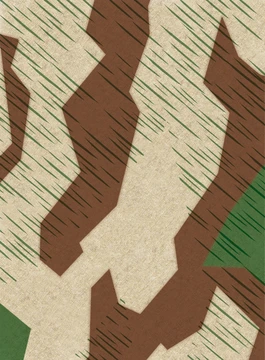
Sumpftarnmuster
A saturated green variant of German splinter camouflage from 1943.
Last updated
Sumpftarnmuster, or Marsh Camouflage, is a German World War II camouflage pattern derived from the earlier Splinter Camouflage. It is notable for its saturated green-dominant color scheme, designed to improve concealment in forest environments, and was first issued to Wehrmacht units in 1943.
Quick Facts
- Developed
- 1943
- Derived from
- Splittertarnmuster (Splinter Camouflage)
- First issued to
- Wehrmacht units
- Forms issued
- smocks
- helmet covers
- winter overpants
- Primary theater
- eastern front
- Post-war user
- West Germany (modified version, early 1950s, border guard)
Facts from the source article.
Background
Sumpftarnmuster was developed from the earlier splinter camouflage pattern. The color dominance shifted from beige to green, creating a saturated version intended to better blend into forest environments. The pattern was first issued to Wehrmacht units in 1943 in the form of smocks, helmet covers, and winter overpants. The two-piece uniform was meant to be worn over the common issue wool or Drillich uniforms and was intended to be effective throughout the year.
For winter use in snowy areas of the Soviet Union, the smocks and overpants reversed to white. The pattern saw action mainly on the eastern front. After the war, a modified version was used in the early 1950s by the West German border guard (Bundesgrenzschutz).
Frequently Asked Questions
What is Sumpftarnmuster?
Sumpftarnmuster, commonly called Marsh Camouflage, is a German World War II field pattern that takes the angular splinter design and recolors it with a much richer, saturated green palette. It was introduced in 1943 to help Wehrmacht soldiers blend into dense woodland terrain.
When and to whom was Sumpftarnmuster first issued?
The pattern entered service in 1943 and was initially distributed to Wehrmacht units. It appeared on smocks, helmet covers, and winter overpants rather than full field uniforms.
More in Camouflage Patterns
Sources
Compiled from Wikipedia and the sources listed below. Text from Wikipedia is available under CC BY-SA 4.0; this entry is adapted from it.
- Wikipedia: Sumpftarnmuster (CC BY-SA 4.0).
Spotted an error? Know more?
Reader corrections go straight into our review queue. Suggest an edit · How this site is sourced