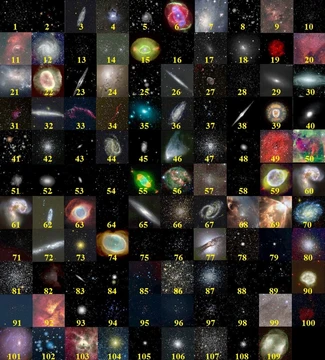
IC 342
A bright spiral galaxy hidden behind Milky Way dust.

IC 342, also called Caldwell 5, is an intermediate spiral galaxy in the constellation Camelopardalis. It sits relatively close to the Milky Way, but its position behind dusty regions near the galactic equator makes it hard to see, which is why it’s nicknamed "The Hidden Galaxy." Even so, binoculars can pick it up easily. Without that obscuring dust, it would be visible to the naked eye. The dust also complicates distance measurements; current estimates range from about 7 million to 11 million light-years. William Frederick Denning discovered it in 1892. It ranks among the brightest members of the IC 342/Maffei Group, one of the nearest galaxy groups to our Local Group. Edwin Hubble originally thought it belonged to the Local Group, but later studies showed it does not. In 1935, Harlow Shapley noted that IC 342 spans an angular width larger than the full moon, making it the third-largest known spiral galaxy by angular size at the time, after the Andromeda Galaxy (M31) and the Triangulum Galaxy (M33). More recent measurements place its apparent size at about half to two-thirds the diameter of the full moon. The galaxy has an H II nucleus. In 2020, astronomers identified KKH 32 as the first known satellite of IC 342—a dwarf spheroidal galaxy. IC 342 has relatively few dwarf satellite galaxies compared to galaxies with large bulges, like Andromeda. KKH 32 lies roughly 10.2 million light-years (3.12 megaparsecs) away and measures about 4,300 light-years (1.32 kiloparsecs) across.
Quick Facts
- Epoch
- J2000
- Ra
- 03 · 46 · 48.5028
- Dec
- +68 · 05 · 46.924
- Constellation Name
- Camelopardalis
- Z
- 31 ± 3 km/s
- Dist Ly
- 10.7 ± 0.9 Mly (3.3 ± 0.3 Mpc)
- Appmag V
- 9.1
- Stars
- 100 billion
Facts from the source article.
Lore & Background
IC 342 was discovered by William Frederick Denning in 1892. Edwin Hubble first thought it to be in the Local Group, but it was later determined not to be a member. In 1935, Harlow Shapley found that it was wider than the full moon, and by angular size the third-largest spiral galaxy then known, smaller only than the Andromeda Galaxy (M31) and the Triangulum Galaxy (M33). Modern estimates are more conservative, giving the apparent size as one-half to two-thirds the diameter of the full moon. The galaxy has an H II nucleus. In 2020, the galaxy KKH 32 was identified as the first known satellite of IC 342 that is a dwarf spheroidal galaxy. Unlike galaxies with large bulges such as the Andromeda Galaxy, IC 342 has relatively few dwarf satellite galaxies. KKH 32 is located about 10.2 million light-years away, and has a diameter of about 4,300 light-years.
Reader's Guide
IC 342 is one of the brightest galaxies in the IC 342/Maffei Group, one of the closest galaxy groups to the Local Group. Its significance lies in its proximity and intrinsic brightness, yet it remains heavily obscured by dust near the galactic equator, earning the nickname 'The Hidden Galaxy'. This obscuration makes it a challenging but rewarding target for amateur astronomers, as it can be detected with binoculars despite the dust. The galaxy's uncertain distance—ranging from about 7 to 11 million light-years—reflects the difficulty of measuring obscured objects. Its historical importance includes being considered by Edwin Hubble as a possible Local Group member and being ranked by Harlow Shapley as the third-largest spiral galaxy by angular size in 1935. The discovery of its first known dwarf spheroidal satellite, KKH 32, in 2020 adds to its legacy as a key member of a nearby galaxy group, offering insights into galaxy formation and satellite systems. IC 342 is often compared to NGC 6946, another galaxy heavily obscured by Milky Way stars and dust.
Did You Know?
- IC 342 is nicknamed 'The Hidden Galaxy' because it is obscured by dust near the galactic equator.
- If not obscured, IC 342 would be visible to the naked eye.
- In 1935, Harlow Shapley found it was the third-largest spiral galaxy by angular size, after M31 and M33.
- Its first known dwarf spheroidal satellite, KKH 32, was identified in 2020.
The Paradox of the Hidden Galaxy
IC 342, also catalogued as Caldwell 5, presents a striking observational contradiction. It is a genuinely large and intrinsically bright intermediate spiral galaxy sitting in the constellation Camelopardalis, yet its position behind dense dust lanes along the galactic equator renders it one of the most challenging targets for visual astronomers. The nickname "The Hidden Galaxy" captures this irony perfectly: without the obscuring interstellar material, the galaxy would be readily visible to the unaided eye. In practice, even binoculars can pick it up, but the dust shroud complicates precise distance measurements, with modern estimates scattering between roughly seven and eleven million light-years. This veil of dust also means that what we perceive as its apparent brightness is a fraction of its true luminosity, making IC 342 a compelling case study in how our own galaxy's structure can mask otherwise prominent extragalactic objects.
Discovery and the Question of Membership
William Frederick Denning first identified IC 342 in 1892, adding it to the Index Catalogue of galaxies. For decades afterward, its proximity to the Milky Way sparked debate about its true affiliation. Edwin Hubble initially classified it as a member of the Local Group, but subsequent analysis corrected this assumption; the galaxy is not part of our own group. Instead, it belongs to the IC 342/Maffei Group, which ranks among the nearest galaxy groups to the Local Group. In 1935, Harlow Shapley measured its angular extent and concluded it spanned more than the full moon's diameter, making it the third-largest spiral galaxy known at the time, trailing only Andromeda (M31) and the Triangulum Galaxy (M33). Modern assessments have tempered that figure, placing the apparent size at roughly one-half to two-thirds of the full moon's diameter, yet IC 342 remains an exceptionally large object on the sky.
Structure and Classification
IC 342 is classified as a Late-Type Spiral galaxy, a designation that reflects its relatively open, loosely wound structure compared to earlier-type spirals. At its core lies an H II nucleus, a region of ionized hydrogen that signals ongoing or recent star formation activity in the galaxy's heart. The galaxy sits in Camelopardalis, a faint northern constellation, and its relative closeness to the Milky Way makes it a valuable nearby laboratory for studying spiral morphology. Its large angular size—still among the most extended spirals visible from Earth—gives it a distinctive, sprawling appearance through telescopes. The combination of its late-type classification, active H II region, and considerable apparent footprint distinguishes IC 342 from many other group members and makes it a useful comparative object when examining how spiral structure evolves in relatively low-density environments.
Satellites and the Broader Neighborhood
In 2020, astronomers identified KKH 32 as the first confirmed satellite of IC 342, a dwarf spheroidal galaxy situated approximately 10.2 million light-years (about 3.12 megaparsecs) from its host. KKH 32 measures roughly 4,300 light-years (1.32 kiloparsecs) across, a modest companion to the much larger spiral. Notably, IC 342 hosts relatively few dwarf satellites, a contrast to bulge-dominated systems like the Andromeda Galaxy, which are surrounded by rich populations of dwarf companions. This sparser satellite environment may reflect IC 342's late-type structure and its position within the IC 342/Maffei Group, one of the closest galaxy groups to our own. The discovery of KKH 32 also draws a parallel with NGC 6946, another large spiral heavily obscured by Milky Way dust, suggesting that obscured nearby galaxies may harbor additional undiscovered companions waiting to be catalogued.
Frequently Asked Questions
What is IC 342?
IC 342, listed as Caldwell 5, is an intermediate spiral galaxy located in the constellation Camelopardalis. It is part of the IC 342/Maffei Group and is often referred to as 'The Hidden Galaxy' because of its obscured position.
Why is IC 342 nicknamed 'The Hidden Galaxy'?
It sits behind dusty regions near the galactic equator, which block its light from reaching Earth unobstructed. Without that dust, the galaxy would actually be visible to the naked eye given its relative closeness.
How far away is IC 342?
Current estimates place it somewhere between 7 and 11 million light-years from us. That unusually wide range exists because the intervening Milky Way dust makes precise distance measurements difficult.
Who discovered IC 342 and in what year?
The English astronomer William Frederick Denning identified the galaxy in 1892. It has since become one of the brighter members of the Caldwell catalogue.
Can I spot IC 342 with binoculars, and how big does it look?
Yes—despite the dust, binoculars pick it up quite easily. It spans roughly half to two-thirds the apparent diameter of the full moon in the sky.
More in Caldwell Objects 1-16
Spotted an error? Know more?
Reader corrections go straight into our review queue. Suggest an edit · How this site is sourced