Frequently Asked Questions
The most-asked questions about butterflyfish.
What exactly is a butterflyfish?
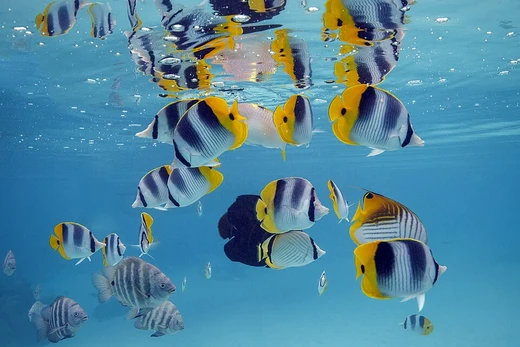
Butterflyfish refers to the family Chaetodontidae, a group of small, laterally compressed marine fish found in tropical and subtropical waters. They are instantly recognizable for their disc-like body shape, large pectoral fins, and often striking color patterns that mimic a butterfly in flight.
How many species of butterflyfish are there?
Taxonomists currently recognize roughly 150 to 170 valid species distributed across about 20 to 25 genera. The Indo-Pacific region hosts the greatest diversity, while the Atlantic and Red Sea contain smaller, more isolated groups.
Where do butterflyfish live in the wild?
They are almost exclusively reef-associated, inhabiting coral reefs, rocky outcrops, and seagrass beds in shallow tropical waters from about 1 to 60 meters deep. The Indo-Pacific, Red Sea, and western Atlantic (particularly the Caribbean and Gulf of Mexico) are their primary ranges.
What do butterflyfish eat?
Diet varies considerably by species: some graze on coral polyps, others pick small crustaceans and worms from crevices, and a few are open-water planktivores. A handful of species are obligate sponge-eaters, making them especially vulnerable to habitat loss.
Why are they called butterflyfish?
The common name comes from their strongly flattened, oval body profile combined with broad, fan-like pectoral fins and vivid, often symmetrical coloration. Together these features give the impression of a butterfly hovering over the reef.
Are butterflyfish easy to keep in a home aquarium?
Most species are considered advanced or expert-level because of their specialized feeding requirements, sensitivity to water chemistry, and tendency to become stressed in captivity. A few hardier species, such as the Raccoon butterflyfish, can succeed in well-established reef tanks, but long-term survival is not guaranteed.
How large do butterflyfish typically grow?
Most species reach a total length between 4 and 10 inches (10–25 cm), though a few larger genera, like the bannerfish group, can exceed 12 inches. Males and females are generally similar in size within a given species.
What is their social and reproductive behavior?
Many butterflyfish are protandrous hermaphrodites, meaning individuals start life as males and later transition to females; the dominant male in a group typically makes the switch when the female dies. Outside of spawning, they often form loose groups or pairs and show mild territoriality around feeding or nesting sites.
How long do butterflyfish live?
In the wild, most species live roughly 5 to 15 years, with larger-bodied species tending toward the upper end of that range. In captivity, lifespans are often shorter due to dietary limitations and stress, though some individuals have been reported surviving well over a decade in expert hands.
What makes butterflyfish ecologically important on a reef?
By grazing on coral polyps, sponges, and small invertebrates, they help regulate the balance between corals and competing organisms. Their foraging also creates microhabitats and recycles nutrients, making them a functional keystone component of healthy reef ecosystems.