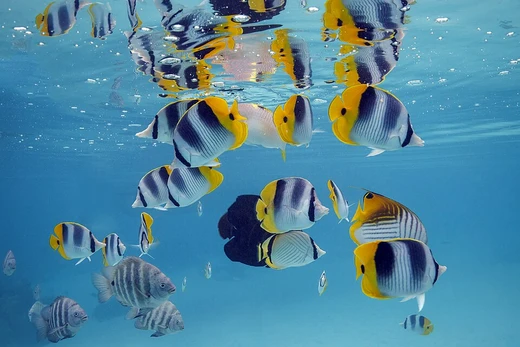
Heniochus varius
A butterflyfish with prominent horns and a hump on the forehead.
Last updated

Diego Delso · via Wikipedia: Heniochus varius · CC BY-SA 4.0
Heniochus varius, commonly known as the horned bannerfish or humphead bannerfish, is a species of marine ray-finned fish belonging to the family Chaetodontidae. It is native to the central Indo-Pacific area and is notable for the distinctive pair of horns and a prominent bump on the forehead of adults, which set it apart from other bannerfish.
Scientific classification
- KingdomAnimalia
- PhylumChordata
- ClassActinopterygii
- DivisionTeleostei
- OrderAcanthuriformes
- FamilyChaetodontidae
- GenusHeniochus
- SpeciesHeniochus varius
Named by (Cuvier, 1829)
Close relatives
Other species of Heniochus with a Codexery entry.
- Heniochus chrysostomus Heniochus chrysostomus
- Heniochus monoceros Heniochus monoceros
- Heniochus pleurotaenia Heniochus pleurotaenia
- Heniochus singularius Heniochus singularius
- Pennant coralfish Heniochus acuminatus
- Red Sea bannerfish Heniochus intermedius
- Schooling bannerfish Heniochus diphreutes
Sources: Wikipedia taxobox: Heniochus varius (CC BY-SA 4.0) · order, family and genus agree with WoRMS AphiaID 276750 (CC BY 4.0)
Conservation status
Least Concern (LC)
- LC▲ this species
- NT
- VU
- EN
- CR
- EW
- EX
Source: IUCN Red List assessment · GBIF copy of the Red List category
How big is it?
Largest length in the source, 0.19 m, next to a 1.8 m person.
Diagram: drawn by Codexery, schematic shapes to scale (not a likeness). Length: Wikipedia: Heniochus varius
Where the heniochus varius has been recorded
Each dot is a place where the species has been observed and reported (2,714 records, half-degree grid) — not a modelled range. 25 inland records left out (institution coordinates).
Map: drawn by Codexery. Data: GBIF occurrence search (records CC0 / CC BY) · Natural Earth basemap (public domain) · place coordinates: Wikipedia (CC BY-SA 4.0)
Background
The horned bannerfish was first formally described as Taurichthys varius in 1829 by the French anatomist Georges Cuvier, with the type locality given as Ambon Island in Indonesia. It has the typical deep-bodied and highly compressed body of butterflyfishes. Adults are distinguished by a pair of obvious horns on the forehead just above the eyes and a prominent bump on the forehead. The predominant body color is brown to blackish, broken by a thin white band behind the head and a second white band running from the spiny part of the dorsal fin to the caudal peduncle, creating a triangle of the base color on the body.
More in Butterflyfish
Test yourself
Three questions drawn from this entry’s sources. Pick an answer to check it.
Answers checked against the source article
Sources
Compiled from Wikipedia and the sources listed below. Text from Wikipedia is available under CC BY-SA 4.0; this entry is adapted from it.
- Wikipedia: Heniochus varius (CC BY-SA 4.0).
- Classification: the source article's taxobox; order, family and genus checked against WoRMS, the World Register of Marine Species (CC BY 4.0).
- Conservation status: IUCN Red List assessment.
- Occurrence records: GBIF (CC0 / CC BY). Basemap: Natural Earth (public domain).
- Word definitions: the Codexery glossary, each quoted from its Wikipedia article.
Spotted an error? Know more?
Reader corrections go straight into our review queue. Suggest an edit · How this site is sourced