Chaetodon zanzibarensis
A small, coral-feeding butterflyfish of the western Indian Ocean.

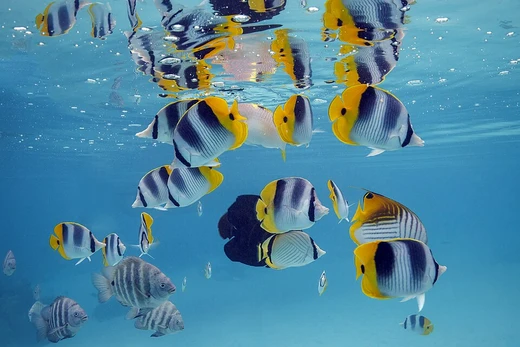
The Zanzibar butterflyfish is a small species, reaching about 12 centimeters long, with a yellow body marked by a large black spot on its upper side, often edged in white or blue. A vertical black stripe runs through its eye, and faint, dark, curved lines run along its sides. Its dorsal fin has 13 to 14 spines and 15 to 17 soft rays, while the anal fin has 3 spines and 15 to 17 soft rays.
This fish lives in the tropical western Indian Ocean, from the eastern coast of Africa to Madagascar, the Seychelles, Réunion, and Mauritius. Its range also includes the Chagos Archipelago, Comoros, Kenya, Mayotte, Mozambique, Somalia, South Africa, Tanzania, and Yemen. It prefers lagoons and outer reef slopes at depths of 1 to 40 meters.
A specialist feeder, it eats the polyps of stony corals, especially Acropora species, and may also take the tentacles of feather duster and Christmas tree worms. To catch these alert prey, it uses its pectoral fins to twist, hover, or dart forward and nip off a mouthful before the animal retracts. In the Chagos Archipelago, coral-rich reefs are dominated by corallivores like this butterflyfish. While more vulnerable to habitat loss than generalist feeders, they handle minor disturbances better.
As a coral specialist, the Zanzibar butterflyfish is at risk from reef destruction and coral loss, though its Indian Ocean home has been less affected by climate-related coral declines than other regions. Some are collected for the aquarium trade, but no major threats are known, and the IUCN lists it as least concern.
Quick Facts
- Genus
- Chaetodon
- Parent
- Chaetodon (Tetrachaetodon)
- Species
- zanzibarensis
Facts from the source article.
Lore & Background
The Zanzibar butterflyfish is one of the smaller members of its genus, growing to about 12 cm. Its overall color is yellow, with a large black spot on its upper flank often rimmed in whitish or bluish, and a vertical black bar through its eye. Numerous faint, slightly curved dark stripes line its sides. The dorsal fin has 13 to 14 spines and 15 to 17 soft rays, while the anal fin has 3 spines and 15 to 17 soft rays.
This species is native to tropical waters of the western Indian Ocean, including the Chagos Archipelago, Comoros, Kenya, Madagascar, Mauritius, Mayotte, Mozambique, Réunion, Seychelles, Somalia, South Africa, Tanzania, and Yemen. It prefers lagoons and outer reef slopes at depths from 1 to 40 m.
Chaetodon zanzibarensis is a specialist feeder that consumes the polyps of scleractinian corals, particularly Acropora species, and may additionally feed on the tentacles of feather duster worms and Christmas tree worms. It uses its pectoral fins to twist, turn, hover motionless, and dart forward to nip prey before the animal retracts its soft tissues. A study in the Chagos Archipelago found that on coral-rich reefs, corallivores such as this species dominated butterflyfish assemblies, and they seem better able to cope with minor disturbances than non-specialist feeders.
Reader's Guide
As a specialist feeder on corals, Chaetodon zanzibarensis is likely to be affected by reef destruction and coral loss. However, the part of the Indian Ocean where this species is found is relatively unaffected by the coral losses associated with climate change seen in other parts of the world. Some individuals are collected for the aquarium trade, but no other major threats are known. The International Union for Conservation of Nature has assessed its conservation status as being of 'least concern'. Its ecological role as a corallivore makes it an indicator of reef health, and its ability to cope with minor disturbances better than non-specialist feeders highlights its resilience within its range. The species' wide distribution across many island nations and coastal East Africa underscores its regional significance, while its specialized feeding behavior and distinctive coloration contribute to its recognition among butterflyfish.
Did You Know?
- The Zanzibar butterflyfish is named after the Tanzanian island of Zanzibar.
- It grows to a length of about 12 cm (5 in), making it one of the smaller members of its genus.
- A study in the Chagos Archipelago found that corallivores like this species dominated butterflyfish assemblies on coral-rich reefs.
More in Butterflyfish, Part 3 1-24
Spotted an error? Know more?
Reader corrections go straight into our review queue. Suggest an edit · How this site is sourced