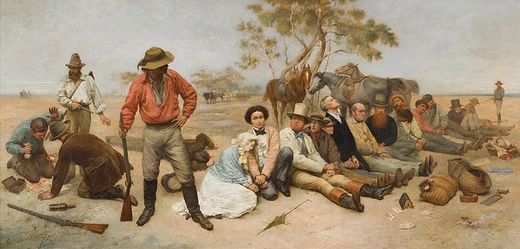
Michael Howe (bushranger)
British convict turned bushranger in Van Diemen's Land.
Michael Howe was a British convict transported to Van Diemen's Land who became a bushranger and gang leader. His notoriety stemmed from his violent exploits and his ability to evade capture for an extended period.
Quick Facts
- Birth name
- Pontefract, Yorkshire
- Other names
- Demon Bushranger
- Occupation
- Seaman, Bushranger
- Born
- c.1787
- Died
- 21 October 1818
- Place of death
- Van Diemen's Land
- Cause
- Died in struggle
- Victims
- 5+
Facts from the source article.
Did You Know?
- He served two years on a merchant vessel at Hull before deserting to join the navy.
- He refused assignment to John Ingle, declaring he would be no man's slave, and escaped.
The gang
Howe escaped while being taken to a doctor, claiming ill-health, and rejoined former companions. He became leader after killing two gang members who had angered him: he cut one's throat and clubbed the other with his gun stock. During a robbery at Ingle's farm, the gang abused a female. Whitehead asked Howe to cut off his head to prevent it being taken for a reward, and Howe complied.
Death
In October 1817, Howe was betrayed by George Watson and William Drew. Howe stabbed Watson and shot Drew dead; Watson died weeks later. Worrall later described facing Howe: they were about 15 yards apart, Howe covered in kangaroo skins with a black beard, carrying a haversack and powder horn. Howe cried 'Black beard against white beard for a million!' and fired. Worrall fired back, hitting him, and as Howe tried to clear a bank, Pugh knocked him down with his gun butt and beat his brains out as Howe opened a clasp-knife. Howe was 31. His head was cut off and taken to Hobart; his body was left to bleach in the woods. Worrall received a third of the reward, a pardon, and free passage to England. Howe's bones were later collected and buried deeper by William Patterson, who marked the spot with a large stone.
Conspiracy
Some powerful men in Hobart and Launceston had arrangements with Howe, including the colony's wealthiest man, Edward Lord. Lord's wife Maria, an ex-convict, negotiated with the bushrangers. Official investigations into Howe's relationship with Edward Lord and Robert Knopwood did not go far, as no documents from his testimonies survived. Carlo Canteri wrote that a complete exposure of the bushrangers' linkages would shake Van Diemen's Land.
Legacy
In 1818, T. E. Wells wrote an account of Howe's life and crimes titled The Last and Worst of the Bushrangers of Van Diemen's Land. Howe's exploits inspired the earliest play about Tasmania, Michael Howe, The Terror of Van Diemen's Land, which premiered at The Old Vic in London in 1821. Another early play was William Thomas Moncrieff's Van Diemen's Land: An Operatic Drama (1830). Two Tasmanian place names commemorate him: Mike Howes marsh and a gully on the River Derwent.
Several relics existed: Dr Robert Espie claimed to have placed Howe's thigh bone in his house wall; it was discovered in 1914. Dr James Ross collected a large iron pot from the death site. A stolen book returned to Frank and Philip Pitt had a cover secured with kangaroo skin. The Campbell Town museum once displayed a photograph of a letter Howe wrote to Governor Thomas Davey in 1816. In 2011, Screen Australia announced a film, The Outlaw Michael Howe, which aired on ABC in 2013 and again in 2016.
More in Bushrangers
Spotted an error? Know more?
Reader corrections go straight into our review queue. Suggest an edit · How this site is sourced