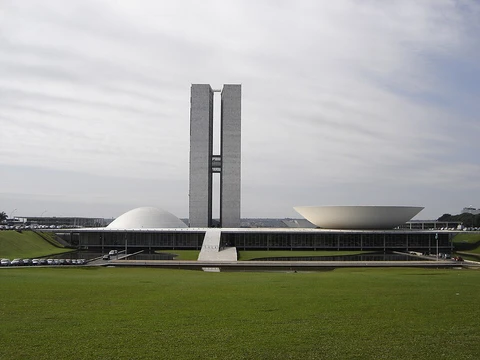
National Congress Palace
Seat of Brazil's National Congress, designed by Oscar Niemeyer.
The National Congress Palace (Palácio do Congresso Nacional) in Brasília, Brazil, serves as the meeting place of the Brazilian national legislature, the National Congress of Brazil. It was built in 1960 and designed by Oscar Niemeyer in the Modernist style. The building sits on the Monumental Axis, the main street of Brasília, with a large lawn in front where demonstrations take place and the Praça dos Três Poderes behind, home to the Palácio do Planalto and the Supreme Federal Court. Since 1987, it has been a UNESCO World Heritage Site as part of Brasília's original urban buildings.
Quick Facts
- City
- Praça dos Três Poderes, Brasília, Federal District
- Country
- Brazil
- Current tenants
- National Congress of Brazil
- Years built
- 1958–1960
- Inauguration date
- 21 April 1960
- Client
- Juscelino Kubitschek administration
- Height
- 100 m / 328 ft
- Floor count
- 3 (main building); 28 (Annex I)
Facts from the source article.
History
Before Brasília became the capital, Brazil’s National Congress operated out of two separate buildings in Rio de Janeiro. The Senate met near Railway Central Station on Moncorvo Filho Street, beside Republica Square, where a Federal University of Rio de Janeiro student center now stands. The Chamber of Deputies convened at Tiradentes Palace, which later housed the Legislative Assembly of Rio de Janeiro. From the 1930s until the early 1960s, the Senate used the Monroe Palace, which was torn down in the 1970s to make room for the Cinelândia subway station.
The Chamber of Deputies began its move to Brasília in the early 1960s, a process that stretched over several years. After Lúcio Costa won the city’s Pilot Plan competition, his design gave the Congress building a highly prominent spot. In item 9 of his justification report, Costa described the Praça dos Três Poderes as a triangle, with each branch of government occupying one corner and the legislative palace at the vertex. He also specified that the square would sit higher than the Esplanade of Ministries and that the Congress building would have façades facing both the Esplanade and the square.
Since the 1960s, the National Congress has been located in Brasília. Designed by Oscar Niemeyer in the Modernist style, the building sits on the Monumental Axis. A large lawn in front serves as a site for demonstrations, while the Praça dos Três Poderes lies behind, home to the Palácio do Planalto and the Supreme Federal Court. On 6 December 2007, the National Institute of Historic and Artistic Heritage designated the building as a historical heritage of the Brazilian people.
Design and construction
Oscar Niemeyer produced the first preliminary designs for the building in 1957, shortly after the city plan was defined, while some structures like the Palácio da Alvorada were already under construction. The main building would house chambers and support offices for plenary halls, with two twenty-eight-storey towers for administrative services and offices. The first preliminary design included a mezzanine for the public in the plenary halls and an auditorium, later discarded; an inclined garden on the west façade remains where the auditorium would have been.
The building does not share formal elements with the Planalto Palace or the Supreme Federal Court building. In Brasília, Niemeyer moved away from his earlier phase, following modernist principles but with less rigidity than the International Style, adding elements referring to colonial architecture and using curves more sparingly. He sought compact, simple, geometric solutions focusing on hierarchy and architectural character, relying on structural engineer Joaquim Cardozo, who worked from a distance in Rio de Janeiro due to his age.
Niemeyer produced sketches and sent the curved forms to Cardozo, whose task was to perform the mathematical calculations needed for the concrete structure to support the smooth shapes. The goal was to create two distinct domes, with an additional challenge for the dome of the Chamber of Deputies, which had to appear as if it were simply resting on the slab. Many hours of calculations and reflection were required before Cardozo found the equations that would produce the appropriate tangencies.
Another trusted collaborator was architect Nauro Esteves, who coordinated technical activities and authorized modifications, such as the roof slab of the base of the plenary halls, modified due to structural considerations. Cardozo also proposed modifications, including the routing of rainwater pipes through the pillars. The Congress was inaugurated in Brasília on 21 April 1960, on the same day the city itself was inaugurated.
The building
Around furniture transferred from the Senate's former buildings in Rio de Janeiro, two floors are dedicated to administrative rooms and reception halls, including the Salão Branco and the Salão Negro. The building contains works by major Brazilian artists such as Athos Bulcão, Marianne Peretti, Alfredo Ceschiatti, Di Cavalcanti and Burle Marx. The upper esplanade on which the domes rest was intended as an open public square but is normally closed for security reasons.
The Salão Negro, with an area of 1,100 square metres, is the common access point to both plenary halls via the main access ramp, hosting exhibitions, ecumenical services and political or cultural events; its black marble floor gives it its name. Noble Halls, one for each chamber, are where the presidents of the Chamber of Deputies and the Senate receive visiting heads of state or government. The Salão Verde, about 2,000 square metres, is associated with the Chamber of Deputies, where journalists usually interview members of parliament; it provides access to the Plenary Hall Ulysses Guimarães and to the office of the President of the Chamber, and has an internal garden and exhibitions of building models, works by visual artists and a gallery of presidents of the Chamber.
Its name comes from a green carpet. The Salão Azul is the Senate’s equivalent of the Salão Verde, also used by the press to approach senators and providing access to the Senate plenary hall.
Events
In 2007, the year Oscar Niemeyer turned 100, IPHAN designated the National Congress building and 34 other works by the architect as protected heritage sites. Before 15:00, the crowd broke the security barrier, occupied the ramp and roof of the National Congress Palace, and stormed and vandalized the Congress, Planalto Palace and Supreme Court Palace. President Lula and former president Bolsonaro were not in Brasília during the storming. The Supreme Federal Court considered the acts terrorism. By March 2023, 2,182 people were arrested for involvement.
More in Buildings and Structures in Brasília
Related in Buildings and Structures in Brasília
Links follow this subject's own source article.
Spotted an error? Know more?
Reader corrections go straight into our review queue. Suggest an edit · How this site is sourced