
Ty Conklin
Last updated

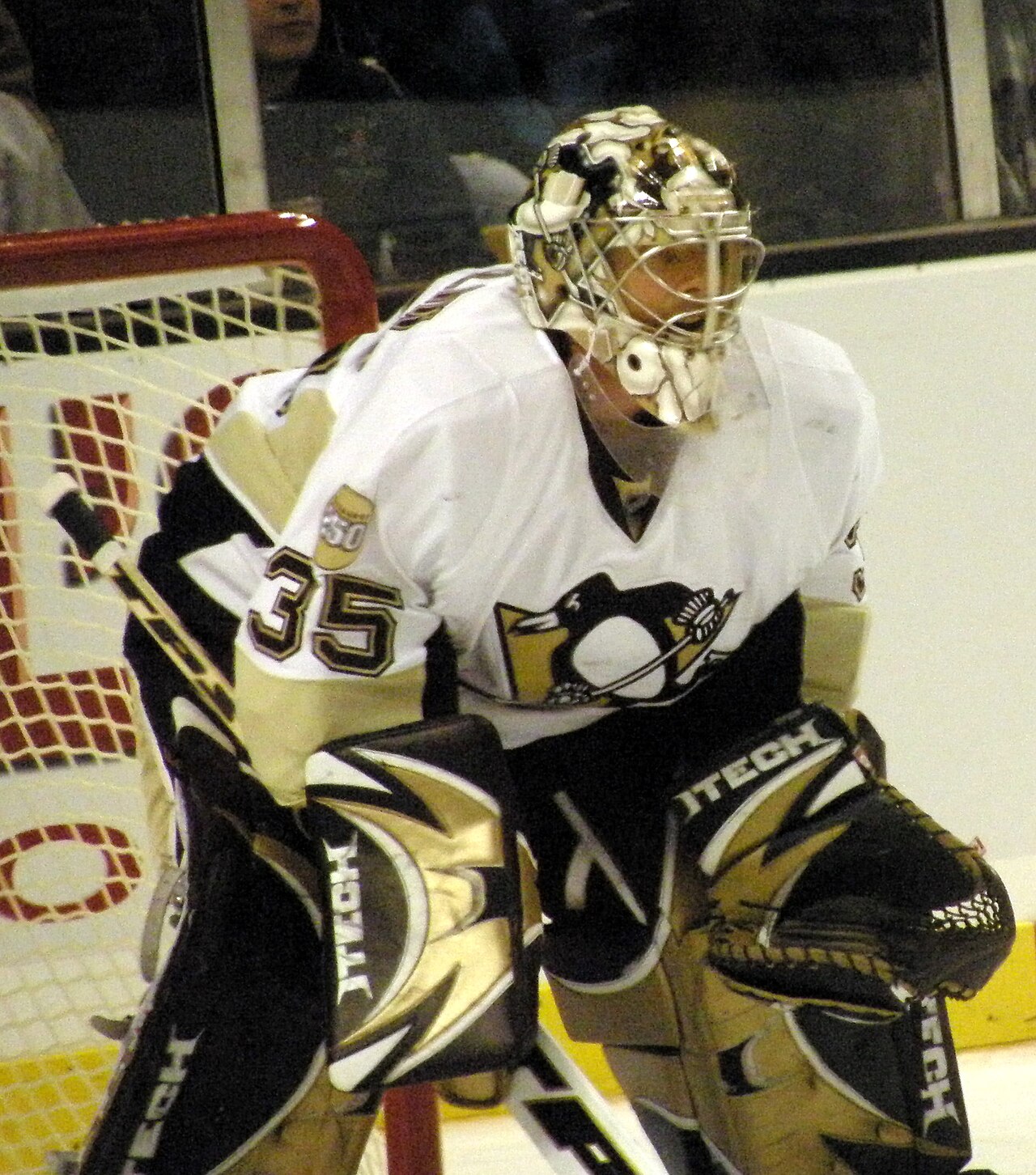
TheAHL · CC BY 2.0
Ty Curtis Conklin is an American former professional ice hockey goaltender who played in the National Hockey League for the Edmonton Oilers, Columbus Blue Jackets, Buffalo Sabres, Pittsburgh Penguins, St. Louis Blues, and two stints with the Detroit Red Wings. Born in Phoenix, Arizona, and raised in Anchorage, Alaska, he went undrafted before signing with the Oilers as a free agent. Conklin is notable for his role in the 2006 Stanley Cup Finals, where he made a costly turnover in his only postseason appearance, and for a remarkable 2007–08 season with the Pittsburgh Penguins, during which he posted a franchise-record save percentage while filling in for an injured Marc-André Fleury.
Background
Conklin grew up in Anchorage, Alaska, and attended Shattuck-St. Mary's, a noted Minnesota hockey prep school. He played for the Green Bay Gamblers of the USHL under Don Granato before spending three seasons at the University of New Hampshire under coach Dick Umile. A self-described 'late-bloomer' and 'shorter kid,' he went unclaimed in the NHL Entry Draft. After college, he signed with the Edmonton Oilers as an undrafted free agent.
He set an AHL record for most saves in a game (83) during a quadruple-overtime Calder Cup Final game with the Hamilton Bulldogs in 2003. During the 2005–06 season, Conklin was inconsistent and hampered by injury, leading the Oilers to waive him and acquire Dwayne Roloson. In Game 1 of the 2006 Stanley Cup Finals, Conklin entered after Roloson was injured and, with the game tied, turned the puck over behind his net, allowing Rod Brind'Amour to score the winning goal into an empty net.
He did not play again in the series, as Jussi Markkanen started the remaining games. Conklin later said, 'Obviously I needed a change of scenery.'
The Undrafted Path from Alaska
Ty Curtis Conklin was born on March 30, 1976, in Phoenix, Arizona, but his formative hockey years were shaped by the cold landscape of Anchorage, Alaska. As a young recruit at Shattuck-St. Mary's, the Minnesota prep school that would later become legendary for developing hockey talent, Conklin was already setting himself apart from the typical pipeline. He then suited up for the Green Bay Gamblers in the USHL under coach Don Granato before heading to the University of New Hampshire, where long-tenured head coach Dick Umile guided the Wildcats.
Conklin described himself at eighteen as a "late-bloomer" and a "shorter kid," and during his draft-eligible window—spanning his post-graduate year at Shattuck and his first season in Green Bay—he remained entirely invisible to NHL scouts. No team selected him in the Entry Draft. He would not seriously consider a professional career until his junior season at New Hampshire, making his eventual NHL journey all the more remarkable.
Hamilton's Record and Edmonton's Turbulent Years
After completing his collegiate career at New Hampshire in spring 2001, Conklin signed as an undrafted free agent with the Edmonton Oilers. His first two NHL seasons were spent largely with the Hamilton Bulldogs, the shared AHL affiliate for Edmonton and Montreal. In 2003, he led Hamilton to within a single victory of the Calder Cup. In Game 2 of that final, a quadruple-overtime thriller lasting 134 minutes and 56 seconds against the Houston Aeros, Conklin recorded 83 saves—an AHL single-game record—helping the Bulldogs win 2 to 1.
The following season he served as backup to Tommy Salo, stepping into a starting role after Salo's injury and later sharing duties with Jussi Markkanen following Salo's trade to Colorado. During the 2004–05 lockout, he played for Wolfsburg in Germany's DEL. When play resumed, local media coined the nickname "Conkkanen" for whichever goaltender started. Yet both proved inconsistent, injuries hampered Conklin, and by early February 2006 the Oilers waived him and acquired Dwayne Roloson from Minnesota.
The 2006 Stanley Cup Finals Miscue
Despite playing only one game for Edmonton between March and June 2006, Conklin found himself on the bench for Game 1 of the Stanley Cup Finals in Raleigh against Carolina. Late in the third period, with the score tied 4 to 4, starter Dwayne Roloson suffered a knee injury that would end his season. Conklin was thrust into the net. Edmonton had led by three goals at one point before Carolina scored four unanswered to take the lead, and the Oilers eventually tied the game.
With just over thirty seconds remaining in regulation, Conklin attempted to play the puck behind the net but fumbled it, allowing Rod Brind'Amour to score unopposed into an empty net for the winning goal. Head coach Craig MacTavish inserted Markkanen for all six remaining games, explaining he needed a consistent netminder.
Analyst Kelly Hrudey called the situation "traumatic" for Conklin. Conklin himself urged fans not to "turn that play into some monumental thing," but the image defined his public perception. The Oilers declined his contract option, and he said, "I needed a change of scenery."
The Road After Edmonton
With his Oilers contract option declined, Conklin entered free agency and signed with the Columbus Blue Jackets on July 6, 2006, as an unrestricted free agent. He was expected to compete for the backup role behind starter Pascal Leclaire, but head coach Gerard Gallant chose internationally experienced Fredrik Norrena instead. Conklin was waived and sent to Columbus's AHL affiliate, the Syracuse Crunch. An injury to Leclaire eventually prompted a recall to the NHL on December 11, 2006.
On February 27, 2007, the Buffalo Sabres acquired Conklin in exchange for a fifth-round pick in the 2007 Entry Draft. His journey through six NHL franchises—Edmonton, Columbus, Buffalo, Pittsburgh, St. Louis, and two stints with Detroit—reflected both the resilience and the turbulence of a career that began without a draft pick. Conklin's own words after the 2006 Finals captured his mindset: "I kicked myself a lot after it happened, but you can't change things, so you just have to deal with it and move on."
Career statistics and honours
International
| Year | Team | Event | GP | W | L | T | MIN | GA | SO | GAA | SV% |
|---|---|---|---|---|---|---|---|---|---|---|---|
| 2004 | United States | WC | 5 | 4 | 0 | 1 | 280 | 10 | 1 | 2.14 | .934 |
| 2004 | United States | WCH | DNP | — | — | — | — | — | — | — | — |
| 2005 | United States | WC | 3 | 1 | 0 | 2 | 180 | 6 | 0 | 2.00 | .885 |
| 2011 | United States | WC | 4 | 1 | 3 | – | 216 | 14 | 0 | 3.89 | .892 |
| Senior totals | 12 | 6 | 3 | 3 | 676 | 30 | 1 | 2.66 | .912 | ||
Awards and honours
Honors
| Award | Year |
|---|---|
| All-Hockey East Rookie Team | 1998–99 |
| All-Hockey East Second Team | 1998–99 |
| All-Hockey East First Team | 1999–00 |
| AHCA East Second-Team All-American | 1999–00 |
| All-Hockey East First Team | 2000–01 |
| AHCA East First-Team All-American | 2000–01 |
Tables copied from the source article, totals included as the source gives them: Wikipedia: Ty Conklin (CC BY-SA 4.0). Wide tables scroll sideways.
Did You Know?
- He was the first player to wear #35 for the Penguins since franchise goaltender Tom Barrasso.
Frequently Asked Questions
What is Ty Conklin most remembered for?
He is widely recognized for a costly turnover during the 2006 Stanley Cup Finals while wearing the Edmonton Oilers' jersey, a blunder that defined his only postseason appearance. That single mistake became the most talked-about moment of his otherwise steady career.
How did Ty Conklin make it to the NHL without being drafted?
Going undrafted, Conklin signed a free-agent deal with the Edmonton Oilers and earned his spot through consistent performance rather than a draft pedigree. His journey from an Alaska kid to a multi-team NHL goalie is often cited as a classic undrafted success story.
What was the highlight of Ty Conklin's career?
His standout stretch came during the 2007–08 season with the Pittsburgh Penguins, when he posted some of the best statistical numbers of his career as a regular starter. That run is generally regarded as the peak of his professional hockey career.
More in Buffalo Sabres Players
Sources
Compiled from Wikipedia and the sources listed below. Text from Wikipedia is available under CC BY-SA 4.0; this entry is adapted from it.
- Wikipedia: Ty Conklin (CC BY-SA 4.0).
- Statistics, medals and awards: the tables of the source article.
- Word definitions: the Codexery glossary, each quoted from its Wikipedia article.
Spotted an error? Know more?
Reader corrections go straight into our review queue. Suggest an edit · How this site is sourced