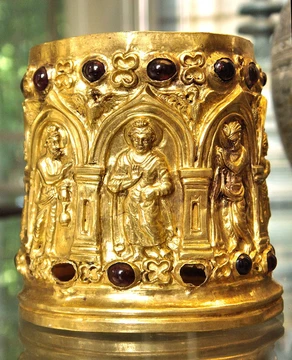
Śarīra
Buddhist relics, often pearl-like beads from cremated masters.
Śarīra is a generic term for Buddhist relics, most commonly referring to pearl- or crystal-like bead-shaped objects found among the cremated ashes of spiritual masters. These relics are believed to emanate or incite blessings within the mindstream of those connected to them, and in the Himalayan Buddhist tradition they are also thought to ward off evil.
Quick Facts
- Sanskrit pronunciation
- ɕɐɽiːɽɐh
- Sanskrit meaning
- body
- Tibetan loanword
- ringsel (རིང་བསྲེལ, ring bsrel)
Facts from the source article.
Terminology
In Buddhist Hybrid Sanskrit texts, when used to mean "relics," it always appears in the plural form śarīrāḥ. The Tibetan loanword ringsel (རིང་བསྲེལ, ring bsrel) is often treated as a synonym, though some interpretations consider ringsels a subset of śarīras. Śarīra can refer to several distinct categories: dharmakāya śarīra, which are sutras as told by the Buddha—described by Ding Fubao's Dictionary of Buddhist Terms as unchanging teachings of the same essence as the Buddha himself; remains of the Buddha or other spiritual masters, including cremated remains, a finger bone, or a preserved body; and broken-body śarīras, which specifically denote cremated remains.
Unqualified usage generally points to the pearl-like remnant left after a master's cremation. Some traditions also treated written scriptures as relics, with manuscripts deposited in stupas called dharmasarira, or "relics in the form of the teaching. Bronkhorst has suggested that Brahmanical purity ideas may have encouraged shifts away from bodily remains toward stupas, scriptures, the Buddha's dharmakaya, and later Buddha images.
Pearl-like śarīras
Though śarīra can refer to various Buddhist relics, it most commonly denotes pearl- or crystal-like bead-shaped objects purportedly found among the cremated ashes of spiritual masters. These objects are considered highly significant in many Buddhist sects, as they are believed to embody the spiritual knowledge, teachings, realizations, or living essence of the master, and are taken as evidence of enlightenment and spiritual purity. Some believe that śarīras are deliberately left by a master's consciousness for veneration, and that their beauty reflects how well the master cultivated mind and soul.
They come in various colors, some translucent, and are typically displayed in a glass bowl inside small gold urns or stupas, or enshrined within a master's statue. Śarīras are also thought to mysteriously multiply inside their containers under favorable conditions, and saffron threads are sometimes placed as offerings. In the Korean Samguk yusa, the monk Myojong received a śarīra from a turtle, which improved others' treatment of him. The occurrence of śarīra is not limited to ancient times or to humans; Pure Land Buddhist texts report śarīras from many adherents, some recent, and some Buddhists associate a student's spiritual life with the amount and condition of śarīra left after cremation.
Many Pure Land Buddhists believe Amitābha's power manifests cremated remains into śarīra, and there are claims that śarīra rain at funerals of eminent monks. Reports also describe śarīra appearing, multiplying, or disappearing depending on a keeper's thoughts or vows. One legend holds that the translator Kumārajīva's tongue remained intact after cremation to demonstrate his translations were not false.
In Javanese language
Javanese has a strong historical bond with Hindu tradition and Sanskrit. In Archaic (Kawi) Javanese, śarīra preserved its original meaning of 'body' or 'human body.' The word entered modern Javanese as "slira" with the same meaning. "Sliramu" (strictly 'your body') and "sliraku" (strictly 'my body') are used in poems or songs to replace 'you' and 'I,' respectively, though the word is not common in either oral or written contexts.
More in Buddhist Relics
Spotted an error? Know more?
Reader corrections go straight into our review queue. Suggest an edit · How this site is sourced