Frequently Asked Questions
The most-asked questions about buddhist mythology.
What exactly is Buddhist mythology?
Buddhist mythology refers to the vast body of narrative, cosmological, and legendary material that grew up around the teachings of the historical Buddha across roughly 2,500 years. It includes stories of celestial Buddhas, Bodhisattvas, demons, gods, and multiple realms of existence, and it varies significantly between Theravada, Mahayana, and Vajrayana traditions.
Who is the central figure in Buddhist mythology?
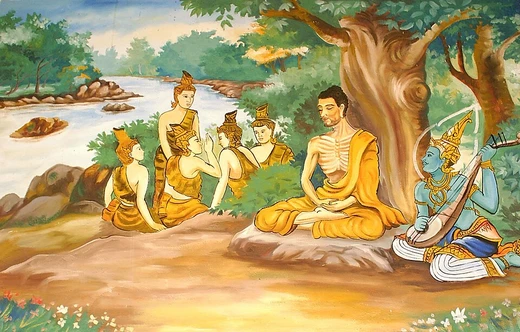
Siddhartha Gautama, the historical Buddha of the 5th–4th century BCE, anchors nearly every narrative thread. His journey from palace-born prince to awakened teacher under the Bodhi tree, followed by his Parinirvana (final passing), forms the narrative spine around which countless other stories orbit.
What are the six realms of existence?
Buddhist cosmology describes six broad planes of rebirth: the god realm, the asura (jealous demigod) realm, the human realm, the animal realm, the hungry-ghost realm, and the hell realm. They are not fixed locations so much as experiential states tied to karma, and all beings cycle through them until liberation is achieved.
Who are the Bodhisattvas and why do they matter?
Bodhisattvas are beings who have realized (or are on the path to) full awakening yet vow to postpone final nirvana so they can guide other sentient beings. Iconic figures like Avalokitesvara (compassion), Manjushri (wisdom), and Ksitigarbha (vows for hell-beings) dominate Mahayana narrative and devotional practice.
What are the Jataka tales?
The Jatakas are a collection of roughly 547 stories recounting the Buddha's previous lives as animals, kings, and commoners, each illustrating a specific perfection (paramita) he was cultivating. They function as moral fables and are among the most widely read narrative texts in the Pali Canon.
Who is Mara and what is his role?
Mara is the personification of death, desire, and distraction who repeatedly tries to obstruct the Buddha's spiritual progress, most famously by besieging him at the Bodhi tree with armies and temptations. In broader cosmology he rules the formless heavens and represents the ego's refusal to let go.
What is the Pure Land and who is Amitabha?
The Pure Land (Sukhavati) is a Western paradise presided over by the Buddha Amitabha, described in texts like the Larger Sukhavativyuha Sutra. Devotees who generate faith and recite Amitabha's name are said to be welcomed there at death, where conditions are ideal for attaining enlightenment without further falling.
How do Theravada and Mahayana mythologies differ?
Theravada narratives tend to center on the historical Buddha, his monastic community, and the Jataka tales, with a relatively modest pantheon of devas. Mahayana expands the cosmos dramatically, introducing countless celestial Buddhas, Bodhisattvas, multiple buddha-lands, and elaborate sutra-landscapes like those in the Lotus and Avatamsaka Sutras.
What are some of the most dramatic or well-known moments in Buddhist narrative?
Highlights include the Buddha's refusal of his father's throne, the four sights that shattered his palace complacency, the night of his enlightenment when Mara's assault failed, and his final sermon and passing at Kushinagar. In Mahayana, the Lotus Sutra's revelation that the Buddha's lifespan is inconceivably vast is often cited as a paradigm-shifting narrative beat.
Where should a newcomer start reading Buddhist mythology?
A good entry point is the Jataka tales for accessible storytelling, paired with a plain-language retelling of the Buddha's life (such as the Pali Canon's Buddhacarita or a modern summary). For Mahayana flavor, the Lotus Sutra and the Amitabha sutras offer rich, dramatic narratives that are shorter and more plot-driven than many other texts.