Frequently Asked Questions
The most-asked questions about brown macroalgae and kelp.
What exactly are brown macroalgae and kelp?
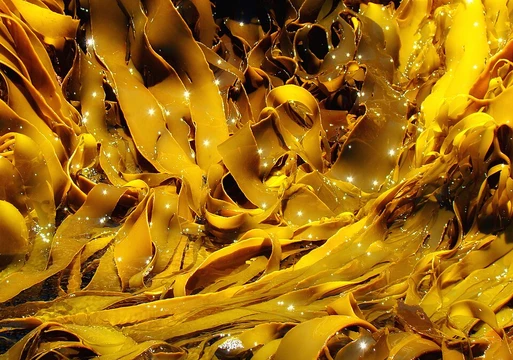
Brown macroalgae (Phaeophyceae) are multicellular marine algae ranging from small leafy fronds to towering kelp forests. They belong to the supergroup Stramenopiles, making them more closely related to diatoms and water molds than to green plants or animals.
Who are the main 'characters' a newcomer should know?
The headliners include Macrocystis (giant kelp), Laminaria (sugar kelp), Sargassum (floating mats), and Fucus (rockweed). Each plays a distinct ecological role, from building three-dimensional underwater habitats to forming vast pelagic rafts.
Where should a newcomer start to understand this group?
Begin with the kelp forest ecosystem, since it showcases the full cast interacting in a single setting. From there, branch out to the smaller Fucoidales on rocky shores and the pelagic Sargassum to see the full range of body plans.
What is the biggest misconception fans often hold?
Brown macroalgae are not plants; they lack true roots, stems, and leaves, instead using holdfasts, stipes, and blades as functional analogs. Their photosynthesis also relies on fucoxanthin and other accessory pigments rather than the chlorophyll a/b pair typical of land plants.
What makes the 'kelp forest arc' so iconic?
Giant kelp (Macrocystis pyrifera) can elongate up to thirty centimeters per day, building sunlit underwater canopies that shelter hundreds of species. These forests rank among the most productive and biodiverse marine ecosystems on the planet.
What are the key 'world-building' biological facts?
They store energy as laminarin and mannitol rather than starch, and their cell walls are rich in alginates that give them a characteristic slippery texture. Their life cycle alternates between a large multicellular sporophyte and a microscopic gametophyte generation.
What is the 'Sargassum event' and why does it generate so much discussion?
Since roughly 2011, massive blooms of Sargassum have stranded along Caribbean and West African coastlines, shifting from a benign floating habitat to an ecological and economic disruption. It has become a prominent case study in how warming waters and nutrient redistribution can upend a once-stable ecological role.
How does the 'cast' fit together taxonomically?
The class Phaeophyceae sits within the phylum Ochrophyta, and its major orders include Laminariales (true kelps), Fucales (rockweeds and Sargassum), and Ectocarpales (small filamentous forms). Kelps are the largest and most structurally complex members of the group.
What is the notable 'origin story' in their evolutionary history?
Molecular evidence points to a single endosymbiotic event roughly one billion years ago in which a heterokont protist engulfed a red-algal cell. That one-time acquisition gave rise to the entire Stramenopile lineage, linking brown algae to diatoms, oomycetes, and beyond.
Why do fans consider them 'underrated' compared to corals or seagrasses?
Despite forming some of the most visually dramatic marine habitats, brown macroalgae receive far less public attention and conservation funding than calcifying organisms. They are also more vulnerable to warming and acidification because they lack a rigid calcium-carbonate skeleton to buffer pH shifts.