Frequently Asked Questions
The most-asked questions about brown macroalgae and kelp, part 2.
What does 'brown macroalgae and kelp, part 2' cover as a whole?
This section dives past the introductory taxonomy of Phaeophyceae into the living ecosystems these organisms build, their complex life cycles, and their growing role in discussions about ocean carbon capture and coastal ecology. It treats kelp forests, giant kelps, and smaller brown seaweeds as interconnected subjects rather than isolated species.
Who are the 'main characters' fans keep asking about?
The recurring headliners are Macrocystis pyrifera (giant kelp), Laminaria spp. (sugar kelps), Sargassum spp. (floating mats), and Fucus vesiculosus (bladderwrack). Each anchors a different habitat—deep kelp canopies, intertidal zones, open-ocean rafts, and rocky shores—so they function almost like distinct storylines within the group.
Where should a complete newcomer begin reading?
Start with the anatomy primer (holdfast, stipe, blade) and the pigment explanation for why the group looks brown-green rather than truly brown. Once those two concepts click, the species profiles and ecosystem chapters read much more naturally.
What makes a kelp forest different from, say, a coral reef?
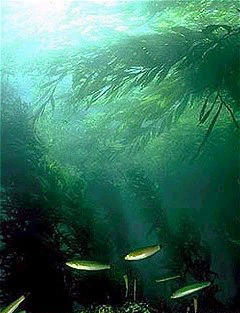
Kelp forests are built by fast-growing photosynthetic macroalgae that can add up to 50 cm of new blade tissue per day, creating a three-dimensional canopy that shelters thousands of invertebrate and fish species. Unlike corals, kelps are not animals or calcium-carbonate structures; they are multicellular algae with no true roots, stems, or leaves.
How does the encyclopedia distinguish 'kelp' from other brown macroalgae?
In strict usage, 'kelp' refers to the order Laminariales—woody, often large seaweeds with a differentiated holdfast, stipe, and blade. Broader 'brown macroalgae' also includes the less structurally complex orders such as Ectocarpales and Siphonocladales, which may lack that tripartite body plan.
What is the standout reproductive fact fans love to cite?
Most large brown algae, including giant kelp, undergo alternation of generations where the tiny, free-swimming gametophyte (a few millimeters) produces spores that grow into the meter-scale sporophyte we actually see. That means the 'giant' form we photograph is just one phase of a two-body life cycle.
Why do they look olive-brown instead of green like most plants?
The dominant accessory pigment fucoxanthin masks the underlying chlorophyll a and c, shifting the reflected light toward yellow-brown wavelengths. This pigment also lets the algae harvest blue-green light that penetrates deeper water, giving them a competitive edge in dimmer, cooler coastal zones.
What are the most commonly cited economic or industrial uses?
Alginates extracted from Laminaria and Macrocystis serve as thickening agents in food and pharmaceuticals, while fucoidan and phlorotannins are studied for antioxidant and anti-fouling properties. In many Pacific and North Atlantic communities, hand-harvested kelp remains a staple food and a small but culturally important industry.
What is the biggest current threat discussed in the ecosystem chapters?
Marine heatwaves and ocean warming are repeatedly cited as the primary stressor, because they push the upper thermal tolerance of temperate kelps, trigger mass die-offs, and allow competing turf algae or urchin barrens to take over formerly productive canopy space. Acidification and reduced nutrient upwelling compound the pressure in many regions.
What is one 'notable moment' or striking fact that fans often share?
A single strand of Macrocystis pyrifera can grow roughly 60 cm in a single day under optimal light and nutrient conditions, making it the fastest-growing organism on Earth by linear rate. That growth speed is what allows kelp forests to recover within a season after a storm tears them apart, a resilience that has no real parallel in terrestrial forests.