Frequently Asked Questions
The most-asked questions about brown dwarfs.
What exactly is a brown dwarf?
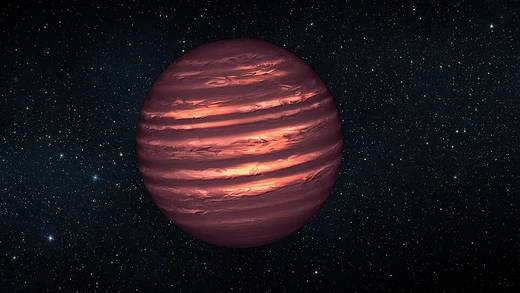
A brown dwarf is a substellar object that forms through gravitational collapse much like a star but never reaches the mass threshold needed to sustain stable hydrogen fusion. It sits in the gap between the most massive gas giants and the lightest true stars, sometimes nicknamed a 'failed star.'
What mass range defines a brown dwarf?
Brown dwarfs typically span roughly 13 to 80 Jupiter masses. Below about 13 Jupiter masses an object can fuse deuterium and is often reclassified as a planet, while above roughly 80 Jupiter masses sustained hydrogen burning begins and the object becomes a low-mass star.
Who made the first confirmed identification of a brown dwarf?
The first object widely accepted as a brown dwarf, Gliese 229B, was announced in 1995 by a team led by Glennis Marcy and collaborators. That discovery confirmed decades of theoretical speculation that a whole population of dim, non-fusing objects existed between planets and stars.
How hot do brown dwarfs get?
Surface temperatures range from about 2,700 K for the hottest T-type dwarfs down to roughly 25–75 K for the coldest known Y-type objects. That means the coolest brown dwarfs are actually colder than the freezing point of water.
What are the spectral types and how do they differ?
Brown dwarfs are sorted into L, T, and Y classes, ordered from hottest to coolest. L dwarfs show strong metal-hydride absorption bands, T dwarfs are dominated by methane features, and Y dwarfs are the faintest and coldest, with water and ammonia signatures in their spectra.
Where should a newcomer begin studying brown dwarfs?
Start by understanding the L-T-Y spectral sequence and the mass boundaries that separate brown dwarfs from stars on one side and giant planets on the other. Then explore well-known examples such as Luhman 16 or WISE 0855-0714 to see how the classification plays out in real, catalogued objects.
How do astronomers actually find brown dwarfs?
Because these objects radiate almost entirely in the infrared, surveys using space-based and ground-based IR telescopes are the primary detection method. Missions like WISE and the earlier 2MASS survey have been especially prolific at cataloguing large numbers of cool, faint brown dwarfs across the sky.
What is a landmark discovery in brown-dwarf research?
The 2013 identification of WISE 0855-0714 pushed the known temperature floor for free-floating brown dwarfs down to an estimated 25–75 K, making it the coldest such object confirmed at the time. It demonstrated that the Y-class sequence extends far cooler than earlier models had predicted.
Can a brown dwarf have its own planets?
Yes—several brown dwarfs, such as Eps Ind Ab, have been found hosting low-mass companions that are consistent with planetary-mass objects. The boundary between a 'planet orbiting a brown dwarf' and a 'binary brown-dwarf pair' can be ambiguous, since both components may fall in the same mass range.
Why are they called 'brown' if they mostly glow in the infrared?
The name is a rough visual shorthand: if you could bring one close enough, the faintest would look very dim orange-red rather than truly brown. The label was chosen to contrast with the red of cool main-sequence stars and the blue-white of hot stars, and it simply stuck in the literature despite being an imperfect color description.