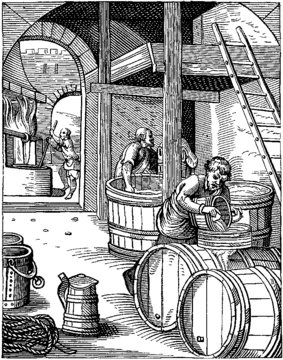
Brewing
Brewing is the production of beer by steeping starch and fermenting with yeast.
Last updated

Amandine André · CC BY 4.0
Brewing has taken place since at least the 11th millennium BC, with archaeological evidence from prehistoric peoples and later civilisations including ancient Egypt, China, and Mesopotamia.[1][2] Beer is created through a process where a starch source is soaked in water and the resulting sweet liquid undergoes fermentation with yeast.[3]
Quick Facts
- Earliest archaeological evidence
- 13,000 years ago at Raqefet Cave in present-day Israel
- Oldest surviving beer recipe
- 3900-year-old Sumerian poem honouring Ninkasi
- Earliest pictorial evidence
- 6000-year-old Sumerian seal from Tepe Gawra (circa 4000 BC)
- Industrial revolution shift
- 19th century
Facts from the source article.
Key facts and history
The brewer's craft in Mesopotamia derived social sanction and divine protection from female deities including Ninkasi, Siris, and Siduri.[2] Analysis of stone mortars at Raqefet Cave in modern-day Israel indicates that the Natufian people produced a wheat- or barley-based beer approximately 13,000 years ago, likely for ceremonial purposes.[4] A Sumerian poem from 3,900 years ago, dedicated to the brewing goddess Ninkasi, provides the most ancient known beer recipe.[5] In early medieval Europe, beer making was mostly done in homes, though commercial production and monastery brewing also existed.[6]
Brewers gained greater process control and understanding through the introduction of hydrometers and thermometers.[6]
What the cited sources add
Peter Damerow's 2012 study notes that the technique of brewing beer was an early technological achievement that presumably predates the advent of the Sumerians in Mesopotamia.[7] Damerow states that there is no conclusive archaeological evidence for the invention of beer brewing technology as early as the beginning of the Neolithic period.[7] Damerow explains that administrative documents from ancient Mesopotamia contain detailed records of raw materials and beer production amounts but not about the real activities performed in brewing processes.[7] Damerow describes that a Sumerian mythical poem dedicated to Ninkasi, the goddess of brewing, provides a description of beer production that is difficult to unambiguously interpret.[7]
Damerow reports that chemical analysis of a late fourth millennium vessel found at Godin Tepe identified a residuum consisting of an oxalate, linked to beer brewing.[7] Damerow concludes that despite an abundance of available sources, any reconstruction of Sumerian beer brewing technology faces great difficulties.[7]
References
- Wikipedia, "Brewing" (CC BY-SA 4.0), which cites: Chris Boulton, "Encyclopaedia of Brewing", John Wiley & Sons, 20 May 2013, p. 111; Li Liu, Jiajing Wang, Danny Rosenberg, Hao Zhao, György Lengyel and Dani Nadel, "Fermented beverage and food storage in 13,000 y-old stone mortars at Raqefet Cave, Israel: Investigating Natufian ritual feasting", Journal; John P. Arnold, "Origin and History of Beer and Brewing: From Prehistoric Times to the Beginning of Brewing Science and Technology", BeerBooks, 2005, p. 34; Patrick E. McGovern, "Fermented beverages of pre- and proto-historic China", Proceedings en.wikipedia.org
- Wikipedia, "Brewing" (CC BY-SA 4.0), which cites: Li Liu, Jiajing Wang, Danny Rosenberg, Hao Zhao, György Lengyel and Dani Nadel, "Fermented beverage and food storage in 13,000 y-old stone mortars at Raqefet Cave, Israel: Investigating Natufian ritual feasting", Journal; Patrick E. McGovern, "Fermented beverages of pre- and proto-historic China", Proceedings of the National Academy of Sciences, 8 December 2004, p. 17593–17598; Delwen Samuel, "Archaeology of Ancient Egyptian Beer", Journal of the American Society of Brewing Chemists, 1996, p. 3–12; Peter Damerow, "Sumerian Beer: The Origins of en.wikipedia.org
- Wikipedia, "Brewing" (CC BY-SA 4.0), which cites: Evan Evans, "The Oxford Companion to Beer", Oxford University Press, 2011, p. 236 (original not read by us) en.wikipedia.org
- Wikipedia, "Brewing" (CC BY-SA 4.0), which cites: Li Liu, Jiajing Wang, Danny Rosenberg, Hao Zhao, György Lengyel and Dani Nadel, "Fermented beverage and food storage in 13,000 y-old stone mortars at Raqefet Cave, Israel: Investigating Natufian ritual feasting", Journal (original not read by us) en.wikipedia.org
- Wikipedia, "Brewing" (CC BY-SA 4.0), which cites: "Sumerian Symbol", University of Chicago Library; "The First Wine & Beer: Chemical Detection of Ancient Fermented Beverages", Analytical Chemistry, 1993, p. 408–413; "Barley Beer", University of Pennsylvania Museum of Archaeology and Anthropology; Peter Damerow, "Sumerian Beer: The Origins of Brewing Technology in Ancient Mesopotamia", Cuneiform Digital Library Journal, 2012, p. 1–20; Steve Mirsky, "Ale's Well with the World", Scientific American, May 2007, p. 102; Horst Dornbusch, "Beer: The Midwife of Civilization", Assyrian International New en.wikipedia.org
- Wikipedia, "Brewing" (CC BY-SA 4.0), which cites: "Prehistoric brewing: the true story", Archaeo News, 22 October 2001; Richard W. Unger, "Beer in the Middle Ages and the Renaissance", University of Pennsylvania Press, 2007, p. 34; Lynn Pearson, "The Brewing Industry: A Guide to Historical Records", Historic England, 2015; Martyn Cornell, "Beer: The Story of the Pint", Headline, 2003, p. 47–49 (original not read by us) en.wikipedia.org
- Peter Damerow, "Sumerian Beer: The Origins of Brewing Technology in Ancient Mesopotamia", Cuneiform Digital Library Journal, 2012, p. 1–20. facts only, no text reused. cdli.earth
Each numbered sentence above was checked against the source it cites before publication. Sentences citing Wikipedia adapt text from the English Wikipedia article Brewing (contributors), used under CC BY-SA 4.0; this entry is available under the same licence. Other sources were used for facts only; no text or images are copied from them.
More in Brewing Processes
Sources
Compiled from Wikipedia and the sources listed below. Text from Wikipedia is available under CC BY-SA 4.0; this entry is adapted from it.
- Wikipedia: Brewing (CC BY-SA 4.0).
Spotted an error? Know more?
Reader corrections go straight into our review queue. Suggest an edit · How this site is sourced