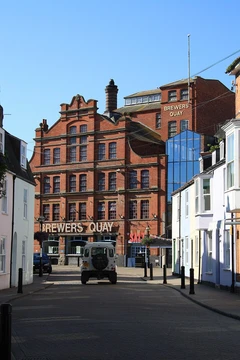
Weltons Brewery
Independent brewer of over 40 beers yearly, closed Spring 2021.
Welton's Brewery was an independent operation started by Ray Welton in 1995, initially in Capel, Surrey, then moving to Dorking. From 2003 until it shut down in spring 2021, the brewery was based in Horsham, West Sussex. Each year, Welton's produced more than 40 different beers, plus a core set of seven beers and Horsham Old, and none of its beers were rebadged.
Ray Welton used the proceeds from selling his drinks distribution business to Beer Seller to build the brewery, constructing it with equipment he discovered in a field. Britain's tax system in the 1990s made things tough for small brewers, so to cut costs he brewed on Arundel's equipment for a time. When Andy Hepworth launched the Beer Station, Welton moved his own gear and yeast there, sharing the site for two years. In August 2003, a year after the sliding scale for brewers was introduced, Welton went independent. He still uses the equipment he built himself, but now, like Fuller's Brewery, he employs a bottom-fermenting ale yeast, which he says yields more beer per fermentation because it produces less foam in the tank.
Since April 2017, Welton's has hosted a brewery tap night on the first Friday of each month, where new monthly specials are available to try.
Welton's made a wide range of cask ales, distributed around Horsham and nationally through Wetherspoons and freehouses in the South East, as well as in bottles across Sussex via Hartleys Wines.
In 1998, Ray, an avid rugby player, wanted a beer he could drink all evening after a game without getting too drunk. He brewed Pridenjoy at 2.8% ABV, which Roger Protz included in his 2005 book "300 Beers To Try Before You Die," describing it as "a most remarkable beer, a beer that is 2.8% but tastes like 4%."
In 2001, Fred Martin, the retired head brewer of King & Barnes, passed on the Old Ale recipe for Horsham Old (4.5% ABV), which Welton's has brewed since then and continues to brew.
In 2016, Ray brewed two beers aged for 12 months in Tomintoul malt whisky casks: a rye beer called Dr French's Whisky Rye (8.3% ABV) and a porter called Dr French's Old Remedy (8.3% ABV).
Quick Facts
- Founded
- 1995
- Founder
- Ray Welton
- Original location
- Capel, Surrey
- Later location
- Horsham, West Sussex (2003–2021)
- Closure
- Spring 2021
- Core beers
- seven core beers plus Horsham Old
Facts from the source article.
Lore & Background
Ray Welton built Welton's Brewery using equipment he found in a field, funded by the sale of his drinks distribution business to Beer Seller. The tax situation in 1990s Britain was not helpful to small brewers, and he eventually brewed on Arundel's equipment to save costs. When Andy Hepworth started the Beer Station, Welton moved his own equipment and yeast onto the site, sharing the operation for two years. In August 2003, a year after the sliding scale for brewers was introduced, Welton set up independently, still using the equipment he built himself. He adopted a bottom fermenting ale yeast, like Fuller's Brewery, which he felt gave more beer per fermentation due to less foam in the tank.
Since April 2017, Welton's held a brewery tap night on the first Friday of every month, where new monthly specials could be tried. The brewery produced a wide range of cask ales distributed in the Horsham area and nationally through Wetherspoons and freehouses across the South East, and also in bottles throughout Sussex by Hartleys Wines.
Reader's Guide
Welton's Brewery operated for over 25 years, from its founding in 1995 to its closure in Spring 2021. It was known for a high volume of distinct beers—more than 40 each year—and a refusal to rebadge any product. The brewery's history reflects the challenges faced by small brewers in 1990s Britain, including an unfavourable tax situation that forced cost-saving measures like brewing on another brewery's equipment. The introduction of the sliding scale for brewers in 2002 allowed Welton to become fully independent in 2003. Ray Welton's resourcefulness extended to building his own equipment from found materials and later adopting a bottom fermenting yeast to improve efficiency. The brewery also preserved local brewing heritage by taking over the Horsham Old recipe from Fred Martin, retired head brewer of King & Barnes, in 2001. Welton's beers reached a national audience through Wetherspoons and freehouses, and its monthly tap nights from 2017 fostered a local following. The closure in Spring 2021 marked the end of an independent brewery that had maintained a distinctive, self-reliant approach throughout its existence.
Narrative & Story Structure
The film follows Whitehead, an alchemist's assistant and astrologer, fleeing the violent Commander Trower during a Civil War engagement in Monmouthshire. Soldier Cutler saves him by killing Trower, and the pair encounter two fellow deserters, Jacob and Friend. Cutler lures the group into a field under the pretense of a nearby alehouse, where he prepares a meal of wild mushrooms. Whitehead, observing a fast, refuses to eat. The group then unearths a buried wooden post, revealing the Wizard O'Neill — Cutler's master and a rival alchemist who had stolen documents from Whitehead's own master. O'Neill seizes control, torturing Whitehead into serving as a human divining rod to locate hidden treasure. As the mushrooms take hold of those who ate them, the group descends into violence. Jacob attacks Friend in a delirious frenzy, and Cutler accidentally shoots Friend. The treasure turns out to be a mere skull. In the final confrontation, O'Neill kills Cutler, then Jacob and Friend fall in turn. Whitehead, having ingested a massive dose of mushrooms, ultimately shoots O'Neill from behind. He buries his companions and walks away, only to see all three friends standing together with himself beyond the hedgerow.
Production & Aesthetic Choices
Director Ben Wheatley and writer Amy Jump — a husband-and-wife team who also co-edited the picture — developed the project over several years before securing financing through Film4.0, an innovation-focused division of Film4. Wheatley's interest in the English Civil War setting originated while filming a documentary about the Sealed Knot, a historical reenactment society, and his research uncovered the 17th-century practice of grinding hallucinogenic mushrooms into powder and blowing it into people's faces for what he described as magic tricks. The decision to shoot in black and white was a spontaneous choice made with cinematographer Laurie Rose, who together studied Peter Watkins's Culloden and 1960s–70s arthouse cinema before committing to what they called an unfussy visual approach. With a modest budget of £300,000, principal photography lasted just 12 days in the Surrey countryside outside Guildford, beginning in late September 2012. Wheatley described the film as weaving the psychedelic sensibilities of his earlier works Kill List and Sightseers into a historical drama framework.
Release & Distribution Strategy
A Field in England premiered in competition at the 48th Karlovy Vary International Film Festival on 4 July 2014, where it took home the Special Jury Prize. The following day, 5 July, the film rolled out across the United Kingdom in an unprecedented multi-platform strategy: theatrical screenings, DVD through 4DVD, free broadcast on Film4, and video-on-demand all launched simultaneously. The Hollywood Reporter noted this marked the first instance of a British homegrown title debuting across all four channels at once. The rollout was made possible by support from the BFI Distribution Fund's New Models strand, which specifically backs experimental release approaches, with Film4, 4DVD, the Film4 Channel, and distributor Picturehouse Entertainment all collaborating. Wheatley drew a parallel to Radiohead's free digital release of In Rainbows. For North America, Drafthouse Films secured distribution rights and partnered with Cinedigm to bring the film to audiences across multiple formats.
Thematic Resonance & Cultural Touchpoints
Variety characterized the film as a psychedelic trip into magic and madness, a description that captures its blend of historical drama, psychological horror, and hallucinatory imagery. The black-and-white photography placed the picture within a broader resurgence of monochrome filmmaking alongside works like The Artist, Much Ado About Nothing, Frances Ha, and Nebraska, as noted by The Observer. The narrative's central conceit — four men trapped in a field, their perceptions warped by mushrooms and dominated by a manipulative alchemist — gives the story a dreamlike, inescapable quality. The film's conclusion, in which Whitehead and Jacob surmise that the true treasure was the friendship they shared, and in which Whitehead ultimately sees his dead companions standing together with himself beyond a hedgerow, lends the horror a deeply melancholic and spiritual undertone. The cultural footprint extended beyond the screen: for the UK cinema release, Weltons Brewery crafted a limited-edition ale specifically for audiences attending theatrical screenings, tying the film's 17th-century alehouse motif to a tangible, contemporary experience.
More in Breweries of England
Spotted an error? Know more?
Reader corrections go straight into our review queue. Suggest an edit · How this site is sourced