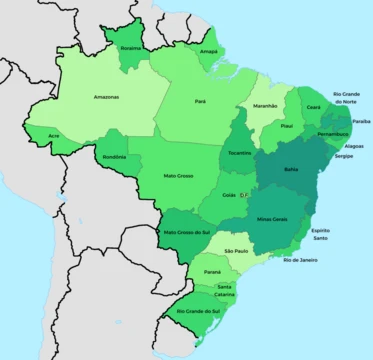
Northeast Region, Brazil
Brazil's Northeast: where the coast meets the sertão, and history meets the future.

via Wikipedia: Northeast Region, Brazil · see source
The Northeast Region of Brazil covers about 18% of the country's territory and is home to roughly 57 million people, or 28% of the national population.[1] The region lies entirely within the tropical zone and encompasses Caatinga, Atlantic Forest, and part of the Cerrado ecoregions.[2] According to a 2011 study by Garmany, 43.5% of the region's inhabitants are classified as living in poverty, defined by an income below two dollars each day.[3]
Quick Facts
- Area
- 18% of Brazilian territory
- Population
- 57 million people (28% of Brazil's total)
- Gdp contribution
- 14.2% (2020) of Brazil's GDP
- Poverty rate
- 43.5% of population lives on less than $2/day
- Urban population
- Nearly three-quarters live in urban areas along the Atlantic coast
- Major capitals
- Salvador
- Recife
- Fortaleza
- São Luís (each with over 1 million inhabitants)
Facts from the source article.
Key facts and history
Portuguese colonists arrived in 1500 under Pedro Álvares Cabral at Porto Seguro in present-day Bahia.[4] Portuguese settlers soon began displacing and enslaving native peoples, leading to conflicts that contributed to indigenous population decline.[5] The Dutch captured Pernambuco in 1630 and made Recife their capital, but the Portuguese recaptured Recife in 1653, ending Dutch Brazil.[6] Between 1877 and 1879, the Great Drought hit the sertão severely, causing about 200,000 deaths and mass migration.[7]
Indigenous groups, predominantly those speaking Tupi–Guarani languages, along with Tapuia tribes in the Sertão, occupied the area prior to European colonization.[4] The Portuguese began bringing enslaved black Africans to Brazil in 1530, with a major destination being Bahia, after the Jesuits opposed the enslavement of indigenous people.[5] Rio de Janeiro replaced Salvador as the colonial capital in 1763.[8] Local oligarchs known as coronéis controlled the interior of the Northeast during the Old Republic, maintaining their dominance through violence and intimidation.[9]
References
- "Breve retrato econômico da região Nordeste Blog do IBRE", blogdoibre.fgv.br. facts only, no text reused. blogdoibre.fgv.br
- Wikipedia, "Northeast Region, Brazil" (CC BY-SA 4.0), which cites: "Breve retrato econômico da região Nordeste Blog do IBRE", blogdoibre.fgv.br (we also read that source) en.wikipedia.org
- Wikipedia, "Northeast Region, Brazil" (CC BY-SA 4.0), which cites: Garmany, "Situating Fortaleza: Urban space and uneven development in northeastern Brazil", Cities, 2011, p. 45–52 (original not read by us) en.wikipedia.org
- Wikipedia, "Northeast Region, Brazil" (CC BY-SA 4.0), which cites: Métraux, "Migrations historiques des Tupi-Guarani", Journal de la Société des Américanistes, 1927, p. 1–45; Campbell, "The Indigenous Languages of South America: A Comprehensive Guide", Walter de Gruyter, 2012; Métraux, "Migrations historiques des Tupi-Guarani", Journal de la Société des Américanistes, 1927, p. 1–45; Williams, "Bridging the Early Modern Atlantic World: People, Products, and Practices on the Move", Ashgate Publishing, Ltd., 2013, p. 117 (we also read that source) en.wikipedia.org
- Wikipedia, "Northeast Region, Brazil" (CC BY-SA 4.0), which cites: Campbell, "The Jesuits, 1534–1921: A History of the Society of Jesus from Its Foundation to the Present Time", The Encyclopedia Press, 1921 (we also read that source) en.wikipedia.org
- Wikipedia, "Northeast Region, Brazil" (CC BY-SA 4.0), which cites: Williams, "Bridging the Early Modern Atlantic World: People, Products, and Practices on the Move", Ashgate Publishing, Ltd., 2013, p. 17; Meuwese, ""For the Peace and Well-Being of the Country": Intercultural Mediators and Dutch-Indian Relations in New Netherland and Dutch Brazil, 1600–1664", University Of Notre Dame, 2003, p. 184 (original not read by us) en.wikipedia.org
- Wikipedia, "Northeast Region, Brazil" (CC BY-SA 4.0), which cites: Marengo, "Drought in Northeast Brazil—past, present, and future", Theoretical and Applied Climatology, 2016-06-09, p. 1189–1200 (original not read by us) en.wikipedia.org
- Wikipedia, "Northeast Region, Brazil" (CC BY-SA 4.0), which cites: Graden, "An Act "Even of Public Security": Slave Resistance, Social Tensions, and the End of the International Slave Trade to Brazil, 1835–1856", Hispanic American Historical Review, 1996, p. 240 (original not read by us) en.wikipedia.org
- Wikipedia, "Northeast Region, Brazil" (CC BY-SA 4.0), which cites: Cavalcanti, "Guerra de Canudos: um resumo de como foi a revolta", Quero Bolsa; Ardissao, "Cangaço: o que foi, resumo, consequências", História do Mundo (original not read by us) en.wikipedia.org
Each numbered sentence above was checked against the source it cites before publication. Sentences citing Wikipedia adapt text from the English Wikipedia article Northeast Region, Brazil (contributors), used under CC BY-SA 4.0; this entry is available under the same licence. Other sources were used for facts only; no text or images are copied from them.
More in Brazilian States
Related in Brazilian States
Links follow this subject's own source article.
Spotted an error? Know more?
Reader corrections go straight into our review queue. Suggest an edit · How this site is sourced