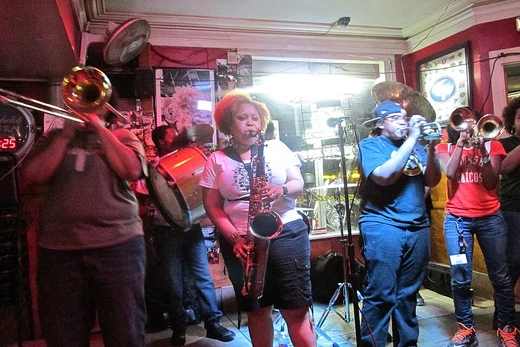
Onward Brass Band
Two New Orleans brass bands spanning over a century.
Last updated
The Onward Brass Band refers to two separate brass bands that were active in New Orleans for long stretches. The first group started in the late 1800s and rose to become a top marching band, while a second band revived the name in 1960 and carried the tradition forward.
Quick Facts
- First incarnation active
- c. 1886–1930
- Second incarnation active
- 1960–2011
- Notable early members
- Isidore Barbarin
- George Filhe
- Lorenzo Tio
- Peter Bocage
- George Baquet
- King O
- Notable later members
- Cag Cagnolatti
- Kid Howard
- Andrew Morgan
- Joe Thomas
- Louis Barbarin
- Alvin Alc
Facts from the source article.
Onward Brass Band (c. 1886–1930)
This early Onward Brass Band played often at picnics, festivals, parades, and baseball games. By 1887, cornetist Joseph Othello Lainez was leading the group, and it quickly became as popular as the Excelsior Brass Band and Pickwick Brass Band. After 1903, Manuel Perez took over leadership.
The band usually had between 10 and 12 players, with three cornets or trumpets, two trombones, two clarinets, an alto horn, a baritone horn, a tuba, a snare drum, and a bass drum. Perez changed the group's name to the Imperial Brass Band in the middle of the 1920s, and it disbanded in 1930. Members included Isidore Barbarin, George Filhe, Lorenzo Tio, Peter Bocage, George Baquet, and King Oliver.
Onward Brass Band (1960–2011)
In 1960, Paul Barbarin and Louis Cottrell Jr. revived the Onward Brass Band name for a new ensemble patterned after the old group. Barbarin led until 1969, then Cottrell Jr. took over until his death in 1978. Placide Adams then led the band until his death in 2003.
The band reorganized in 2005. It recorded albums in 1965, 1974, and 2009, and consisted of eight to ten players, hewing strictly to traditional brass band music. Members included Cag Cagnolatti, Kid Howard, Andrew Morgan, Joe Thomas, Louis Barbarin, Alvin Alcorn, Danny Barker, and Freddie Kohlman.
Short history
The earliest known written references to the band performing appear in The Weekly Pelican, a weekly newspaper that published African-American news. On Saturday, February 19, 1887, it noted the Onward Brass Band furnished the music at a banquet for the L’Avenir Juvenile B.A. The band gained considerable popularity during the 1880s. By the Spanish–American War in the late 19th century, it had a reputation as the number one marching band in New Orleans.
Around 1898, under James McNeil, members of the Onward Brass Band enlisted in the Ninth Immunes Regimental Band and served in Cuba. Upon returning to the U.S. in 1899, those members played in the Victory Parade down Fifth Avenue in New York City. After the war, cornetist Manuel Perez, a student of Onward founder Sylvester Coustaut, assumed leadership. The band soon came to be regarded in the local music community as the most exciting of the city's early brass bands.
Its membership included Perez, Peter Bocage, Lorenzo Tio Jr., George Baquet, Isidore Barbarin, and briefly King Oliver. This band never recorded. Perez led on and off from 1903 until the unit disbanded about 1930. The band fell into decline during the Great Depression, and its history for the next three decades is obscure.
Around 1960, famed drummer Paul Barbarin, son of Isidore, reformed the band and patterned it after its great predecessors. Under Paul, the Onward included his younger brother Louis, nephew Danny Barker, Louis Cottrell Jr., Placide Adams, and many other top New Orleans jazz musicians. They made two recordings in 1965 and 1968.
More in Brass Bands from New Orleans
Sources
Compiled from Wikipedia and the sources listed below. Text from Wikipedia is available under CC BY-SA 4.0; this entry is adapted from it.
- Wikipedia: Onward Brass Band (CC BY-SA 4.0).
Spotted an error? Know more?
Reader corrections go straight into our review queue. Suggest an edit · How this site is sourced