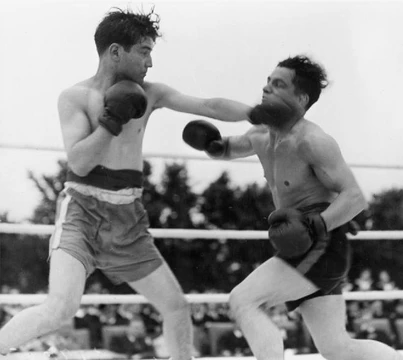
Weight class (boxing)
Weight classes define the upper and lower limits for boxers.
In boxing, a weight class defines a range of allowed body weights for competitors. The lowest weight in a division matches the highest weight of the division directly below it. The top division, which has no maximum limit, is known as heavyweight in professional boxing and super heavyweight in amateur boxing. Fights are typically set for a specific weight class, and neither boxer may weigh more than that division's upper limit. A catchweight is a nonstandard weight limit.
Quick Facts
- Original eight divisions
- flyweight, featherweight, lightweight, welterweight
- Year wbc recognized bridgerweight
- November 2020
Facts from the source article.
Did You Know?
- Winning titles at multiple weight classes to become a multiple champion is considered a major achievement.
- A nonstandard weight limit is called a catchweight; championships are awarded only at the standard weight classes.
Weigh-in
If a boxer is slightly over the weight limit, they might strip naked to try and make the weight. In professional boxing, if that doesn't work, they can usually attempt a second weigh-in later, often by sweating off the extra pounds through intense exercise in a steam room. However, if the excess weight is significant, the effort required to shed it can leave the boxer too drained to fight. In that situation, the bout might be canceled and the overweight fighter penalized, or it could go ahead as a catchweight non-title match.
The International Boxing Federation has a distinct rule for its title fights. Besides the standard weigh-in the day before the fight, boxers must also step on the scale on the morning of the bout. At this second check, a fighter cannot weigh more than 10 pounds above the division's limit. If a boxer misses this morning weigh-in or fails to meet the 10-pound allowance, the fight can still happen, but the IBF title will not be on the line. For heavyweight title fights, the morning weigh-in is still required, but since there is no upper weight limit in that class, the only penalty for skipping it is a sanction for failing to show up.
Amateur boxing is stricter. A boxer must hit their weight at the initial weigh-in with no second chance. Those who miss their projected weight are eliminated from their bouts. There are two types of weigh-ins: a general one before the tournament starts and a daily one on the morning of each fight. At the general weigh-in, a fighter must fall between the class's upper and lower limits; at the daily weigh-in, only the upper limit matters. If a boxer is outside the limit at the initial weigh-in, they might be allowed to compete in a different weight class if there is room in the tournament.
History
In the early 1800s, boxers fought without any standardized weight limits. A slang dictionary from 1823 set a "light weight" at 12 stone, or 168 pounds, while another source that same year put the cap at 11 stone, or 154 pounds. These mismatches put smaller fighters at serious risk and made for dull viewing. To establish credible national and world titles, agreed-upon weight classes were essential.
Two key sets of rules came from the National Sporting Club of London in 1909 and the 1920 Walker Law, which created the New York State Athletic Commission. When the WBA and WBC split in the 1960s, the divisions got tighter. This meant more champions could hold belts at the same time, and fighters found it easier to move between weight classes. Although the cutoff weights are consistent across professional sanctioning bodies, the names for these divisions vary.
The weights are given in pounds, a nod to the historical influence of Britain and later the United States on the sport. Boxing recognizes an "Original Eight" set of weight divisions, often called the traditional, classic, or glamour divisions. These are the sport's most famous and respected weight classes.
Professional boxing
The major sanctioning bodies—the WBA, WBC, IBF, and WBO—along with BoxRec, the TBRB, The Ring, and Boxing News, all use the weight class names and limits shown in this table. The WBC has recognized bridgerweight since November 2020, and the WBA followed in December 2023, calling it super cruiserweight; no other major body currently recognizes it. The date listed marks when a major sanctioning body first continuously recognized a world title in that class; some divisions had earlier, intermittent champions from minor groups. One class with only minor recognition is super cruiserweight, often used informally but officially a weight class of the lightly regarded International Boxing Association, set at 210 pounds. The IBA’s cruiserweight limit, by contrast, is 190 pounds.
Amateur boxing
When the International Boxing Association (AIBA) took over amateur boxing in 1946, it converted the weight class limits to metric, rounding them to the nearest kilogram. Later changes, detailed in the Olympic boxing rules, created differences between amateur and professional class names and limits. A planned adjustment in September 2010 was set to introduce a strict minimum weight for adult boxers. In amateur boxing, each class has both a maximum and a minimum weight, with the minimum matching the next heavier class's maximum.
For safety, a boxer cannot compete at a weight higher than their class allows. This rule also means the heaviest class has a lower limit, not an upper one. The heavyweight lower limit was set at 81 kg in 1948. When a 91+ kg class was added in 1984, the 81+ kg class kept the name heavyweight, and the new class became super heavyweight—a term not used in professional boxing.
At the Olympics, each weight class is a separate single-elimination tournament that awards one gold, one silver, and two bronze medals. The schedule is arranged so that all finals occur over the last two days. Boxers who lose on the penultimate day receive bronze medals, while the finals on the final day decide gold and silver. Bouts are held in order of increasing weight, with the super heavyweight final last.
For each class, preliminary and qualification bouts are held when the number of entrants requires multiple matches before the finals. The lightest class requiring such matches goes first, followed by the next heavier class, and so on. Additional rounds—second, third, or fourth—may be needed to complete the schedule, always following the same progression from lightest to heaviest until the final is reached.
More in Boxing
Spotted an error? Know more?
Reader corrections go straight into our review queue. Suggest an edit · How this site is sourced