Hun speech
Wilhelm II's incendiary farewell to troops bound for China.
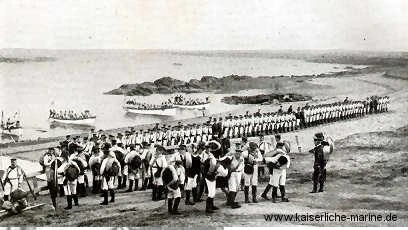
The Hun speech was delivered by German emperor Wilhelm II on 27 July 1900 in Bremerhaven, as he bid farewell to the German East Asian Expeditionary Corps sent to quell the Boxer Rebellion. It gained worldwide attention for its incendiary content and was long considered the source of the epithet "Huns" for Germans, used by the British during World War I.
Quick Facts
- Speaker
- Wilhelm II
- Date
- 27 July 1900
- Location
- Bremerhaven
- Occasion
- Farewell to the German East Asian Expeditionary Corps
- Context
- Boxer Rebellion
Facts from the source article.
Did You Know?
- The speech was delivered freely by Wilhelm II; no manuscript has survived and one may never have existed.
- In 2012 an Edison-wax cylinder phonograph was discovered containing a recording of the slightly abridged second version of the speech; whether it was voiced by Wilhelm II remains disputed.
- The 'Hun' stereotype had already been used during the Franco-Prussian War (1870–1871), so the speech is no longer considered the sole source of the epithet.
Historical background
The Hun speech occurred during the Boxer Rebellion, an anti-foreign and anti-Christian uprising in Qing China from 1899 to 1901. After telegraphic communications with the Beijing legations were disrupted in May 1900, open hostilities broke out between foreign troops and the Boxers, who were later backed by regular Chinese forces. On 20 June 1900, the German envoy Clemens von Ketteler was shot dead by a Chinese soldier on his way to the Zongli Yamen.
The Qing court then declared war on all foreign powers, and the Siege of the International Legations began. The Eight-Nation Alliance, including Germany, Japan, the United States, and five other European states, dispatched an expeditionary force. After seven weeks, the alliance prevailed, Empress Dowager Cixi fled, and the foreign forces looted Beijing. Wilhelm II delivered the Hun speech during a farewell ceremony for part of the German East Asian Expeditionary Corps, one of at least eight such speeches.
The speech
The speech was given on 27 July 1900. Wilhelm II first inspected two of the three troopships—the Batavia, the Dresden, and the Halle—in Bremerhaven. He then returned to his imperial yacht SMY Hohenzollern II and hosted a breakfast at 12:00 for dignitaries including the chairman of Norddeutscher Lloyd, general directors, and officers. During the inspection, Wilhelm II delivered farewell remarks—the Hun speech—to the Corps and a few thousand spectators. After the speech, von Lessei thanked the Emperor, and a band played "Heil Kaiser Wilhelm Dir. The Batavia set sail at 14:00, followed by the other two ships at 15-minute intervals. The speech's text survives in several variations; the central passage is known.
Interpretation
With the Hun speech, Wilhelm II called on German troops to wage a ruthless campaign of revenge in China, particularly to avenge the assassination of Clemens von Ketteler. In an earlier dispatch of 19 June 1900 to Bernhard von Bülow, Wilhelm II had demanded that Beijing be levelled and called the coming fight a "battle of Asia against all Europe." He also donated the painting Peoples of Europe, preserve your most sacred goods! to troop transports, an allegory of defending Europe under German leadership against the "Yellow Peril," a long-standing concern of the Emperor.
A 1895 sketch by Wilhelm II had inspired the painting by Hermann Knackfuß. In modern academic interpretation, Thoralf Klein argues the scandalous effect of the speech lies in its explicit call to break international law and its blurring of boundaries between "barbarism" and "civilisation." The call to give no quarter violated Article 23 of the Hague Land Warfare Convention of 29 July 1899, signed by Germany but not by Qing China. The blurring is seen in Wilhelm II choosing the "barbarian" Huns as a role model for German troops sent to fight in the name of "civilisation" against China's supposed relapse into "barbarism."
Reactions and consequences
Soldiers reportedly took the emperor literally; a non-commissioned officer recorded the speech in his diary. German soldiers marked railway wagons with inscriptions like "revenge is sweet" or "no quarter." Letters from soldiers reporting excesses in China, later printed in German newspapers, were called "Hun letters." The speech met both approval and criticism. Bernhard von Bülow later called it "the worst speech of that time and perhaps the most disgraceful speech that Wilhelm II [had] ever given," while Prince zu Hohenlohe described it as a "sparkling speech." In German public debate, liberal politician Friedrich Naumann defended the emperor, arguing no prisoners should be taken, earning him the nickname "Hun priest." Eugen Richter criticized the speech in a Reichstag debate on 20 November 1900, stating it did "not correspond to Christian conviction."
More in Boxer Rebellion
Spotted an error? Know more?
Reader corrections go straight into our review queue. Suggest an edit · How this site is sourced