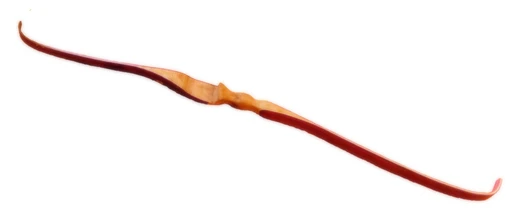
Self bow
A bow made from a single piece of wood.
A self bow, or simple bow, is crafted from a single piece of wood. It may include added horn nocks at the tips or a built-up handle. Some modern experts also consider a bow made from two pieces spliced together at the handle to be a self bow.
Quick Facts
- Draw length factor
- 2.3 times the draw length
- Minimum work time
- A day of work starting with a seasoned stave or felled tree
- Typical height
- Approximately the height of the archer
Facts from the source article.
Comparison with composite bows
An effective self bow can be made from widely available local material with limited tools, requiring about a day of work starting with a seasoned stave or felled tree. A composite bow requires at least a week and possibly several years, along with a greater range of materials and skills. Self bows must be roughly the archer's height for a long draw and are less efficient in flight archery. Well-designed composite bows of high draw-weight give higher arrow velocity and are shorter, but their hide glue absorbs water and dissolves if soaked, whereas self bow wood is less sensitive to humidity. The greater density of horn and sinew usually cancels any advantage of composite construction for modern amateurs due to greater weight. For most practical non-mounted archery, self bows can perform as well as composite; initial velocity is about the same for all bow types within certain limits.
History
A self bow is a simple bow made from a single piece of wood. Most traditional bows across Africa, the Americas, northern Europe, and Southern Asia are self bows. The oldest known bow artifacts, found in Northern Europe at Stellmoor and Holmegaard, are also self bows. The Stellmoor bow was carved from the heartwood of a Scots pine, while the earliest Holmegaard bows came from small-diameter elm trees. In primitive flight archery, Holmegaard-inspired designs are effective because of their lightweight, non-bending tips. Today, traditional archers, primitive skills practitioners, and hunters still use self bows. With enough draw weight and a broadhead used at close range, they can ethically take game for food. For young people living on a homestead or in the wilderness, learning to fell a tree and craft a self bow remains a valuable educational skill.
Selecting wood
A self bow is crafted from a single piece of wood, and in most places where people live, common tree trunks can provide excellent material. To get the best wood for the bow's mechanics, the tree should be felled with an axe or handsaw, as branches or logs lying on the ground won't work as well. The time needed to make a durable bow ranges from a few weeks to two years, depending on how the wood is dried and shaped. The stave must be about as long as the archer is tall, and the wood grain needs to be fairly straight. Denser woods store energy more efficiently, allowing for narrower bows that require less effort to draw. High-quality yew, for instance, makes especially narrow self bows, like the traditional European longbow. Different cultures have used various woods: Eastern Woodlands tribes favored hickory, Midwestern tribes used osage orange, West Coast Native Americans made short, wide, recurved bows from American Pacific yew, and Brazilian rainforest tribes used palm wood. In Europe and North America, common woods like maple, ash, elm, and oak make excellent flat bows and are much easier to find than top-grade yew. The fibers on the back of the bow must be as continuous as possible. This can be done by using the outer, under-bark surface as the back (common with white woods), by carefully removing outer growth rings (often done with yew and osage orange), or by following a cut or split surface with unbroken grain (typical with commercially sawn wood). A wood's density directly affects its energy storage; denser woods can be made into narrower bows, while less dense woods need to be wider near the center to avoid taking a permanent set or breaking. Interestingly, bows of equivalent performance have roughly the same mass, regardless of wood density. The bending section of the bow should be about 2.3 times the draw length. Narrow bows, called longbows, can bend in the handle. Wider bows, known as flatbows, must have a stiff, thick handle that doesn't bend, which usually makes the whole bow longer. Self bows can have any side-view shape, and moderate recurves can often be added using heat and force.
More in Bow Types
Spotted an error? Know more?
Reader corrections go straight into our review queue. Suggest an edit · How this site is sourced