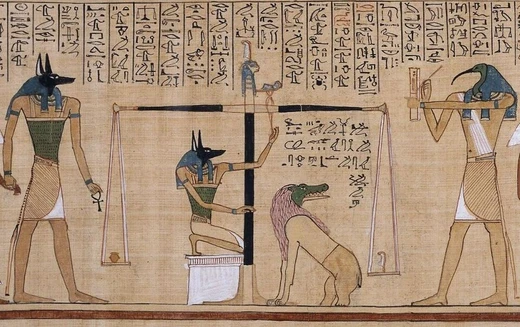
Assessors of Maat
42 judges of the dead in Egyptian afterlife.
The Assessors of Maat were 42 minor ancient Egyptian deities charged with judging the souls of the dead in the afterlife. They joined the judgment of Osiris during the Weighing of the Heart.
Quick Facts
- Abode
- Duat
Facts from the source article.
Description
Chapter 125 of the Book of the Dead lists the names and provenances—either geographical or atmospheric—of the Assessors of Maat. A declaration of innocence corresponds to each deity, pronounced by the dead person to avoid damnation for specific sins that each of the 42 judges punishes. The deceased was accompanied before Osiris by the psychopomp god Anubis, where he would declare himself guilty of none of the 42 sins against justice and truth by reciting the Negative Confessions.
The heart (ib/jb) was then weighed on a two-plate scale: one plate held the heart, the other the feather of Maat. Maat, in whose name the 42 judges acted, was the deification of truth, justice, rectitude, and cosmic order, often symbolized by an ostrich feather. If heart and feather balanced, the deities were convinced of the deceased's rectitude, and he could access eternal life as mꜣꜥ-ḫrw (Maa Kheru), meaning 'vindicated' or 'true of voice.' If the heart was heavier, the monster Ammit devoured it, destroying the soul.
This psychostasia episode is one of the few parts of the Book of the Dead with moral connotations, depicting Egyptian ethics and morality. The 42 declarations of innocence have been interpreted as possible historical precedents of the Ten Commandments, though the Negative Confessions appear as divine transpositions of daily morality rather than revealed norms. Egyptologist Richard Herbert Wilkinson inventoried the 42 Assessors in his 2003 work, though other translations of the Papyrus of Ani give different impressions of their tasks.
More in Book of the Dead
Spotted an error? Know more?
Reader corrections go straight into our review queue. Suggest an edit · How this site is sourced