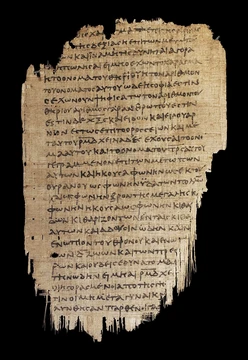
John's vision of the Son of Man
John's vision of the Son of Man in Revelation 1.
John's vision of the Son of Man, described in Revelation 1:9–20, is a vision in which the author John sees a figure he calls one 'like the Son of Man.' This vision is notable for being the only known description in the Christian biblical canon that gives identifiable physical characteristics of the Son of Man.
Quick Facts
- Biblical reference
- Revelation 1:9–20
- Key figure
- Son of Man
- Associated objects
- Seven lampstands
- seven stars
- double-edged sword
Facts from the source article.
Did You Know?
- John wrote that on the Lord's Day he was 'in the Spirit' and heard a loud voice 'like a trumpet.'
- The Son of Man figure identifies himself as 'the First and the Last,' who 'was dead, and behold I am alive for ever and ever,' referencing the resurrection of Jesus.
- The vision includes a double-edged sword coming out of the Son of Man's mouth.
Connection with the rest of the book
Language from Revelation 1 reappears in Revelation 19, where the Rider on the White Horse also has a sword from his mouth and eyes like blazing fire. The sword from Jesus' mouth describes how God's messiah conquers through the word of God. The Son of Man walks among seven lampstands representing the seven churches of Asia, and he instructs John to write to them. The letters in chapters 2 and 3 identify him using vision imagery, such as 'him who has the sharp, double-edged sword.'
Connection with the Book of Daniel
John's vision resembles Daniel's vision of a son of man, with both featuring white hair. In Daniel's vision, the son of man has a body like tarshish, interpreted by Rabbi Rashi as the archangel Gabriel. In Jewish mysticism, angels serve as heavenly priests, wearing priestly robes and sashes; Jesus is similarly depicted as the eternal high priest of mankind in the New Testament.
Significance of the seven stars
John states in Revelation 1:20 that the seven stars are the angels of the seven churches. The Greek word for angels (aggelos) can also mean human messengers, as used elsewhere in the New Testament. Merrill Unger suggests the stars represent human messengers, while C. I. Scofield proposes they were men sent by the churches to check on John, or any who bear God's messages. Other scholars disagree: Isbon Beckwith sees them as the churches' 'ideal conception of its immanent spirit,' and Henry Barclay Swete calls them the 'prevailing spirit' of the church.
The image of Jesus holding seven stars parallels coins of Emperor Domitian, which depict his deified infant son with seven stars, symbolizing divine nature and world dominion. Frederick Murphy suggests Revelation's image may critique this, asserting Jesus' cosmic significance over the Roman imperial family. Austin Farrer interprets the stars as the seven classical planets, representing Christ's lordship over time.
More in Book of Revelation
Spotted an error? Know more?
Reader corrections go straight into our review queue. Suggest an edit · How this site is sourced