Frequently Asked Questions
The most-asked questions about bolt-action rifles.
What is a bolt-action rifle?
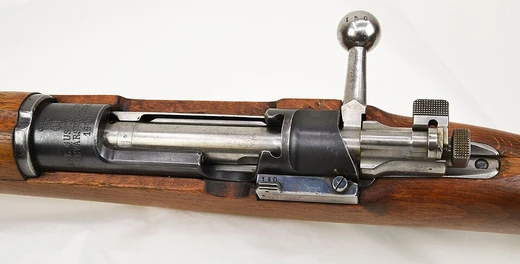
A bolt-action rifle is a manually operated firearm in which the shooter cycles a bolt to eject a spent cartridge and chamber a new one before every shot. It is the simplest and most mechanically reliable of the common rifle action types.
How does the bolt mechanism actually work?
The shooter lifts the bolt handle, draws it rearward to unlock the breech and pull the case free, then pushes it forward to lock the bolt head and seat the next round. This manual cycle is what gives the action its name and its well-known mechanical simplicity.
What are the main bolt-action variants?
The rotating-bolt design, used in Mausers, Springfields, and most hunting rifles, is by far the most common. Other variants include the straight-pull action and the falling-block design, each trading off cycling speed for different mechanical advantages.
What are some of the most iconic bolt-action rifles?
The German Mauser 98, the British Lee-Enfield, the Russian Mosin-Nagant, and the American M1903 Springfield are among the best-known military examples. In hunting and target shooting, rifles such as the Remington 700 and the Ruger Mark series are equally well recognized.
Why are bolt actions often considered more accurate than semi-automatics?
A rigid locked breech and the absence of a gas system or moving receiver parts reduce variables that can disturb barrel harmonics. This is why bolt actions dominate in precision long-range shooting and competitive marksmanship.
Where did the bolt-action concept originate?
The modern rotating-bolt design is generally traced to Fritz Boxer's 1880s patents, which the German military soon adopted as the Gewehr 98. The concept spread rapidly to other nations and became the standard military rifle action through both World Wars.
What are bolt-action rifles used for today?
They remain the dominant platform for big-game hunting, long-range target competition, and designated-marksman roles in many militaries. Their simplicity, reliability, and accuracy keep them in steady demand across civilian and tactical applications.
What is the key difference between a bolt-action and a semi-automatic rifle?
A bolt-action requires the shooter to manually cycle every round, while a semi-automatic uses gas or recoil energy to eject and reload automatically after each trigger pull. The trade-off is speed of follow-up shots versus mechanical simplicity and peak accuracy.
What are some notable historical moments tied to bolt-action rifles?
The Lee-Enfield's five-round magazine gave British troops a significant rate-of-fire edge in World War I, and the Mosin-Nagant saw extensive service through both World Wars and the Korean War. The Mauser 98's design influence shaped bolt-action engineering for nearly a century.
Where should a beginner start learning about bolt-action rifles?
Understanding the basic bolt cycle—unlock, extract, load, lock—is the essential first step before diving into specific models. From there, studying the major action families such as Mauser-derivative and falling-block designs provides a solid framework for comparing rifles.